
I'm going to put this blog on ice for a while. If you want to know what's up with me, drop me an e-mail at joemiller [at] kc [dot] rr [dot] com.
See you 'round.
Tuesday, December 13, 2005

Saturday, December 03, 2005
my needs
A meme, via Professor Kim,
Google "[your first name] needs" and write down the first lines from the first page of hits:
Joe needs his Tampa tame.
Joe needs two cracking matches.
joe needs help.
Joe needs an editor.
Joe Needs You.
Joe needs our help.
Joe Needs your Help.
Joe needs help!
Joe needs to try a number of different things.
Google "[your first name] needs" and write down the first lines from the first page of hits:
Joe needs his Tampa tame.
Joe needs two cracking matches.
joe needs help.
Joe needs an editor.
Joe Needs You.
Joe needs our help.
Joe Needs your Help.
Joe needs help!
Joe needs to try a number of different things.
matinee

Allie and I went to a double feature matinee with our friend Mark. It was at the new Screenland theater. Great place. They've got some plush recliner chairs.
We saw The Untold Story of Emmitt Louis Till and The Prize Winner of Defiance, Ohio, both of which were fantastic.
It was a good pairing. Both were set in the 1950s (the latter stretching into the 60s) and they both gave a some perspective on how much American society has changed over the last 50 years. We still have a lot of growing to do in this country. But sometimes it's good to take stock of the progress we've made.
The Emmitt Till documentary told the more extreme story of the two films. It's kind of startling to look back only one or two generations and see a culture with values that are so utterly foreign to those of today. Can you imagine a group of white men committing such an evil, hateful crime? And then being declared not guilty to the applause of an entire community?
Watching this documentary I got to thinking of the OJ trial. Imagine if that had happened in 1955. A black guy is charged with the murder of a white woman, and it looks like a slam dunk, with blood and DNA everywhere. Then when he's declared innocent blacks are out dancing in the streets. And there are no riots and lynch mobs in response. The connection might be tenuous. Indeed, the celebration wasn't for OJ's innocence so much as for a win against a so-called justice system that's still terribly unfair, for an instance in which a black man beat whites at their own game. But certainly these events are milestones in an era of incredible societal change.
The oppression depicted in The Prize Winner of Defiance, Ohio wasn't anywhere near as intense, but it showed a time when the order of things were quite a bit different. Great film, with many insights into the ways gender roles have transformed over the last half century, and ways they've stayed the same. I found it unsettling how I could relate on some level to Woody Harrelson's character, the drunken loser dad, whose anguish thrived on almost mythical social constructions of who he ought to be. Just a little thought, really. A small opportunity for introspection. The overwhelming feeling I had was one of gratitude for living in a time and relationship where equality is more the norm.
I guess this film hasn't quite caught on yet. I think it will, though. It's just terrific. Brought tears to me eyes.
regrets
When it comes to hard-hitting stories I've written about black leaders, there are two that haunt me. One I completely regret having written. I might talk about that one in a later post. The other I don't necessarily regret. But as time goes on I feel more and more uneasy about it.
It was an election story about Wesley Fields's bid for city council.
This is a story I was encouraged to do by a number of political insiders I used to keep close contact with. I was given a good number of promising leads early on. I also had a small number of black sources who were pretty much provided to me by folks affiliated with Fields's opposing candidate, incumbant Becky Nace, who is white.
In retrospect, a lot of the "dirt" I digged up on Fields was insignificant. He was clearly a carpetbagger, having moved to Nace's district after local leaders talked Fields out of challenging Troy Nash.
But I need to stop right here and acknowledge that if Fields had been taking on Nash, another black candidate, I have no doubt that we would have not gone with the story. Even if you think carpetbagging is bad, the racial dynamics of this should tell you a lot.
Then I found that Fields had registered his car in Grandview, at his parents' house. As such, he didn't pay taxes to the Kansas City school district in which he lived.
Ok.
I don't know. In the big scheme of things, this doesn't seem a very big deal. Indeed, I did the same thing when I was in college, so as to avoid the higher taxes of the town where I was living.
But in a large story package, it seemed to add to the heft of the case against Fields.
That said, the bulk of the investigative work I did on the story was aimed at Fields's position at Bryan Cave, a law firm with deep political connections. Fields was one of the primary lawyers on Bryan Cave's contract with the quasi-public Economic Development Corporation, which administers the city's corrupt tax-incentive program. And this was my main justification for doing the story. I felt very strongly at the time that Fields was a pawn of The Man.
Also I should add that I worked very hard to investigate and publicize Fields's strengths and accomplishments. And I even went so far as to point out that he's a textbook example of how Kansas City ought to develop new generations of leaders. He was valedictorian of his high school, he went to an Ivy League school and then to the top-ranked University of Virginia law school. All along the way he distinguished himself as a natural leader. Unfortunately, young men and women like Fields tend to not return to Kansas City, opting instead for cities like Chicago and Atlanta, where the power structures in the black community are much stronger.
One thing that I still ache over with regards to the story was that one of Fields's roommates from college didn't get back to me until after the story had gone to print. This former classmate gave some terrific examples of what kind of a leader Fields is. The stories he shared with me offered particularly strong evidence of Fields's ability to bridge divides between whites and blacks, and that's something Kansas City obviously needs.
I began regretting the story almost as soon as it ran. While I got a lot of props behind the scenes from white leaders, and a few blacks, some of my more reliable contacts in the black community were pretty lukewarm about it. When I explained my concerns about Fields's tax-incentive-program connections they seemed to understand, but there was lingering discomfort of the all-out-effort nature of the investigation, digging up every little piece of dirt I could possibly find.
Worse, I heard from a lot of sources that the main black sources I relied on to call Fields's credibility as a black leader into question were themselves not the most credible within the black community.
And this was confirmed quite emphatically when the election reslts came out. Though Fields lost handily, he beat Nace decisively in the black districts.
When that happened I had two unsettling thoughts. One, I and the Pitch had little clout in the political landscape. And, two, I was wrong.
And now, with the passage of more time, I'm thinking that Fields might well have been a better choice, though it's still tough to get around the whole tax-incentive-program angle. But even there, I think I have to come clean about the institutionally racist nature of my coverage of this story. As I said, we probably wouldn't have done the story if Fields were challenging Nash. And if it were really all about the tax-incentive stuff, why work so hard to call Fields out on the petty stuff, which people probably wouldn't think twice about if he were white?
It was an election story about Wesley Fields's bid for city council.
This is a story I was encouraged to do by a number of political insiders I used to keep close contact with. I was given a good number of promising leads early on. I also had a small number of black sources who were pretty much provided to me by folks affiliated with Fields's opposing candidate, incumbant Becky Nace, who is white.
In retrospect, a lot of the "dirt" I digged up on Fields was insignificant. He was clearly a carpetbagger, having moved to Nace's district after local leaders talked Fields out of challenging Troy Nash.
But I need to stop right here and acknowledge that if Fields had been taking on Nash, another black candidate, I have no doubt that we would have not gone with the story. Even if you think carpetbagging is bad, the racial dynamics of this should tell you a lot.
Then I found that Fields had registered his car in Grandview, at his parents' house. As such, he didn't pay taxes to the Kansas City school district in which he lived.
Ok.
I don't know. In the big scheme of things, this doesn't seem a very big deal. Indeed, I did the same thing when I was in college, so as to avoid the higher taxes of the town where I was living.
But in a large story package, it seemed to add to the heft of the case against Fields.
That said, the bulk of the investigative work I did on the story was aimed at Fields's position at Bryan Cave, a law firm with deep political connections. Fields was one of the primary lawyers on Bryan Cave's contract with the quasi-public Economic Development Corporation, which administers the city's corrupt tax-incentive program. And this was my main justification for doing the story. I felt very strongly at the time that Fields was a pawn of The Man.
Also I should add that I worked very hard to investigate and publicize Fields's strengths and accomplishments. And I even went so far as to point out that he's a textbook example of how Kansas City ought to develop new generations of leaders. He was valedictorian of his high school, he went to an Ivy League school and then to the top-ranked University of Virginia law school. All along the way he distinguished himself as a natural leader. Unfortunately, young men and women like Fields tend to not return to Kansas City, opting instead for cities like Chicago and Atlanta, where the power structures in the black community are much stronger.
One thing that I still ache over with regards to the story was that one of Fields's roommates from college didn't get back to me until after the story had gone to print. This former classmate gave some terrific examples of what kind of a leader Fields is. The stories he shared with me offered particularly strong evidence of Fields's ability to bridge divides between whites and blacks, and that's something Kansas City obviously needs.
I began regretting the story almost as soon as it ran. While I got a lot of props behind the scenes from white leaders, and a few blacks, some of my more reliable contacts in the black community were pretty lukewarm about it. When I explained my concerns about Fields's tax-incentive-program connections they seemed to understand, but there was lingering discomfort of the all-out-effort nature of the investigation, digging up every little piece of dirt I could possibly find.
Worse, I heard from a lot of sources that the main black sources I relied on to call Fields's credibility as a black leader into question were themselves not the most credible within the black community.
And this was confirmed quite emphatically when the election reslts came out. Though Fields lost handily, he beat Nace decisively in the black districts.
When that happened I had two unsettling thoughts. One, I and the Pitch had little clout in the political landscape. And, two, I was wrong.
And now, with the passage of more time, I'm thinking that Fields might well have been a better choice, though it's still tough to get around the whole tax-incentive-program angle. But even there, I think I have to come clean about the institutionally racist nature of my coverage of this story. As I said, we probably wouldn't have done the story if Fields were challenging Nash. And if it were really all about the tax-incentive stuff, why work so hard to call Fields out on the petty stuff, which people probably wouldn't think twice about if he were white?
media blackout
Lately, I've written a number of posts that were very critical of the local media's coverage of race issues. And it got me thinking about my own work, from when I used to be employed. One thing that's always troubled me is that a lot of my hardest hitting stories were about black leaders. Sure, I wrote stories that came down hard on white leaders, too. But it was much easier to get dirt on blacks. There just seemed to be a lot more people, white and black, who were willing to dish it out.
Plus it was hard to frame stories about whites in the same you'd frame ones about blacks. For instance, if I were looking into a development project on the East Side that had gone over budget and was loaded with politically connected contracts, that would be fairly easy to pull together and present as a patronage/corruption story. But if I were to tackle a story about a Northland development project loaded with tax breaks that was being put together by politically connected folks, I'd get a different response. Not necessarily from readers but from the folks I'd be interviewing. Like, if I were to suggest in an interview with a white bureaucrat at city hall that the Northland development looks like a patronage situation, they'd likely look at me as if I were a little odd, as if I were just another alt-weekly radical.
It's all very troubling, really. I can look back on all of my stories and see the subtle and not so subtlle ways I was encouraged to expose the datardly deeds of blacks. In some cases entire, readymade stories were dropped in my lap, documents and all. And I was never lacking a tip or a lead into some story about a black leader who was doing something wroong.
And it's not that I regret doing those stories. I think it's important to be an equal-opportunity watch dog. But really, it's not equal.
Plus it was hard to frame stories about whites in the same you'd frame ones about blacks. For instance, if I were looking into a development project on the East Side that had gone over budget and was loaded with politically connected contracts, that would be fairly easy to pull together and present as a patronage/corruption story. But if I were to tackle a story about a Northland development project loaded with tax breaks that was being put together by politically connected folks, I'd get a different response. Not necessarily from readers but from the folks I'd be interviewing. Like, if I were to suggest in an interview with a white bureaucrat at city hall that the Northland development looks like a patronage situation, they'd likely look at me as if I were a little odd, as if I were just another alt-weekly radical.
It's all very troubling, really. I can look back on all of my stories and see the subtle and not so subtlle ways I was encouraged to expose the datardly deeds of blacks. In some cases entire, readymade stories were dropped in my lap, documents and all. And I was never lacking a tip or a lead into some story about a black leader who was doing something wroong.
And it's not that I regret doing those stories. I think it's important to be an equal-opportunity watch dog. But really, it's not equal.
Thursday, December 01, 2005
blog against racism
I was born to two teenagers out of wedlock.
My dad got caught up in drugs and left my mom and I when I was about two years old. He came back, and straightened his life out, but my mom had moved on. She remarried three times. I went through three divorces.
My dad died in an accident when I was eight.
I didn't like school. I didn't do much homework, goofed off a lot, got into trouble often.
I started smoking pot in sixth grade. In high school I got real into partying, expanding my drug diet beyond weed. I frequently skipped classes.
Yet I graduated. I never doubted I would go to college. I was supremely confident. And after college, I never really had a problem landing good jobs. I'm now working on a book that sold for six figures.
The book is about black kids. If I were to lay out the details of their childhoods as starkly as I've laid out my own, the stories would seem similar. Same thing for their relatives and for many of their friends.
But in most cases the endings would be different.
My dad got caught up in drugs and left my mom and I when I was about two years old. He came back, and straightened his life out, but my mom had moved on. She remarried three times. I went through three divorces.
My dad died in an accident when I was eight.
I didn't like school. I didn't do much homework, goofed off a lot, got into trouble often.
I started smoking pot in sixth grade. In high school I got real into partying, expanding my drug diet beyond weed. I frequently skipped classes.
Yet I graduated. I never doubted I would go to college. I was supremely confident. And after college, I never really had a problem landing good jobs. I'm now working on a book that sold for six figures.
The book is about black kids. If I were to lay out the details of their childhoods as starkly as I've laid out my own, the stories would seem similar. Same thing for their relatives and for many of their friends.
But in most cases the endings would be different.
Wednesday, November 30, 2005
tomorrow
Apparently December 1 is "Blog Against Racism Day". I'm not sure who started it, but I'm up for it. Anybody else? We'll see tomorrow.
Thursday, November 24, 2005
thanksgiving
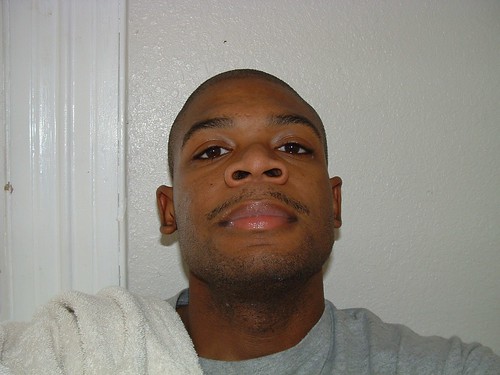
I went to Ebony's house for Thanksgiving. Allie is at her folks' house, in western New York.
When I arrived, there was a friend of the family sprawled out on the floor by the TV, taking a nap. Later he woke up, and when he spotted me his face twisted up, as if to say, "Who the fuck is that white dude?" But everyone else knew me, and were at ease, so he quickly figured out that I am harmless.
It wasn't a vegan affair. I had turkey, duck, ham and brisket. And giblet gravy. In the non-meat category there were mashed potatoes, dressing and several varieties of pie. Ebony's mom and auntie are outstanding cooks. The turkey was very moist. The duck was especially good. Ebony's little cousin Duran said he liked the duck best. I told him it was Daffy Duck. Then I told him I was kidding when he made a face like he believed me.
I brought the camera, and Ebony spent the day snapping pictures.
The Lions game was on while we ate. But it was boring, so we watched DVDs. At first we watched part of a bootlegged movie. I don't know what the movie was called; we only watched a couple of minutes of it. It was one of those hardcore bootlegged movies, the kind that are video taped in the theater. The picture was filmed at a slight angle, and you could see the dark edge of the movie screen on the top and the bottom of the TV screen. You could hear people in the audience cough.
Ebony switched it to Scarface. I've never seen this movie.
Ebony's mom said, "So many black men have died because of this movie. But they didn't get the message. And the message is: The guy dies in the end."
I wasn't upset that she gave it away for me. She repeated this point several times during the film, especially as the violence escalated toward the finale.
Scarface is one of Ebony's favorite movies. He's seen it several times. As we watched, I kept turning to Ebony and saying, "This isn't very interesting. This is just like everyday life for me." When Scarface watched his friend get chopped up with a chainsaw in a bathroom, I said, "I had to go through a similar situation before I could break into journalism."
My tolerance for violence in movies has diminished as I've aged, but I hung in there with this one. It was very violent. But I liked the part where Scarface told the rich people in the restaurant that they need bad guys like him. I wish they'd pushed this concept a little more.
Then we watched Dave Chappelle's concert movie on Ebony's laptop, and I about fell out of my chair several times, I was laughing so hard. Like when he said, in reference to R Kelly's recent dramas, "I'm just saying that if 15-year-olds are old enough to get life in prison, they oughta be old enough piss on."
I miss Allie, and I miss my family, but this was one of the best Thanskgivings I've had in a while.
Wednesday, November 23, 2005
brick by brick
Jessi left an interesting comment on my post about the media's response to the murder wave here in KC. A lot of really tough questions.
I felt sort of like a schmuck when I read it. I think I come off sounding high and mighty when I try to tackle such a difficult and complicated issue in a little blog post.
And I know I'm a pretty easy target for Tony's criticism that I blame everyone but the blacks who are actually commiting the crimes. I'm probably guilty of painting blacks as victims, and that carries its own set of dangers.
Truth is, there probably is no viable solution. Not in an immediate global sense. This is probably as obvious here in Kansas City as it is anywhere in the country, considering our epic failures at integration.
It's important to remember, though, who these words are coming from, and who they're directed toward.
I'm a white, middle-class American, and my comments are aimed at me and my kind. More specifically, with regards to the post Jessi was commenting on, I feel compelled -- perhaps foolishly -- to challenge myself as a journalist, and other journalists like me, to rethink our assumptions about stories with an obvious racial component. And to consider how these assumptions perpetuate the injustice of the status quo.
There are quite a few books I've read which have really shaped my thinking on this subject. One of the best is Dismantling Racism, by Joseph Barndt. In it he writes:
In the book, Barndt (a white man) argues that the first step whites need to take is to realize that there are privileges we're afforded because of the color of our skin, and the class we were born into, and all the history that has carved out our position in the world. And these privileges are made possible in part by others' lack of privilege. We also need to understand, as he says in the passage above, that racial separation hurts us, too.
So the obvious next step is to try to eliminate the separation.
That's where it can get really tough.
I'm reading a great book right now by Samuel G. Freedman called Upon This Rock, about a black church in Brooklyn. In it, the main character, Pastor Johnny Ray Youngblood, tells a group of white seminary students:
Good advice, if a bit discouraging. But then he says:
And this is where, on the other hand, it can get really easy, and fun, and cool, and rewarding. Like, it feels great to break out of the white ghetto. It didn't take long trying before much of my perspective on things did a complete 180, and my life feels much, much richer.
But how do we begin to tear down the walls? How do you start a movement that people are running away from before it's even begun?
I felt sort of like a schmuck when I read it. I think I come off sounding high and mighty when I try to tackle such a difficult and complicated issue in a little blog post.
And I know I'm a pretty easy target for Tony's criticism that I blame everyone but the blacks who are actually commiting the crimes. I'm probably guilty of painting blacks as victims, and that carries its own set of dangers.
Truth is, there probably is no viable solution. Not in an immediate global sense. This is probably as obvious here in Kansas City as it is anywhere in the country, considering our epic failures at integration.
It's important to remember, though, who these words are coming from, and who they're directed toward.
I'm a white, middle-class American, and my comments are aimed at me and my kind. More specifically, with regards to the post Jessi was commenting on, I feel compelled -- perhaps foolishly -- to challenge myself as a journalist, and other journalists like me, to rethink our assumptions about stories with an obvious racial component. And to consider how these assumptions perpetuate the injustice of the status quo.
There are quite a few books I've read which have really shaped my thinking on this subject. One of the best is Dismantling Racism, by Joseph Barndt. In it he writes:
To study racism is to study walls. We have looked at barriers and fences, restraints and limitations, ghettos and prisons. The prison of racism confines us all, people of color and white people alike. It shackles the victimizer as well as the victim…
But we have also seen that the walls of racism can be dismantled. We are not condemned to an inexorable fate, but are offered the vision and possibility of freedom. Brick by brick, stone by stone, the prison of individual, institutional, and cultural racism can be destroyed. You and I are urgently called to join the efforts of those who know it is time to tear down, once and for all, the walls of racism.
In the book, Barndt (a white man) argues that the first step whites need to take is to realize that there are privileges we're afforded because of the color of our skin, and the class we were born into, and all the history that has carved out our position in the world. And these privileges are made possible in part by others' lack of privilege. We also need to understand, as he says in the passage above, that racial separation hurts us, too.
So the obvious next step is to try to eliminate the separation.
That's where it can get really tough.
I'm reading a great book right now by Samuel G. Freedman called Upon This Rock, about a black church in Brooklyn. In it, the main character, Pastor Johnny Ray Youngblood, tells a group of white seminary students:
"The white person who ministers in the slum better not do it because you feel sorry for poor people or because you think it's the Christian thing to do or you need to feel some leftover liberal guilt. That will get your ass killed...
"We don't need any more Great White Fathers or Great White Mothers."
Good advice, if a bit discouraging. But then he says:
"Don't do for us. Do with us. Don't believe what others tell you about us. Ask us."
And this is where, on the other hand, it can get really easy, and fun, and cool, and rewarding. Like, it feels great to break out of the white ghetto. It didn't take long trying before much of my perspective on things did a complete 180, and my life feels much, much richer.
debate update
Having failed to engage an entire class full of high school kids in the great game of debate, I and the folks at [The School] decided to start trying to teach it to kids after school. I'd be working with only the most motivated kids, and there'd be less of them, and we figured I might be more succesful that way.
Well, no doubt there's been fewer kids. I had two show up for the first practice, one for the second, and three for the third, which was yesterday. This wouldn't be an issue if it were just me running the show. I can work with what I get. But the folks at [The School] really want there to be four kids involved on a consistent basis, so as to make it worth their while. Obviously I haven't quite reached that level.
Still, it's been a pretty cool experience. Two girls showed up to the first practice, and we spent the whole time just talking. I told them why I want to start a debate program ("I'm kind of a radical," I said), then I asked why they joined debate, what they want to get out of it. Then I asked what their goals are in life, and I told them ways in which debate could help them achieve those goals. Finally, I asked, "If you were in charge, if you were the president or the mayor, and you could change one thing, what would it be?"
This sparked a wide ranging conversation, covering everything from murders in the inner-city to reparations for the decendents of enslaved Africans. All the while I kept asking questions, trying to sharpen their focus, until I isolated one goal the two new debaters share: To gain respect for themselves and for their community.
With this mission statement of sorts in place, we turned to the topic high school kids across the country are debating this year:
I wrote this resolution on the board and we went through it section by section until the girls understood it. Then we started talking about how this relates to respect for them and for their community. Soon, we were discussing racial profiling, how cops seem to disrespect blacks. From there, we started piecing together a plan, a debate case we might argue this season, that would help us achieve our mission of gaining respect.
It was pretty simple. We'd have Congress pass a Racial Profiling Act, and we'd add on a requirement for cops to have regular meetings with people in the community, to learn more about them and naturally build more respect. If this were to happen, we reasoned, racial profiling would go down because cops would have a better idea of who's who, who deserves respect, and who deserves more scrutiny.
All the while I'm thinking about how this fits into a bunch of evidence I have at home, selections from policy papers and news reports and philosophical books which give warrants to the very arguments we were generating in this little classroom on Kansas City's East Side.
I said, "What would you think if I were to tell you that the ideas you came up with are the same ideas that scholars and people in power have come up with? How does that make you feel?"
They didn't qite know how to answer.
I continued, "See, you're just as smart as the people who run the world. Debate is a way for you to build on those smarts. To get some of the skills people use to get power."
They seemed to like the idea.
More later...
Well, no doubt there's been fewer kids. I had two show up for the first practice, one for the second, and three for the third, which was yesterday. This wouldn't be an issue if it were just me running the show. I can work with what I get. But the folks at [The School] really want there to be four kids involved on a consistent basis, so as to make it worth their while. Obviously I haven't quite reached that level.
Still, it's been a pretty cool experience. Two girls showed up to the first practice, and we spent the whole time just talking. I told them why I want to start a debate program ("I'm kind of a radical," I said), then I asked why they joined debate, what they want to get out of it. Then I asked what their goals are in life, and I told them ways in which debate could help them achieve those goals. Finally, I asked, "If you were in charge, if you were the president or the mayor, and you could change one thing, what would it be?"
This sparked a wide ranging conversation, covering everything from murders in the inner-city to reparations for the decendents of enslaved Africans. All the while I kept asking questions, trying to sharpen their focus, until I isolated one goal the two new debaters share: To gain respect for themselves and for their community.
With this mission statement of sorts in place, we turned to the topic high school kids across the country are debating this year:
Resolved: The United States federal government should substantially decrease its authority either to detain without charge or to search without probable cause.
I wrote this resolution on the board and we went through it section by section until the girls understood it. Then we started talking about how this relates to respect for them and for their community. Soon, we were discussing racial profiling, how cops seem to disrespect blacks. From there, we started piecing together a plan, a debate case we might argue this season, that would help us achieve our mission of gaining respect.
It was pretty simple. We'd have Congress pass a Racial Profiling Act, and we'd add on a requirement for cops to have regular meetings with people in the community, to learn more about them and naturally build more respect. If this were to happen, we reasoned, racial profiling would go down because cops would have a better idea of who's who, who deserves respect, and who deserves more scrutiny.
All the while I'm thinking about how this fits into a bunch of evidence I have at home, selections from policy papers and news reports and philosophical books which give warrants to the very arguments we were generating in this little classroom on Kansas City's East Side.
I said, "What would you think if I were to tell you that the ideas you came up with are the same ideas that scholars and people in power have come up with? How does that make you feel?"
They didn't qite know how to answer.
I continued, "See, you're just as smart as the people who run the world. Debate is a way for you to build on those smarts. To get some of the skills people use to get power."
They seemed to like the idea.
More later...
Tuesday, November 22, 2005
murder pool
It's interesting to watch the response to the high number of murders in Kansas City this year. I might be wrong, but it seems as though every comment or publicity stunt I've read has operated with the assumption that it's the governnment's responsibility to solve this problem.
Perhaps.
The most poignant comment I've heard about the issue came from an old friend I bumped into back in August who blamed the whole matter on the Republican-controlled White House, pointing out that the last time violent crime spiked so high was at the tail end of the Reagan and Bush Sr. years. Seems plausible, especially after hearing from Ebony yesterday that the murder rate has spiked in Louisville as well. Kind of gives me the sense that things are bad all over.
But I'm convinced that the problem goes much deeper than government, and I'm generally uneasy with the conversation so far. I think it's missing the mark. Just about every morning I read my favorite blog taking our local leaders to task over the issue. He's relentlessly slammed Mayor Kay Barnes, suggesting that she cares more about condo developments than about dying black people. I doubt this is true, though the mayor's silence betrays her obvious detachment from poor and downtrodden in her city, which is certainly worthy of stinging editorial comment.
But then, what would she really accomplish by calling some press conferences and making a show of doing something about it?
She'd get slammed.
Tony has consistently lampooned Alvin Brooks, Mike Sanders and Terry Riley for their responses to the situation. And now my former employer has taken an extremely odd, not-so-subtle dig at Brooks with their latest cry for attention, by asking contestants of a twisted betting pool to guess how many more murders will occur, and how many people died before Brooks "proposed the formation of the new Commission on Violent Crime." Aside from being another example of how the paper mirrors the inconsistent personality of its corporate owner, Michael Lacey (which, as the anemic page counts would seem to suggest, might not be a perfect match for Kansas City), the implied barb of this contest, and of Tony's regular sniping, only serve to reveal how disconnected both of these media sources are from the black side of town, where most of the crimes have taken place.
I don't want to prop Brooks up as some kind of saint. But the fact is that he's one of the only leaders in this city who has consistently addressed the issue of violent crime in the black community. He's done so on many, many levels. He founded the Ad Hoc Committee on Crime back in 1977, and he's served on numerous criminal and social justice committees over the years. But perhaps more important than that is the work he does behind the scenes. He routinely visits prisons with the hopes of reaching some young convict and setting him or her straight. He counsels families of young people who are falling into lives of crime. And he consoles folks whose loved ones have been murdered. He doesn't make a big show of this. Indeed, I wanted to profile him a few years ago when I worked for the Pitch and he declined because he didn't really want the attention. But this is all widely known in the black community. (Similar things can be said of Riley, who started his public life as a community volunteer in the Blue Hills neighborhood during the height of the crack epidemic. I've spent just a little time with Riley, but it was enough to see that he's deeply involved in the lives of his constituents, that he's well known, widely respected, and that folks truly depend on him.)
I have to admit that I'm skeptical of how effective this new committee Brooks has founded will be. But that's not because of some lack of sincerity on his part. It's because the problem is beyond the grasp of government. This is a societal thing, stemming from what Joseph Barndt calls "the prison of individual, institutional and cultural racism." And the media's calls on the government to find solutions only contribute to this because it distances the majority community -- the consumers of media -- from the problem. It's the classic middle-class liberal approach: We want to help the poor and the downtrodden, but we don't want to get our hands dirty.
It's doubly sad that I'm singling out Tony's Kansas City and the Pitch for this criticism, because, aside from The Call, Carter Broadcast and KC Currents, they're without a doubt the media sources in this city that are the most proactive in airing diverse points of view. I would count them among the good guys. So if they're contributing to the problem, then the problem is very, very bad. Indeed, the focus of my fury should be on the Star for its dangerous and irresponsible series rating suburban communities, because that -- the cult of separation -- is what I think is truly at the heart of the issue. (In fairness, I should note that the author of the Star's "Rate the Suburbs" series wrote an excellent series ten years ago called "Divided We Sprawl" about how disconnected this metro area is.)
History has shown that segregation is a blight governments simply cannot solve. The solution lies with us. Bottom line, we all need to get off our asses and start tearing down the walls of separation.
Perhaps.
The most poignant comment I've heard about the issue came from an old friend I bumped into back in August who blamed the whole matter on the Republican-controlled White House, pointing out that the last time violent crime spiked so high was at the tail end of the Reagan and Bush Sr. years. Seems plausible, especially after hearing from Ebony yesterday that the murder rate has spiked in Louisville as well. Kind of gives me the sense that things are bad all over.
But I'm convinced that the problem goes much deeper than government, and I'm generally uneasy with the conversation so far. I think it's missing the mark. Just about every morning I read my favorite blog taking our local leaders to task over the issue. He's relentlessly slammed Mayor Kay Barnes, suggesting that she cares more about condo developments than about dying black people. I doubt this is true, though the mayor's silence betrays her obvious detachment from poor and downtrodden in her city, which is certainly worthy of stinging editorial comment.
But then, what would she really accomplish by calling some press conferences and making a show of doing something about it?
She'd get slammed.
Tony has consistently lampooned Alvin Brooks, Mike Sanders and Terry Riley for their responses to the situation. And now my former employer has taken an extremely odd, not-so-subtle dig at Brooks with their latest cry for attention, by asking contestants of a twisted betting pool to guess how many more murders will occur, and how many people died before Brooks "proposed the formation of the new Commission on Violent Crime." Aside from being another example of how the paper mirrors the inconsistent personality of its corporate owner, Michael Lacey (which, as the anemic page counts would seem to suggest, might not be a perfect match for Kansas City), the implied barb of this contest, and of Tony's regular sniping, only serve to reveal how disconnected both of these media sources are from the black side of town, where most of the crimes have taken place.
I don't want to prop Brooks up as some kind of saint. But the fact is that he's one of the only leaders in this city who has consistently addressed the issue of violent crime in the black community. He's done so on many, many levels. He founded the Ad Hoc Committee on Crime back in 1977, and he's served on numerous criminal and social justice committees over the years. But perhaps more important than that is the work he does behind the scenes. He routinely visits prisons with the hopes of reaching some young convict and setting him or her straight. He counsels families of young people who are falling into lives of crime. And he consoles folks whose loved ones have been murdered. He doesn't make a big show of this. Indeed, I wanted to profile him a few years ago when I worked for the Pitch and he declined because he didn't really want the attention. But this is all widely known in the black community. (Similar things can be said of Riley, who started his public life as a community volunteer in the Blue Hills neighborhood during the height of the crack epidemic. I've spent just a little time with Riley, but it was enough to see that he's deeply involved in the lives of his constituents, that he's well known, widely respected, and that folks truly depend on him.)
I have to admit that I'm skeptical of how effective this new committee Brooks has founded will be. But that's not because of some lack of sincerity on his part. It's because the problem is beyond the grasp of government. This is a societal thing, stemming from what Joseph Barndt calls "the prison of individual, institutional and cultural racism." And the media's calls on the government to find solutions only contribute to this because it distances the majority community -- the consumers of media -- from the problem. It's the classic middle-class liberal approach: We want to help the poor and the downtrodden, but we don't want to get our hands dirty.
It's doubly sad that I'm singling out Tony's Kansas City and the Pitch for this criticism, because, aside from The Call, Carter Broadcast and KC Currents, they're without a doubt the media sources in this city that are the most proactive in airing diverse points of view. I would count them among the good guys. So if they're contributing to the problem, then the problem is very, very bad. Indeed, the focus of my fury should be on the Star for its dangerous and irresponsible series rating suburban communities, because that -- the cult of separation -- is what I think is truly at the heart of the issue. (In fairness, I should note that the author of the Star's "Rate the Suburbs" series wrote an excellent series ten years ago called "Divided We Sprawl" about how disconnected this metro area is.)
History has shown that segregation is a blight governments simply cannot solve. The solution lies with us. Bottom line, we all need to get off our asses and start tearing down the walls of separation.
Sunday, November 20, 2005
earth to america

Allie and I watching Earth to America. Larry and Laurie David are brilliant. The should be given jobs with the DNC.
This is like a two-hour long sustained attack ad against the GOP, except it's funny as hell and totally entertaining. I about fell off the couch during Will Ferrell's impression of George W. Bush talking about global warming from his ranch in Texas. And when Triumph the Dog interviewed four stubborn Republican congressmen.
Seriously. If the Dems have Hollywood on their side, they shoul use it like this, over and over again.
But maybe I'm biased.
Saturday, November 19, 2005
emasculation complete
When Allie first suggested the notion of watching a five-hour BBC production of Pride and Prejudice I grew quite distressed. It sounded most insufferable, yet I suspected I was going to have to suffer through it.
And yes, it did wind up in the Netflix queue, but, no, it wasn't as awful as I suspected. Actuallly, I really got into it.
Honestly, my favorite character was Mr. Collins, who is this hideous, stupid suck-up. I also loved the scene where Lizzie had it out in the garden with ultra-snob Lady Catherine de Bourgh. And both Mr. Darcy and Lizzie Bennet were suitably swoonworthy for Allie and I, respectively. The whole thing was captivating, thoroughly entertaining.
At the end, Allie felt victorious. "A five-hour chick flic," she crowed, "and you liked it!"
And yes, it did wind up in the Netflix queue, but, no, it wasn't as awful as I suspected. Actuallly, I really got into it.
Honestly, my favorite character was Mr. Collins, who is this hideous, stupid suck-up. I also loved the scene where Lizzie had it out in the garden with ultra-snob Lady Catherine de Bourgh. And both Mr. Darcy and Lizzie Bennet were suitably swoonworthy for Allie and I, respectively. The whole thing was captivating, thoroughly entertaining.
At the end, Allie felt victorious. "A five-hour chick flic," she crowed, "and you liked it!"
Friday, November 18, 2005
kerry james marshall
I surfed around today and wound up on the site for PBS's Art:21. They have a bunch of video clips about some really cool contemporary artists. I was happy to find some stuff on Kerry James Marshall. I'd almost forgotten about him.

Marshall's been one of my favorite artists ever since I saw one of his paintings at the Denver Art Musuem back in the late 1990s. It was such an awesome painting. Huge. Like, ten by twelve. It was of a housing project, painted in crisp lines and brilliant colors. It suggested the American Dream of a clean and sturdy place to live. The people posed in these environs were black -- very black, like, pitch black -- and they were well dressed and they had perfect postures. It was like something out of a 1950s' Life magazine ad.
But at the same time the canvas was strewn with dozens of sloppy strokes of runny paint, loose spirals that looked a lot like graffiti and garbage but were oddly beautiful at the same time. Indeed, at first glance some of these intrusions appeared to be flowers until one looked closer. They were like ghosts from a rotten future.
When I go to museums I usually find at least one painting or sculpture that I simply can't stop looking at and this was one of those. I kept coming back to it. It was as deep and vast as a novel.
Anyway, it was nice to be reminded of his work -- even if the images on the web are maddeningly small:

Marshall's been one of my favorite artists ever since I saw one of his paintings at the Denver Art Musuem back in the late 1990s. It was such an awesome painting. Huge. Like, ten by twelve. It was of a housing project, painted in crisp lines and brilliant colors. It suggested the American Dream of a clean and sturdy place to live. The people posed in these environs were black -- very black, like, pitch black -- and they were well dressed and they had perfect postures. It was like something out of a 1950s' Life magazine ad.
But at the same time the canvas was strewn with dozens of sloppy strokes of runny paint, loose spirals that looked a lot like graffiti and garbage but were oddly beautiful at the same time. Indeed, at first glance some of these intrusions appeared to be flowers until one looked closer. They were like ghosts from a rotten future.
When I go to museums I usually find at least one painting or sculpture that I simply can't stop looking at and this was one of those. I kept coming back to it. It was as deep and vast as a novel.
Anyway, it was nice to be reminded of his work -- even if the images on the web are maddeningly small:
work update
At several points while I was working on my book I was overcome with doubt and anxiety. In fact, it happened again recently, as I was going over the copy-editor's comments on my manuscript. As I reread my own work I felt convinced that it was subpar and that it'll be a flop.
Fortunately it was just a bad day. I'm actually having a very good time rereading this work for the umpteenth time, and I think that's a good sign.
Lately I've been distressed about my next project. My idea is a book about a particular area of contemporary Christianity. The subject is rich, particularly from a historic perspective, and while there've been a number of books written about it, none that I've found really succeed at telling a good story. So I've been spending a lot of time lately at several churches in the area. And I've been vascilating wildly between confidence and uncertainty.
My main challenge has been figuring out where the story is. With the first book, I had a clear narrative structure: A debate season. And I lucked out when the team I was following finished tenth in the nation.
But with these churches there's not as clear a structure for a complete story. I'm sort of jumping into the life midstream and seeing where it'll take me. It's a lot like a ride-along with the cops, and I remember hearing a person say once at a journalism conference that these experiences rarely result in good stories because they don't offer clear beginnings, middles and ends.
For now, though, my spirits are up, and I'm feeling confident I'll find my hook. I have to keep reminding myself that this is a process. I'm just trying to make incremental progress, and I feel as though I'm succeeding.
At this point, I'm mostly just conducting in-depth interviews, and trying to find characters to focus on, and negotiating access. The interview process has been particularly fruitful. I'm using an interview technique I picked up at another journalism conference I attended years ago, from a lecture by Leon Dash. Dash won the Pulitzer for his work at the Washington Post investigating the root causes of poverty and teen pregnancy. To get to these deep underlying stories, he would conduct several series of very in-depth biographical interviews -- one of the subjects' family histories, another of school history, another on church and still another on the subjjects' social lives (their friendships and romantic relationships). All of these interviews begin with the subjects' earliest memories and progress very slowly from there. Each history is typically explored in several interviews, each lasting an hour to 90 minutes. These are all tape recorded and transcribed prior to the subsequent interviews.
He started doing this because when he sat down and tried to ask folks directly about things like teen pregnancy and poverty he would get canned answers that weren't particularly enlightening. But by facilitating an autobiographical discourse, he found that subjects would eventually get around to describing the deep underlying forces that drive their lives.
It's really hard work (especially the transcription part, which is maddening), but the results are remarkable. I conducted one on Wednesday night, and by the end of it I had gathered some fascinating information about the subject's spiritual life, which is one of the primary aims of my journalistic inquiry.
I'm starting to think I might be ready to start piecing together a proposal. I think I'll begin Thanksgiving weekend, right after I ship my manuscript back to the publisher for them to begin laying out in an actual book.
So exciting!
Fortunately it was just a bad day. I'm actually having a very good time rereading this work for the umpteenth time, and I think that's a good sign.
Lately I've been distressed about my next project. My idea is a book about a particular area of contemporary Christianity. The subject is rich, particularly from a historic perspective, and while there've been a number of books written about it, none that I've found really succeed at telling a good story. So I've been spending a lot of time lately at several churches in the area. And I've been vascilating wildly between confidence and uncertainty.
My main challenge has been figuring out where the story is. With the first book, I had a clear narrative structure: A debate season. And I lucked out when the team I was following finished tenth in the nation.
But with these churches there's not as clear a structure for a complete story. I'm sort of jumping into the life midstream and seeing where it'll take me. It's a lot like a ride-along with the cops, and I remember hearing a person say once at a journalism conference that these experiences rarely result in good stories because they don't offer clear beginnings, middles and ends.
For now, though, my spirits are up, and I'm feeling confident I'll find my hook. I have to keep reminding myself that this is a process. I'm just trying to make incremental progress, and I feel as though I'm succeeding.
At this point, I'm mostly just conducting in-depth interviews, and trying to find characters to focus on, and negotiating access. The interview process has been particularly fruitful. I'm using an interview technique I picked up at another journalism conference I attended years ago, from a lecture by Leon Dash. Dash won the Pulitzer for his work at the Washington Post investigating the root causes of poverty and teen pregnancy. To get to these deep underlying stories, he would conduct several series of very in-depth biographical interviews -- one of the subjects' family histories, another of school history, another on church and still another on the subjjects' social lives (their friendships and romantic relationships). All of these interviews begin with the subjects' earliest memories and progress very slowly from there. Each history is typically explored in several interviews, each lasting an hour to 90 minutes. These are all tape recorded and transcribed prior to the subsequent interviews.
He started doing this because when he sat down and tried to ask folks directly about things like teen pregnancy and poverty he would get canned answers that weren't particularly enlightening. But by facilitating an autobiographical discourse, he found that subjects would eventually get around to describing the deep underlying forces that drive their lives.
It's really hard work (especially the transcription part, which is maddening), but the results are remarkable. I conducted one on Wednesday night, and by the end of it I had gathered some fascinating information about the subject's spiritual life, which is one of the primary aims of my journalistic inquiry.
I'm starting to think I might be ready to start piecing together a proposal. I think I'll begin Thanksgiving weekend, right after I ship my manuscript back to the publisher for them to begin laying out in an actual book.
So exciting!
Tuesday, November 15, 2005
channel 41's big investigation
Last night I did something I rarely do: I watched the news. I lucked out, I guess. Channel 41, our local NBC affiliate, was airing a big woopty-doo investigation of the Kansas City School District.
I heard about this investigation back in September. That's when district officials sent teachers an e-mail informing them that the station had filed a Sunshine Law request for the e-mail address of every teacher in the district. In the memo they reminded the teachers of district policy that no one is allowed to talk to the media without first getting permission from Central Office.
In last night's report, the NBC reporter made a big deal about this, saying that their report offered information district officials "don't want you to know." He added indignantly that district officials blocked the station's domain name from their e-mail system.
Channel 41 got a few sympathy points from me here. It's a crime how hard it is to get information out of the school district. When I was working for the Pitch, it got to the point where I had to CC the lawyer for New Times (which owns the Pitch) on every info request I made of the school district.
But then it's hard to blame the district for playing interference when the info winds up in lazy and dumb reports like this.
OK. Maybe I'm being unfair. The district has a real challenge with regards to school safety, and they don't always meet it. Case in point: Early this year a kid got his throat slit at Central High. From what I gathered on the gossip chain, the alleged assailant had snuck an Exacto blade into the school. Worse, the blade bearer is rumored to have been transfered to Cedntral from another school after being kicked out for violent behavior, but the administrators and teachers at Central were not informed of this, nor of the student's history of mental health problems.
On the other hand, KC school officials are so vigilent about safety that schools like Central feel more like prisons than places of learning. Plus, as Superintendent Taylor said in the news report, the school system has to provide an education to the city's kids. Presumably this includes the so-called problem kids.
So the issue is much more complicated and difficult than Channel 41's report would lead us to believe. The reporter continually harped on the district for allowing students back into schools after they'd done something violent, such as threatening or pushing a student.
But what then? Where do the presumably bad kids go? Do they just disappear? Are they sent to jail? Do they walk the streets? What?
I have some real problems with such simplistic thinking.
Worse, the reporter didn't even try to get at what might be causing the violent behavior they were raising alarms about. For instance, they mentioned instances of arson at Southeast High. But they said nothing about how notoriously wretched that place is as a place of learning. Nothing about the high rates of turnover in that school among teachers and administrators. And certainly nothing about the racist block-busting and white flight that shaped that school's history.
And it really bugs me that the story package was billed as a "School Safety Survey." If you read the actual survey results, you see this is a deceptive title. Out of 24 questions, the survey offers just four on safety. Really, it's sort of a fishing-expedition survey, with a wide range of general questions.
Indeed, if you read through the answers you'll find hints at a much more dangerous violence in the KC school district, a cognitive violence that, in my humbly radical opinion, is nothing short of dehumanizing.
The 20th statement in the survey was "I feel the Kansas/Missouri Assessment is an accurate measure of a student's ability." Eighty two percent of the respondents disagreed, and only ten percent agreed.
This was by far the most decisive response to any of the statements in the survey.
This tells me that the professionals who work most closely with our community's children day in and day out are in almost unanimous agreement that the fundamental basis of our educational system is intrinsically flawed.
That's where the investigation needs to go.
Fix that and I would argue that safety will become a non-issue.
But that wouldn't win sweeps month, would it? The fear associagted with the prospect of violent black kids is a much easier sell.
I heard about this investigation back in September. That's when district officials sent teachers an e-mail informing them that the station had filed a Sunshine Law request for the e-mail address of every teacher in the district. In the memo they reminded the teachers of district policy that no one is allowed to talk to the media without first getting permission from Central Office.
In last night's report, the NBC reporter made a big deal about this, saying that their report offered information district officials "don't want you to know." He added indignantly that district officials blocked the station's domain name from their e-mail system.
Channel 41 got a few sympathy points from me here. It's a crime how hard it is to get information out of the school district. When I was working for the Pitch, it got to the point where I had to CC the lawyer for New Times (which owns the Pitch) on every info request I made of the school district.
But then it's hard to blame the district for playing interference when the info winds up in lazy and dumb reports like this.
OK. Maybe I'm being unfair. The district has a real challenge with regards to school safety, and they don't always meet it. Case in point: Early this year a kid got his throat slit at Central High. From what I gathered on the gossip chain, the alleged assailant had snuck an Exacto blade into the school. Worse, the blade bearer is rumored to have been transfered to Cedntral from another school after being kicked out for violent behavior, but the administrators and teachers at Central were not informed of this, nor of the student's history of mental health problems.
On the other hand, KC school officials are so vigilent about safety that schools like Central feel more like prisons than places of learning. Plus, as Superintendent Taylor said in the news report, the school system has to provide an education to the city's kids. Presumably this includes the so-called problem kids.
So the issue is much more complicated and difficult than Channel 41's report would lead us to believe. The reporter continually harped on the district for allowing students back into schools after they'd done something violent, such as threatening or pushing a student.
But what then? Where do the presumably bad kids go? Do they just disappear? Are they sent to jail? Do they walk the streets? What?
I have some real problems with such simplistic thinking.
Worse, the reporter didn't even try to get at what might be causing the violent behavior they were raising alarms about. For instance, they mentioned instances of arson at Southeast High. But they said nothing about how notoriously wretched that place is as a place of learning. Nothing about the high rates of turnover in that school among teachers and administrators. And certainly nothing about the racist block-busting and white flight that shaped that school's history.
And it really bugs me that the story package was billed as a "School Safety Survey." If you read the actual survey results, you see this is a deceptive title. Out of 24 questions, the survey offers just four on safety. Really, it's sort of a fishing-expedition survey, with a wide range of general questions.
Indeed, if you read through the answers you'll find hints at a much more dangerous violence in the KC school district, a cognitive violence that, in my humbly radical opinion, is nothing short of dehumanizing.
The 20th statement in the survey was "I feel the Kansas/Missouri Assessment is an accurate measure of a student's ability." Eighty two percent of the respondents disagreed, and only ten percent agreed.
This was by far the most decisive response to any of the statements in the survey.
This tells me that the professionals who work most closely with our community's children day in and day out are in almost unanimous agreement that the fundamental basis of our educational system is intrinsically flawed.
That's where the investigation needs to go.
Fix that and I would argue that safety will become a non-issue.
But that wouldn't win sweeps month, would it? The fear associagted with the prospect of violent black kids is a much easier sell.
Saturday, November 12, 2005
jane austen interrupted

Today was a big day for Allie and her Jane Austen buddy, one they'd been looking forward to for weeks. The new Pride and Prejudice opened this weekend in KC. They went to the matinee at the Cinemark on the Plaza. The place was packed with Jane Austen fans, some of whom had driven more than two hours to see the film.
Then, after a half hour of previews, 15 minutes into the movie, the screen went blank, and there was nothing but sound. It was a pivotal moment. "When she first meets Mr. Darcy," Allie tells me. "Elizabeth first meets him. At the ball!"
It took the theater people forever to even do anything about it. This throng of Jane Austen fanatics were left to just sit there seething with neo-Victorian rage. "You could people in the theater shifting around," Allie says, "and maybe like cursing under their breath."
Finally, the lights went on, and they could hear the sounds of people trying to fix things up in the projection booth. But all they could get was pictures and no sound. "So this key, key scene was going by, and you couldn't tell what was going on," Allie says.
After some banging around upstairs, the theater hacks got the sound fixed, but now the pre-movie slides of Coke and popcorn were being projected on top of the film, which was "supremely annoying."
As if that weren't bad enough, the screen then started going blank intermittantly until it ultimately succumbed to complete darkness.
At last, a man came in and said, "I'm not with Cinemark, but I'll tell you what's happening because they're not going to come in to tell you."
Allie and her pal got up to leave. They were pretty steamed. Allie's friend said, "If this had been any other movie, I would've been ok with it."
In the lobby, they encountered an angry mob of Jane Austen fans, shouting stuff like, "This is a big theater! You should have someone working the projector!!"
The manager, I'm told, was being quite pissy about the whole thing.
One woman appeared to be about nine and a half months pregnant. She was especially furious, because she knew this would be the last movie she'd be able to go to for a long time. The woman she was with said to her, "You could go into labor right here!"
"If I do, I hope that manager has to clean it up! Anything to make his day worse!!"
Allie got her money back, and free passes.
george w. bush's head
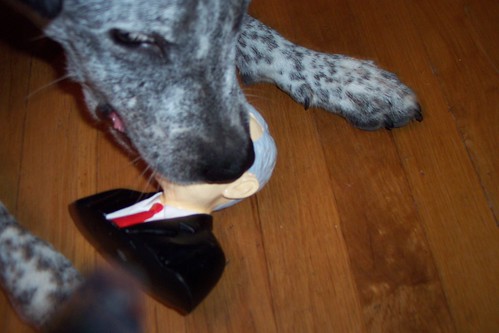
Regular readers might know that our youngest dog, Gobo, is a biter, which is usually a drag. But then we got him ">George W. Bush's head, and now we're very happy. It squeeks!
Wednesday, November 09, 2005
future
This blog entry is on point. And gutsy -- it's written by a reporter at the Philadelphia Daily News, which is owned by Knight-Ridder (which also owns our beloved Star), and it actually takes a few smacks at the corporate ownership.
What's great about it is that the fictional part that opens the passage is probably the best prediction I've yet seen about the future of news. And I like it! It looks really cool.
I know I bash on the local paper here quite a bit here, but the truth is, I'm scared to death at the prospect of the Star or any other big daily paper going under. Grumbles aside, these papers still have the the only real institutional heft to carry the Fourth Estate forward in our country. Bloggers can't do it. Alt-weeklies can't do it. And TV news is racist drivel.
So this idea of the "norg" being a converged salon of information where folks can enter from whichever direction they feel comfortable, interact with the info, repackage it, share it with one another -- I think it's exciting.
This Attytood post reads in parts like a manifesto:
Damn right!
What's great about it is that the fictional part that opens the passage is probably the best prediction I've yet seen about the future of news. And I like it! It looks really cool.
I know I bash on the local paper here quite a bit here, but the truth is, I'm scared to death at the prospect of the Star or any other big daily paper going under. Grumbles aside, these papers still have the the only real institutional heft to carry the Fourth Estate forward in our country. Bloggers can't do it. Alt-weeklies can't do it. And TV news is racist drivel.
So this idea of the "norg" being a converged salon of information where folks can enter from whichever direction they feel comfortable, interact with the info, repackage it, share it with one another -- I think it's exciting.
This Attytood post reads in parts like a manifesto:
We prefer to talk down to the public rather than talk to them. Even at our very best – and there are many, many talented newspaper journalists in America – we are more likely to aim at wooing contest judges than at wooing new readers. And we have a knee-jerk tendency to defend our narrow world of messy ink printed on dead trees, when instead the time is here to redefine who we are and what we do.
We are, and can continue to be, the front-line warriors of information -- serving up the most valuable commodity in a media-driven era. But that means we must be the message, not the medium, and so we must adjust to give consumers news in the high-tech ways that they are asking for, not the old-tech way that we are confortable with.
Damn right!
Tuesday, November 08, 2005
the last abortion clinic

I was an unplanned pregnancy, pre Roe v. Wade, and I'm happy to be alive. So, on a very superficial level, some of the rhetoric associated with the so-called pro-life movement appeals to me. But I can't get around the hipocracy.
Tonight Allie and I watched Frontline's "The Last Abortion Clinic," about how a seldom discussed Supreme Court decision of 1989 has made it increasingly difficult -- in some cases, almost impossible -- for a growing population of women to choose to have an abortion. The documentary focused on Mississippi, where there's basically just one abortion clinic still in operation. And even that clinic could close its doors early next year.
The show offered lots of interviews with so-called pro-lifers, and it showed them praying outside of the clinic in Jackson. Most of them were men, and I can't recall seeing a black face among them. And I kept thinking, You don't really care about these babies you think you're saving.
After just two minutes of Googling, I found a handful of Mississippi counties where 40 percent of the children live in poverty (that's federally defined poverty, which is artificially low, not actual poverty), and the infant mortality rate is as high as 20 per thousand. Statewide, 24 percent of Mississippi's children live in poverty, the highest rate in the country. Twelve percent live in "extreme poverty."
Mississippi ranks 50th among states (including DC) in per-pupil expenditures on education.
And this:
Mississippi families who pay for care spend an average of 9 percent of earnings on child care. Families with incomes below 200 percent of poverty spend an average of 14 percent of parental earnings, more than the 7 percent of earnings spent by families with incomes at or above 200 percent of poverty.
In Mississippi, at least 41 percent of families with incomes below 200 percent of poverty get some sort of child care help; at least 15 percent have government/organization help and at least 20 percent have all their child care provided free by relatives. The percentage of these families with government/organization help is lower in Mississippi than in the United States as a whole. (Urban Institute)
And, of course, there are lots of kids in Mississippi who are waiting for someone to give them a stable home, as there are in every state.
I'm not necessarily trying to bash Mississippi.
But come on! What are you doing for the kids that are already alive?
In the Frontline show, the Mississippi so-called pro-lifers crowed about these "Pregnancy Crisis Centers" they've established across the state to help poor women deal with their lack of choice. I yelled, "Right on!" at the screen when an anonymous abortion clinic owner addressed these outposts of dubious benevolence.
Right now it seems that the crisis pregnancy centers want to help women have babies, but really offer no real alternatives for women to raise these babies and have no resources truly available to them for the long term.
And again, a woman with children already, some baby clothes and formula and even a stroller isn't going to help for that long. That's just not what's required to raise a child. The whole thing that is really problematic for me is the disconnect between the pre-born and the post-born. I just don't understand that. It seems that so many of these groups, so many of the hardliners, when they say, "I'm pro-life," they mean "I support the pregnancy in utero," in the uterus. But I see so little sustenance and support for women and children, particularly poor women and children. Those are the ones that are castigated and blamed.
Subscribe to:
Posts (Atom)


