Friday, January 19, 2007

more tif

I might have over-simplified my explanation of TIF yesterday. Using an analogy of fixing up a falling down house, I explained that TIF is based on the estimate of how much tax revenue a fixed-up house would generate. And then the so-called "new revenue" -- the difference between the lower taxes for a run-down shack and the higher taxes for a remodeled palace -- is funneled into the development. That's before the so-called new taxes come in.

This explanation gives the impression that all of the imaginary money goes into the actual development. Like, if you're gonna deck the sheck out in Itallian marble, the taxes pay for the marble. That's not entirely true. In theory, the money goes toward stuff one would ordinarily expect a city to pay for, like new roads and sidewalks around the project, and sewer lines and such. And some of the money does. (more on that later.)

But some of the money actually does goes to the Italian marble, so to speak. For instance, with this TIF for a luxury hotel in Kansas City's richest neighborhood that the council hurriedly approved last week, some of the predicted tax money is going toward meeting spaces in the luxury hotel.

(Not exactly what I like to see my hard-earned money spent on. But who am I but an honest taxpayer, and therefore worthless in the eyes of those who approve such deals.)

But here's something you never read about in the newspaper: A lot of this TIF money goes to lawyers.

Like, MILLIONS.

And that's a BIG reason why TIF is used so much. It's a guaranteed revenue stream for a handful of politically connected law firms in town.

Here's something I wrote in the aforementioned PItch article on Wesley Fields:
Bryan Cave has earned more than $800,000 from the TIF Commission over the past three years. Fields alone has billed more than $400,000. And he continues to work for the TIF Commission even as he runs for office.

Fields is quick to point out that this isn't taxpayer money his firm is earning. He says that "approximately 90 percent" of the firm's bills have been paid by developers involved with TIF projects.

But Fields' legal bills show that's not true.

The Pitch compiled a database from 373 Bryan Cave invoices and found that half of the firm's bills were paid out of the TIF Commission's general fund, an observation confirmed by Laura Whitener, the TIF Commission's top administrator. That fund is made up of 5 percent of the taxes created by new TIF developments -- in other words, it's public money.

The TIF Commission's public meetings, at which developers pitch schemes to build parking garages, luxury hotels and, in one instance, a McDonald's, have been particularly profitable for Bryan Cave. During the first two years of its contract, the firm sent two lawyers -- Fields and Stephen Sparks -- to prepare for and sit through the meetings. "There are some times when you need to have an attorney at the table," Whitener says. "You're never going to be able to predict those times."

From March 2000 through January 2001, the two lawyers' administrative activities earned their firm more than $50,000. Since then, the TIF Commission has cut back to having just one lawyer -- Fields -- present at its meetings.

But even the other half of Bryan Cave's bills, the ones supposedly paid by developers, are eventually reimbursed with public money as well. That's because current TIF policy allows developers to include legal expenses in their TIF financing agreements, labeling them "soft costs." Moreover, developers may also be reimbursed for hours billed by their personal lawyers.

"It's a sleight of hand," Nace says. "The developer doesn't own the taxes his project will generate. It's not his money. It's taxpayer money. On the Finance and Audit Committee, we're working right now to limit the amount they can be reimbursed for soft-money expenses. And we're getting a lot of resistance."

As early as 1982, city leaders knew that the legal expenses of the Economic Development Corporation, which provides staff for the TIF Commission, were straining the city's budget. A report issued that year by the Cleaver-appointed Citizens Budget Review Committee recommended reducing those expenses by $100,000, even though back then they were a mere $155,000 a year. Instead, the council voted to increase payments to lawyers. Now attorneys are making millions from the EDC.

A 1999 Star article cautiously suggested that these contracts are doled out as part of a patronage system. With minimal notice to the public, the EDC board met off-site to retain the services of Bryan Cave and the King Hershey law firm. Lawyers at both firms contributed heavily to Mayor Kay Barnes' campaign. Bryan Cave senior partner Herb Kohn, for example, is one of the mayor's chief allies. Kohn has billed the TIF Commission for more than 200 hours -- more than $35,000.

Although this money creates potential conflicts of interest, Fields promises that as a City Council rep, he will shape TIF policy based on the community's "collective vision." It's uncertain how he would accomplish that given that he would have to step aside from many of the TIF debates at City Hall.

"If we still have the contract at the time, he would be, directly or indirectly, a beneficiary," Kohn admits. "He'll probably want to recuse himself, but that's a decision he'll want to make at the time."

In other words, TIF creates a new trough along the City's revenue stream for lawyers to feed on. They don't even have to work for it, because there's no bidding process. And the only incentive is for them to push more TIF projects, because that makes the trough bigger. (BTW, that story won honorable mention in the 2003 Missouri Press Association Excellence in Journalism contest for "Best Coverage of Government," a category in which I also took first place for a package of three stories.)

And please note that the TIF money pays for not only the TIF Comminssion's lawyers, it also pays for the developers' lawyers. Such a sweet deal, huh? Make's you think twice about law school, don't it?

So there's really NOBODY representing the public good (more on this later, too). There's no incentive to. Bryan Cave represents the TIF Commission, which gets all of its money on a 5 percent commission of all TIF projects. So, more TIF projects, more money.

It's just that simple.

And that, folks, is why the city has no TIF policy. Because if there were a TIF policy, the folks on the City Council's Finance Committee -- three of whom are running for mayor -- would have to decide when and where TIF projects will happen. And that could cut off the money trough for the developers and lawyers, all of whom make healthy campaign contributions to the committee's three mayoral candidates -- Al Brooks, Chuck Eddy and John Fairfield.

It's weird that reporters think this stuff is boring. It's straight-up graft. It's the rape of the common good for the sake of the few and the rich. What could be more interesting than that?

(Other than puppies and Britney Spears's sex life. And maybe the untimely murder of Lil Jakes.)

Thursday, January 18, 2007

in a tif

A few years back, I wrote a major take-out piece on Wesley Fields, who was running for City Council. In many ways, I'm ashamed of the piece. At the urging of Steve Glorioso (who was working for Fields's opponent, Becky Nace), I really went all out and dug up every scrap of dirt I could and I put it all out there. Some of the stuff -- the stuff Glorioso tipped me off on -- was really insignificant, and probably wouldn't have amounted to much if Fields were white, or if his opponent weren't a white woman.

On the other hand, the meatiest stuff in my exposé, the stuff that got me interested in him to begin with, was that as an attorney at Bryan Cave he was one of the main lawyers representing the TIF Commission. And, it wasn't long after I moved to Kansas City that I learned that TIF (short for Tax-Increment Financing), is one of the biggest scams in the city, so it raised a red flag.

A lot of people think TIF is boring and confusing, but it really isn't. Anyone who cares enough to vote understands it in principle. Basically, it's an incentive to develop areas that are difficult to develop. That's the theory, anyway.

It's like this. Imagine you buy a falling-down shack. Taxes on it are low because it ain't worth squat. Well, as an incentive to get you to fix it up, the City offers to freeze the taxes at the worthless level. Then they figure out how much your property will be worth after it's fixed up, and they give that money to you ahead of time so you can fix your place up.

Sound like a good deal?

It's a hella good deal!

The problem I saw with this, though, was that it looked like most of these TIF deals were going to folks who weren't fixing up shacks. They were going to people who were developing farmland in the suburban Northland. People who wanted parking garages on the Plaza, which is the primo shopping district in the region. They were going to, in one instance, a gated community directly adjacent to the Plaza.

So, in my young and radical alt-weekly mind, it looked to me like institutional racism. More accurately, it seemed a social and economic justice issue, which, in an old Jim Crow town like KC, disproportionately impacts blacks. I didn't say that in the article, but I said it to folks behind the scene, in particular those who accused me of embarking on a racist attack on a promising young black candidate. (To which I now say, guilty -- at least on the Glorioso-inspired parts.)

But with regards to the real substance of the story, I was on point. When it comes to a lot of his work at Bryan Cave, Fields was (is?) a tool for what might well be Kansas City's most egregious injustice.

Because now there's proof!

There's no other way to say it: This report is a damning indictment of Kansas City.

We all ought to be ashamed of ourselves for letting this kind of enrich-the-rich graft take place on our behalf.

Check this out:
88% of TIF plans are in four Council Districts (1, 2, 4, and 6) which contain the two-thirds of the city’s population who are the most affluent, best educated and least likely to be members of a minority group.

The two Council Districts (3 and 5) with one-third of the population who have the lowest income and the highest rates of poverty and unemployment receive only 12% of TIFs.

Do you need further explanation?

It says: A program for poor neighborhoods is being used for rich ones.

Now, I remember Fields's argument in defense of TIF being used this way. It's the same as Mayor Barnes's, which was dutifully transcribed this week by her stenographer:
“Neighborhood concerns and economic development are bonded together,” she said. “You don’t have to pit one against the other.

“To address neighborhood and social concerns, you need to generate economic development to do it. The other option is raising taxes.

“Be alert to anyone sending a message: ‘We’ve done enough economic development and we need to focus on neighborhoods.’ We can do both.”

Here "economic development" is code, in part, for TIF. And "neighborhood concerns" is code, in very small part (at least, I think, in her elitist mind), to the needs of poor people.

Yet, as Reclaim Democracy's report reveals:
The use of TIF and particularly the inclusion of (predictions of how much tax new developments bring in) has grown rapidly in Kansas City over the past few years. The amount of redirected tax revenues transferred to the TIF Commission has surged by 208% between fiscal 2000 and 2004. EATS grew by an equivalent 204%. That growth coupled with findings that actual revenues of TIF plans accounted for only 23% of projected revenues should create serious concerns among the citizens and elected officials.

In other words -- going back to the fixed-up-shack analogy here -- the predictions for how much money these new projects will bring in have been way, way off the mark. But developers still get the predicted windfall up front. And that money has to come from somwhere.

So where does it come from?

You guessed it!

Poor people.

Actually, it comes from all of us.

But, as you can plainly see when you drive across the districts where the fewest TIF projects are underway, it's the poor who can least afford it.

Monday, January 15, 2007

christian science monitor

Got a nice review in the Christian Science Monitor.

Sunday, January 14, 2007

sparse

Sorry I haven't been updating much. Most of the stuff that would make good blog fodder is stuff I can't really write about. I'm working on this mayoral campaign, and the candidate debates and forums have been great on the comedy end of the blog spectrum. But I can't really do that to the opponents, even if it is just straight reporting of absurd things they say in public.

It kind of felt like our candidate took the lead last week (knock wood) -- especially with this kind of attention.

Anyhoo...

I checked into the old Motel 6 this week. Didn't spend any nights there, just used it as an office of sorts to force my way through a draft of my proposal for my second book. This would be my third go at a proposal. Proposals are by far the hardest things I have to write.

I'm falling into a pattern. When the writing gets tough, I check into the Motel 6 on 87th and I-435. And I write and anguish on the frumpy little bed and I pace the tiny room and I write again. And then I always go for lunch at least once at Peachtree Buffet. And I take short walks in the tiny neighborhood behind the motel and listen to the same three Mariah Carey songs over and over again on my iPod. And then I write a little more. Dang but that Mariah sure does sing pretty.

Three days of that and I got a draft together, and Allie read it today and said a lot of it is really, really good, but that it has some structural issues. (the worst kind, of course!)

And then, perfect timing, The New York Times starts a three-part series about Pentecostalism today, which, of course, had some points I'd forgotten to mention in this proposal.

We finally have winter around here. I'm not enraged about it.

Wedding's fast approaching. Costa Rica, too.

(kind of a dump-file post. sorry.)

Thursday, January 11, 2007

missour-uh

Saturday, January 06, 2007

spin

I'm a little pissed off this morning.

Yesterday I planned my first ever press conference. Mark Funkhouser was scheduled to file his petitions to be candidate for mayor, so I worked with him and his staff to put together an event. Before filing, Mark read and signed a giant copy of a Commitment Letter to the people of Kansas City, which laid out a number of priorities that would guide his tenure as mayor.

It all came together just as planned, and I walked away a little high, because we'd managed to attract the daly paper and a number of TV crews.

I should've paid a little closer attention to the newspaper that morning. Of course I noticed the headlines. Even in Kansas City it's not often that you have two elected officials indicted for mortgage fraud in as many days. But I was so caught up in planning the event, it adn't occured to me that our nice little press conference about good, honest leadership might be buried under the slime of business as usual.

So what happens?

The alleged criminal fiiles for office and steals all the spotlights as reporters record her insane comments.

And I do mean insane.
Shields claims the Bush administration is almost exclusively targeting Democratic officeholders, such as herself, which the U.S. attorney denies. The mayoral race is nonpartisan.

“I am not going to give in to political terrorism,” Shields said.

I'm sorry, but that is positively deranged. DERANGED!

There's no other word for it.

Anyhoo, it's funny to be on the other side of things. All those years I was a reporter, duutifully hustling the bad story. Now I'm the flak whining, Why can't they write about the positive?

(Which isn't really true. It's more like I'm growsing, Why can't people who are so drunk on their own tinhorn power as to be certifiably insane just go away so we can have a city that works for once?)

Thursday, January 04, 2007

american way

Got a mention in American Airline's magazine.

Sunday, December 31, 2006

cheesy

100_4461.JPG

Allie and I had a wedding shower in November.

We got lots of stuff.

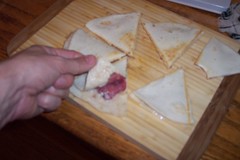
One of the items in the kitty was the quesadilla make pictured above.

As we were packing up the car I looked at it and scoffed, "What are we going to do with a quesadilla maker." I thought it had garage sale written all over it.

Well, it's become my best friend. I've had quesadillas almost everyday. I've even gotten adventurous, making brie and smoked turkey quesadillas, goat cheese and calamata olive quesadillas. Below are pictures of blue cheese and pepperstea quesadillas and meatball quesadillas, which are my favorite so far.

100_4462.JPG
Ham, cheese and pickle.

100_4463.JPG
Blue cheese and peppersteak.

100_4465.JPG
Meatball.

100_4466.JPG
Meatball.

100_4467.JPG
Meatball.

more info

For more information
about my book
- Cross-X -
please visit
the official website.


(But if you want to know more about me, feel free to stick around and read my blog.)

Saturday, December 30, 2006

home

Last night, my uncle told me that he and my other uncle have completely cleared my grandma's house out. He said it is now empty.

I've known that they were in the process of moving her things for a while now. She moved in to her new place a few weeks ago. And we've all had conversations about what a tough time this is. And I've tried to stay the unsentimental course. My message has been everything's temporary. And the pros of Grandma finally moving to Goshen -- cultural and spiritual center of Elkhart County -- far outweigh the cons.

But then I hear that her house is now completely empty and I feel as though I've been punched in the gut.

More than any other place, Grandma and Grandpa's house has been my home since the day I was born. I don't mean that as a slight against my mom or Bob or the Minichillos. But there's something about 125 Hollywood Avenue I've never found anywhere else.

You know that old meditation cliché, when they tell you to close your eyes and, go to that special, safe place? That's where I always went.

I suppose I could go on a long memory bender.

For some reason the first one that pops in my mind is the time I ate a pound of walnuts in front of the TV. I got a horrible stomach ache and I begged grandma to give me Alka Seltzer. But she accidently gave me Efferdent. Fearing she'd poisoned me, she tried to get me to let her stick her finger down my throat so I'd throw up. But I refused, and lived anyway.

Or when I called my grandpa's bluff. Whenever I asked him what he wanted for Christmas he always said, "A good boy." So one year I cut a bunch of pictures of good boys out of a magazine and gave them to him.

Or the tree house he built for me.

Or...

I could really go on and on, and on.

But the memory I always come back to is a summer when I was home from college. It was a perfect day and I was laying in the hammock with a book and some sweetened ice tea in one of those tall green glasses they used to have. I don't remember the book I was reading, only that it was one of those good ones you don't want to end. At the close of one of the chapters, I laid the book on my chest and looked up at the late afternoon sunlight sifting through the leaves of the old pin oak. Time was moving neither too slowly nor too fast. I was young and content that I was exactly where I needed to be.

I had several more moments like that over that summer, and a few times in my visits since. But gradually the pace of life has outclipped even the serenity of the granfolks' place. I've tried many, many times to bring that feeling back. Haven't succeeded yet.

dream

It's 3:15 in the morning.

I awoke from a dream in which I saw my father again.

I was on my knees tending a garden at my grandmother's house. Except it wasn't his mom's house; it was my mom's mom's house. But my grandma (his mom) was inside. We were both waiting anxiously because we knew he was going to arrive. There was snow all around the exposed patch of earth that I was working.

Dad pulled into the driveway in his truck, the early-70s gold model. He glanced over at me and then stared at the steering wheel, obviously overcome with emotion.

I made my way to the car, feeling choked up, too, but also very excited and happy.

He got out of the truck. He acted a little slow and dazed, which seemed appropriate for a man who's been dead for 30 years. He looked good, though. Just like in the pictures.

Grandma rushed out of the house to greet him.

I can't remember what was said, or even if we embraced. I woke up before we could really get to talking.

It was a pleasant dream, if frustrating. It felt very real, but not real enough.

Wednesday, December 27, 2006

write

I wrote three sentences on Monday. I sent the sentences to Agent Lydia right away, fearing the worst. She said they were great. It was a major breakthrough.

I wrote another sentence today. And then I copied a paragraph from another document and pasted it on the end of that sentence.

Another breakthrough.

Not sure what's next. An outline, I suppose. Then I'll probably have to check in to the Motel 6 again, lock myself up, so to speak, and gitter dun!

This is how writing goes sometimes. Days and weeks of nothing, or what looks like nothing. Then a drip or two. Then, ahem, a flood.

Except it's not nothing in between. It's thinking as strenuous as weightlifting.

Sunday, December 24, 2006

norfolk

Allie told me about this site where you can answer a bunch of questions and it'll tell you where you ought to live. She did it and it told her to move to Sheboygan, Wisconsin, which she found supremely disappointing.

I did it, and all the top pickswere in the South. A bunch of places I never really gave much thought to, with the top finisher being Norfolk, Virginia.

Allie and I have actually talked about Norfolk before. It's supposedly a vegan paradise, because PETA is based there. Looks pretty cool, actually.

Saturday, December 23, 2006

book meme

I've been tagged by Joel. I think I've done this one before.

Confederates in the Attic, Tony Horwitz
"We look at the little pictures, He takes the big view." Another woman wailed, "I don't want to go to hell, Lord. It's hell here."

Which probably is as good a reason as any to apologize for my lack of posting here. A lot's been going on, most of it good. Plus it's the holidays. But the "lot," in general terms is:

*Getting ready for the wedding
*Reworking my proposal for book2
*Helping Ryan and Marshawna get ready for the big tourney at MBA
*Helping Mark Funkhouser get elected mayor

I'm home alone for the holidays right now, which is kind of weird. I've stayed behind while Allie is at home with her folks so I can stick around this church I'm writing about. I'm not sure who's in town for Christmas, but if you're here, drop me a line.

Tag:
MAWG
Some Sort of Bird
It Never Happened

(you know the old saying: "That family that blogs together...)

Monday, December 18, 2006

feel good


(I love the reporter's grasp at meaning at the end.)

Sunday, December 17, 2006

person of the year

I've been named Person of the Year by TIme magazine.

Wednesday, December 13, 2006

lil' jake's r.i.p.

I heard that the overlords of KC are going to condemn the best barbecue joint in the city and give the property to rich people.

I'm having lunch there tomorrow. So stay tuned for a full report.

But for, now, my Googling found doom foretold in a Star article published last year.
One well-known business that would be relocated should the development plan move forward is Lil' Jake's Eat It and Beat It, a popular 18-seat barbecue restaurant at 1227 Grand Blvd. [Jon] Copaken said there had been discussions with Danny Edwards, the owner, to try to find a suitable new downtown location.

"I love going to Lil' Jake's as well," Copaken said. "He is an institution downtown, and we want to find a way to satisfy him."

Suitable location?!

That's the reporter's words.

SUITABLE LOCATION?!?!

Seems to me Mr. Edwards already had a damn suitable location, one he snagged fair and square years before a bald developer with more money and more connections decided he wanted it for himself. But, of course, Kevin Collison is Copaken's unofficial stenographer. So to him, it seems, the word choice "suitable" is even-handed and accurate.

So now Mr. Edwards is -- indeed, we all are -- going to lose this venerable beacon of Kansas City culture to eminent domain. As if it's in the public's best interest to have a downtown "institution" swatted away so -- what? -- so a rich person can get richer, I suppose (but no less bald).

Seriously. I'm at a loss here. It's not like the joint is being demolished so we can have a highway we all need, or a light rail line. It's being shut down because someone with extreme privilege has decided they want it. And our ever compliant government shall make it so.

We're still living in America, right?

To think the liberals on the Supreme Court supported this crap.

You'd think we live in Zimbabwe or something. Like Robert Mugabe is running downtown.

Sunday, December 10, 2006

chicago tribune

Cross-X was named one of the best books of the year by the Chicago Tribune.

Thursday, December 07, 2006

upside down world

It's interesting to read about the looming Supreme Court decision on school desegregation after having worked my way through Robert Caro's Master of the Senate: The Years of Lyndon Johnson.

That entire, massive book is about a Herculean push to pass the tiniest, nearly insignificant civil rights legislation in 1957. I was amazed at how well the system worked against such measures, how the powers that be would invariably interpret laws and procedures such that they'd benefit bigotted whites and oppress everyone else.

This recent deseg stuff is kind of similar. From the NYT:
Justice Stephen G. Breyer let his frustration show in several exchanges with Solicitor General Paul D. Clement, who argued the Bush administration’s position as a “friend of the court” for the challengers and against the school systems in both cases.

“Think, go back to Cooper v. Aaron,” Justice Breyer told the solicitor general, referring during the argument in the Louisville case to the court’s 1958 decision enforcing a desegregation order in Little Rock, Ark. “Go back to the case where this court with paratroopers had to use tremendous means to get those children into the school. That’s because the society was divided.”

He continued: “Here we have a society, black and white, who elect school board members who together have voted to have this form of integration. Why, given that change in society, which is a good one, how can the Constitution be interpreted in a way that would require us, the judges, to go in and make them take the black children out of the school?”

“Well, I understand that, Justice Breyer,” Mr. Clement said. “But I think the answer to that is that the lesson of history in this area is that racial classifications are not ones where we should just let local school board officials do what they think is right.”

There's so much in that little exchange.

Back in LBJ's time, it was the cry for local and state rights that led the conservatives' charge against integration. Now it's the opposite. Now it's conservatives' arguing that the local governments can't be trusted to do what's right, lest they discriminate by integrating.

Tuesday, December 05, 2006

end of the line

The tour is officially over. I've got a few appearances left, but it's not all tour like. They're just readings in places where I'll already be, like Kansas City and, um, Kansas City.

What a long, strange, fun, exhausting trip. Seems like a year ago since that first nervous reading in St. Louis. Now I'm sitting in the dinky Long Beach airport, after talking to a crowd of five at Eso Won Books in L.A., and selling all of two books, one of them to myself because I didn't have a freeby to give to my housing host.

But I've long since stopped caring about sales. The LA event was set up because I had planned to be here anyway, and the goal was to make a connection with the store's owner, which I did.

Yesterday I rented a bike at the Santa Monica Pier and rode it south past LAX and back. Then I went for a walk at sunset listening to Mile's Davis's In a Silient Way, the best beach-at-sunset album ever made. Today I drove the PCH from Laguna Beach to Long Beach, stopping at various state parks and walking the sand barefooted.

I hate to say it: I love Southern California.

It's like heaven on earth. Too bad it would be hell to live here.

Oh, what a drivellish blog entry this is. I've had so many I've wanted to write over the last several weeks. One about the night I sang a kareoke duet of "You Never Even Call Me By My Name" with an old black woman in an all black bar on the black side of Louisville. Or about Robert Caro's magnificent Master of the Senate. Or I need to rework my proposal for number 2, a prospect I'm actually quite thrilled about. Or...

See, that's what happens. I get these ideas and then they just disappear into mush, because I'm so damned tired.

Christmas music is playing. I hope this overdose of sunshine I've had for the last five years will carry me through the bleakest months in the Midwest. The sun here is as tart and satisfying as orange juice.