Sunday, September 04, 2005

i want

I made two major purchases last week: an iPod (60 gig model) and the new Kanye West CD. I got the latter for obvious reasons, and the former because I've always kind of wanted one and because I was gearing up for a drive to Denver and I thought it would be convenient (almost cost efficient) to have every sound file I own at my finger tips. It seemed a better way to survive the drive than my usual habit of burning a stack of CDs before hand.

But really, I bought the damn thing to get high. I wanted the rush of a big purchase. Problem is it didn't work.

First there was the disappointment of how it sounded on my car stereo -- all staticky with the weak radio transmitter ($40). So I returned that transmitter and bought a more expensive one ($80), an absurd white-plastic apendage that stuck into the lighter and stuck out a good foot or so, getting in the way of the air-conditioner controls and swaying and bouncing around as I drove. Worse, it didn't work: Still static. Andthat's why I bought it, for my car, since I don't need it at home, where my stereo is hooked into my computer. So I look up ways to attach it directly to the factory stereo in my car, and that appears to be a $200 ordeal, and for what? I drive a lot. But do I really need 15,000 songs rolling with me?

Then there's the way it organizes songs. Since a lot of my music is stolen, there's no uniformity to its coding system, so there are files on the iPod like <..00instrum.kd.track.4.m,p3--, which is as annoying as hell, especially in a small machine of such austere beauty. So I've spent hours upon hours going through each of my 3,785 songs, cleaning up their titles, so that they'll appear all clean and orderly on my iPod, which is a pain in the ass because I can't figure out how to code batches of files in iTunes.

Meantime, I'm listening the new Kanye album, and I'm hearing stuff like, I'd do anything to say I got it/ Damn, them new loafers hurt my pocket and Claiming money is the key, so keep on dreaming/ And put them lottery tickets just to tease us and:
Good morning, this ain't Vietnam still
People lose hands, legs, arms, fo' real
Little was known on Sierra Leone
And how it connect to the diamonds we own
When I spit the diamonds in this song
I ain't talkin' 'bout the ones that be glowin'
I'm talkin' 'bout Roc-a-Fella, my home
My chain, this ain't conflict diamonds
Is they Jacob? Don't lie to me, man
See, a part of me sayin', "Keep shinin'"
How? When I know what a blood diamond 's
Though it's thousands of miles away
Sierra Leone connect to what we go through today
Over here it's a drug trade, we die from drugs
Over there they die from what we buy from drugs
The diamonds, the chains, the bracelets, the charmses
I thought my Jesus piece was so harmless
'Til I seen a picture of a shorty armless
And here's the conflict
It's in a black person soul to rock that gold
Spend your while life tryin' to get that ice
On a Polo rugby it look so nice
How can something so wrong make me feel so right?

Which is deep. He's testifying on several levels here. And I'm listening to it and looking at this $400 suped up Walkman I don't need, didn't even get high on, didn't make me "feel so right", doesn't really work the way I want it to, and meantime all the images from New Orleans are driving home a clear message about inequality.

So I'm going to take the stupid thing back. Though it ain't gonna be easy. As unsatisfying as it is, I still want it. It's the wanting that's the thing.

Saturday, September 03, 2005

tony's kanye city

In the spirit of good debate, I want to respond to a post on my favorite blog (and primary news source) about Kanye West's comments about Katrina.

First, the minor stuff: Dude, those sites you've linked to discrediting Kanye are not the least bit credible. One of them speculates elsewhere that his dad might be Cornell West, which is aboslutely absurd. Coonsider this: If these allegations were remotely true, do you honestly believe that with all the attention Kanye has received from the media -- the so-called liberal white media -- that there isn't a single ambitious reporter or news organization would pounce on the opportunity to discredit a black man? And he's not a "third rate rapper" by any measure. He's obviously at the very top of the game. Moreover, he's reacquainting the medium with its original socially conscious spirit. (More on that later.)

But with regards to what Kanye said, I think he was on point. Yes, it's an exageration to say that Bush doesn't care about blacks. But Bush is the figurehead of a vast and historical policymaking apparatus that, the overwhelming evidence indicates, has little regard for blacks (or, in more plain, frustrated English: "doesn't care"). And I fail to see how one can see the images coming out of New Orleans and not see it as clear evidence of the racial divide in our country.

Of course, it seems an over simplification to say the slow response to the needs of those stranded in the city is due to a lack of caring for blacks. But it's true if you tease out the genealogy of the situation. Consider the report KC's own Jamie Metzl helped to write regarding America's ability to respond to terrorist attack. It pointed out that first responders -- fire fighters, cops, emergency crews, etc. -- are underfunded and poorly trained. Sure, the report was about terrorism, but these are the same tools our government uses to protect the public's well-being in natural disasters. Why are these first-responders ill-equipped? Because, under Bush's leadership, our nation's priorities are elsewhere, namely in tax cuts for the rich and an imperialist war in Iraq.

So how does this relate to blacks? Well, history has clearly shown that disasters of any kind disproportionately affect the poor. And the poor in this nation is disproportionately black (and I might mention here that the very existence of New Orleans, the fact that it's situated below a floodplain, is because of "King Cotton" and all the enslaved Africans who picked it, not to mention the stolen, bloody land it was grown on).

For the past five years, we've seen Bush spend a lot of capital advancing the interests of the white and well-to-do in this country. And this has left us vulnerable to suffer the sort of problem that we, as the "most advanced country on earth," should be able to easily solved. What I'm saying is, we're advanced enough to know that this was an inevitibility. You don't build a river under water without knowing the potential consequences. And you don't have cities that are predominantly black and poor without knowing that those cities are black and poor and knowing that when the inevitible comes that its inhabitants will be fucked.

So, I agree. Bush, and all that he represents, doesn't really care about blacks. Not in a significant way. That's what I see in the images on my TV screen.

Wednesday, August 31, 2005

king's night

swear, I've got the social graces of a traffic cone.

Last night was Whitney Terrell's big hometown second-novel party night, with a reading at Unity Temple and a reception at a loft in the Crossroads District. Allie and I went to both.

It started off well. The reading was great (though it reminded me of how pissed I am that Rainy Day Books is now requiring purchase of a book to attend). Whitney was really funny as he handled questions from the crowd. Allie and I laughed when he said everyone who writes a book thinks at various times that it sucks and the publisher won't accept it. He said that he had written an entire draft of this book and then had to throw it all away, all 800 pages, and start over, which is a hell far deeper than any I've suffered (knock wood).

His new book's funny too, though the very real story it tells isn't at all funny, at least not to me, which makes the book really complex and cool. I picked it up last Thursday and I'm enjoying the hell out of it. I liked his first book, too, a lot. But this one is a marked improvement. And he's obviously getting quite a bit of attention for it, what with reviews in People, Entertianment Weekly and all the big newspapers, and I think that's fantastic and well-deserved.

So it was all fine and dandy through the reading, because you can be a shlub at such things. But then we went to the reception and steamrolled into a series of social car crashes (actually, they were more like social getting-stuck-in-the-mud-out-in-the-middle-of-nowheres, because no one but me seemed to notice or care).

First, we pulled up to the loft where it was being held, and we were startled to find no-option valet parking. It was free, but neither of us had any cash to tip. Allie and I lingered for a while in the parking lot for a minute or two, frantically scheming how to get our hands on some cash. Allie looked into the loft's lobby, hoping to see an ATM, which obviously wasn't there. Then she asked if one might be within walking distance, but this place was situated in a no-man's land at the north end of Pennn Valley Park, a good half mile from a cash machine. I said I thought there might be some spare change in my care (sparing her the detail that it would likely be sticky with spilled pop), and she grimaced.

"Wait!" she said, hopefullly, "I have my check book. Maybe they'll take that."

"Cool," I said. "We can at least offer, and we won't look like total dicks."

So we went in, got the off-duty cop escort up to the third of fourth floor and stepped into an immaculate loft filled with people in nice, clean clothes. I looked down at my feet, shrooud in dusty Crocs, and damn near had a panic attack (It's not totally my fault: Gobo has eaten all of my attractive-yet-comfortable shoes, and I'm still too into summer and jobless comfort to succumb to the blister-making "church" shoes).

The elevator had let us out into a foyer, and I pulled Allie into a corner of it. "We have to leave," I said. "I can't be here dressed like this."

She tried to reassure me, and we took a couple of tentative steps forward to peer around a wall into the vast expanse of the loft (carpeted, BTW, Kansas City style). I spotted a guy in jeans and sneakers, and though they were clean, silvery sneakers, I felt a bit relieved. So we went in and got some drinks from the open bar, did a pass around the lovely snack spread, and planted ourselves in wallflower pots at the far end of the joint, where we stayed for most of our hour at the party.

We knew only a couple of people there, a reporter/editor from the Star, and old Pitch colleague, and, of course, Whitney and his wife Gayle. So, after squeezing as much conversation as we could out of our four acquaintances, and after doing an investigative sweep through the place to determine as much as we could about its owner (son of former mayor, Ilus Davis, we figured out, thanks to the framed memorabilia that said, essentially, "Son of former mayor Ilus Davis), we split.

And, wouldn't you know, we bumped into one of our best friends, Sylvia, just as the valet was pulling our car up. She was on her way in.

And the valets were nice when they said they didn't take checks. Allie wouldn't let me scrounge for change.

Maybe I should go to charm school.

Tuesday, August 30, 2005

writer's block

Every morning I start over. Brand new. Mountain just as high as the day before (the current mountain being a proposal, and proposals are hands down the biggest bitch to write). There's no momentum carrying over from the previous day, because that momentum lasted exactly three hours yesterday, and then abruptly stopped. And now it's nearing nine, and I've procrastinated right to the edge of doing anything at all. As if to tempt me, Allie decided not to walk the dogs, and I'm thinking perhaps I should do that, it's quite nice out, after all.

A couple sentences...

Sunday, August 28, 2005

future man

Hung out in Lawrence with my friend Joel last night. Apparently, he's going to be on CBS Sunday Morning because he's an emerging god of media convergence. He's already been in the New York Times and on NPR. I really want to read the NYT piece, but I can't find it on Google. (Joel?!)

Joel represents more than the future of media. He's ushering in, and helping define, new notions of community. It's weird hanging out with him. You walk down Mass Street and every fifth or sixth person stops to chat with him. He's super popular because he's always out at cafes and restaurants chatting with people, and because he has a popular blog, and a weekly column, and he does TV reports and newspaper reports (and he's friendly and kind of a ham). And I can't help but think that Joel's the Pied Piper. I think media is going to become more and more community based, very local and very democratic, coming in many different forms -- newspapers, TV, radio, blogs, coffee shop conversation. It's going to be seemless. Think high-tech bonfire or village water well.

Really, it's all so young, this change, I'm having a hard time describing it. Let me try this: Joel and I had a long conversation about the future of newspapers last night, focusing mostly on the Star. He made the good point that with so many national and international media choices all updating quickly, all coming at you in differennt voices to suit almost every imaginable prejudice, there's diminishing need for a morning paper with a front page full of wire copy. So newspapers have to become intensely local, because that's the one niche they can really claim. But there are problems with this for the Star. For one, they're part of the Knight-Ridder chain, which is all about cutting personnel, and you need peoples to cover a community. Also, the Star's community is totally fractured -- two states, tons and tons of separate municipalities, class division, race division. Really, the Star's circulation area is a bunch of separate markets, some as big as the Journal World's, some as small as that of my neighborhood paper, Northeast News.

And what each of those mini-markets needs is a Joel Mathis (or two or a few).

Admittedly, Joel is in a rare position. The company he works for is one of the few that seems to really understand the value of content. And their revenue stream is diversified enough (they are the primary cable provider in Lawrence) to pay for it: For instance, Joel told me last night that the LJW has a bigger news staff than Topeka's paper, and the market's half the size.

So what's the point I'm trying to make?

I think that the convergence of media technologies, and the increasing ease of publishing/broadcasting, is going to bring us full circle to the roots of media, to the village model of info sharing, where folks get news from folks they really know and trust. People like Joel will naturally rise to annointed positions, but there'll be places the introverted (like me) as well (especially when you throw books into the mix).

I'm not sure where this leaves the big media companies, though I think they'd be very wise to follow the World Company's lead and start branching out into content facilitation in addition to content providing (for one, stop requiring registration on the website and instead allow folks to ineract with stories -- like, why not offer a Wiki feature?). That and they need to back away from the idea that content can deliver the profit margins that, say, shampoo does. Because if viillage idiots like me are going to partake of the content facilitation, we're going to need some decent content to discuss.

(Sorry for the ramble. Still trying to figure it all out.)

Friday, August 26, 2005

peluquero italiano

There's a barbershop in my neighborhood called Joe's Barbershop. I usually go to a salon in Midtown, but I had to try this place at least once.

It's on St. John, near a pentecostal church -- a little place with two chairs, paneled walls and a TV in the corner tuned to a baseball game. When I came in, Joe, the owner, was practicing golf swings with an older guy who grew up in the neighborhood but now lives in the Northland.

Haircuts cost 15 bucks there, but I only had 12 on me, and Joe doesn't take checks. But he quickly agreed to give me a trim and trust me to bring the rest of the money by later.

We got to talking, and quickly determined that we're both Italian. He'd lived in the neighborhood his entire life, operating his shop for 40 years. He was pleased to learn that I'd settled in the Northeast. "I like new blood," he said.

He told me the neighborhood had gone from really good to really bad to "maybe it's not so bad." He owns a house near the Colonade, where there's a plaza with a nice fountain. Early this summer it had become a popular hang out spot for Hispanics, especially on Sundays, when the place was as packed as a zocolo in a Mexican village, tamale vendors and all. I knew this ticked off the white folks who own undervalued mansions near the colonade, so I asked Joe his opinion.

"Well, we got that problem taken care of," he said. He explained, but he didn't have to: I'd read in the Northeast News about the sting that had taken place there a few weeks back, where several dozen immigrants were deported.

Then Joe and his old friend just started going off on "the Mexicans," complaining about how they come up here looking for work and they don't even speak the language and they collect social security and they drink and they're all ex-cons and they I can't remember what else but it was pretty long bash session.

And I said, "Well, you know, our people were just like them back in the 20s. My great grandfolks came here with nothing, not speaking the language, and folks said the same stuff about them you're saying about these people."

They tried to tell me how it's different now. "There was a lot less people here back then," the old man said. "We came here to be Americans." I didn't really understand the distinction.

Then a man came in with two young daughters. His English wasn't perfect, but he could understand and pretty much be understood. Joe was very accomodating. He switched the TV to cartoons, gave the girls bubblegum (that same hard, cheap kind my barber gave out when I was a kid), and tried to strike up a conversation with the dad.

Joe's a nice guy. When I returned later to pay the rest of my bill plus a tip, he gave me a card so I could make an appointment the next time. But I won't be going back.

Wednesday, August 24, 2005

way to go tony-o!

Met up with Tony Ortega and Fatimah to swap see-ya-laters, and I can't resist adding to the blogger tribute parade. It's been great getting to know both of them, and to have played a key role in their raising of fur children.

Tony's a great editor, this move is a much deserved bump up, and the folks in Ft. Lauderdale are lucky to have him. He's got a lot of energy and enthusiasm, and a rare mix of strength in both reporting and writing. I always loved the way he'd shout, "Dude, that's fucking awesome!" whenever I told him I'd unearthed a particularly juicy tidbit for a story.

I have to mention here a couple of stories we worked together on, both of which are among my favorites from my time at the Pitch, and which his editing improved immensely.

One was about a certain conniving U.S senator. I'd gotten really bogged down early on in my reporting, printing out stacks and stacks of documents from government sites and Lexis-Nexis, trying to nail this dude from all angles, and I was sort of driving myself nuts. But Tony kept telling me it's real simple: Just point out how local Democrats love him, and then play that against his record on Democratic issues. I still went pretty deep into the story, but Tony's guidance kept me focused, and the story wound up generating a fair amount of buzz (it even got quoted in a later article by Salon).

The other was a story about a scientist at Stowers. I'd always wanted to do a science story, and Tony was very supportive, even though it wasn't the sort of thing I usually did. When I turned in the draft, I played all the stuff about cloning up real high, but Tony told me to move all that down and put the stuff about the scientist's research into to birth defects up front. Which I thought was really sophisticated and cool -- not what you might expect from an alt-weekly -- and it definitely made the story much better.

After both of these stories ran, my grandpa, who was a newspaper editor and one of my toughest critics, called me up to praise me, which didn't happen often. Both stories are right up there at the very top of my clip pile.

I know this is sounding like is as much in praise of me as Tony. But that's what editors do -- they make writers look good. With little in return. Except bigger paychecks.

Thanks Tony! And all the best to you!!

Tuesday, August 23, 2005

good news

My editor accepted my final draft, so I'm set to get paid again soon (looks like I can lay off the garbage cans this time). The book "goes into production" after Labor Day. Not sure what all that entails, but I guess we're still shooting for a fall '06 release date.

It's all so exciting.

esmie

In spring 2002, a 12-year-old girl from suburban Kansas City started a blog, under the pseudonym "rockonlittleone." She named her site, "Sorrow is like the ocean and sometimes I wish my heart would stop" (at least that's what it was named most recently).

Right off the bat she was a prolific blogger, adding as many as 13 posts in a single day. She kept at it through all her early teen years, letting the public in on her trials and triumphs, through piano lessons and debate tournaments, good grades and bombed tests. She posted the results of just about every online quiz created over the last four years, and photos of outings with her friends, goofy pictures of gangly girls having fun. And, of course, long accounts of fights with her parents -- lots and lots of those. Her parents were Chinese and quite old fashioned, you might say strict, borderline mean, and the girl sometimes said she hated them. But all in all it was your normal teen blog, though perhaps the writing was better than most, and the author, Esmie Tseng (pictured above, on sorryeverybody.com), appeared to be just your typical suburban kid growing up on the Internet.

Then all of Esmie's entries -- hundreds and hundreds of them -- disappeared, because she's in jail, charged with stabbing her mother to death in their Johnson County home. I went through all her posts yesterday before the site was shut down. To say the least it was an unsettling experience. I wish I could turn back time, really. Now prosecuters are pushing to have her tried as an adult, which she clearly isn't, for first-degree murder, so it appears as though this bright young person will live for ever in prison, which, wrong as it might be to say, doesn't seem right.

I seem to be amassing a small collection of stories about 16-year-olds whose lives ended, or were essentially ruined, by their own acts of violence.

First there was Porky, a kid who went to Central High for a while, and was friends with a few of the debaters, before he suddenly went off the deep end and started going around town shooting a gun. His adventure ended in June 2003 when stray bullets from his gun struck several innocent bystanders at the gas station across the street from Central, killing one of them. Last I checked, Porky is due for a long stretch in the state pen.

Then last summer I read about Jonathan Jackson, a 16-year-old who was so upset about his older brother George's imprisonment that he essentially launched a teen-rage coup against the government, storming the courthouse where his brother was having a hearing of his case in an attempt to break his brother free. Some California state officials were killed in the crossfire, I think, and Jackson took a few more hostage, before he was brought down in a hail of gunfire. (George Jackson was, BTW, one of the central figures in the prison abolition movement.)

And now Esmie. I'll be curious to see what the system makes of her.

These are powerful stories, and I'm not sure what they say collectively, if, indeed, they say anything at all. For a while I thought the Jackson and Porky stories said something about the political agency of teens, or lack thereof, particularly among inner-city youths. But Esmie's story twists things a bit, it's so odd and out of stereotype, she being of a completely different world. But I suppose there are similarities down there somewhere.

Anyway, they're all haunting, to say the least, and I have a hunch I will continue to reflect on them as I deepen my coommitment to work with teens.

Sunday, August 21, 2005

prairie man


My big thing this summer is canning. I went out and bought a big pot with a wire rack and some Kerr jars, and I've been going at it. Cool hobby. I like hobbies you can eat. Above are today's special: Blackberry jam (thanks, Jane, for the free berries).

It's hotter than hell, though, what with all burners on the stove going full blast, and steam everywhere. Every once in a while I pause and think this is how folks used to do it. They'd grow stuff in the summer and can it for the winter. And this was back before AC. And I'm like, man. That had to be some work.

Strange economy we have here in the US. Or strange life I'm living. Where what was once a dreaded, hot, miserable job has become a hobby. Something fun. What the hell does that say about me?

Here's what I've made so far this summer:


Them's tomatoes to the right, and blackberry preserves to the left. Hiding back in there somewhere is soome ungodly hot salsa.

back in books

I've been in a bit of a reading slump; I haven't finished a book since I finished my book, the first draft, that is, way back in April (actually, that's not true; I finished Native Son). It's weird. I haven't been able to get into anything. Or when I have gotten into something, I haven't been able stay into it.

Well, I'm glad to say, the slump is over, thanks to the stupid sci-fi novel pictured above. It's about infinity, I think, and a bug played a prominant role. Just finished it last night, though I don't feel much richer for having done so, and now I'm back onto more interesting stuff, and a reading list is forming. Right now, I'm deep into James' Baldwin's Go Tell it on the Mountain, which I've never read. I'm sensing an all-time favorite here. It's starting to make me feel the way I did when I read Graham Greene's The Power and the Glory, the way it seems to be working up to a massive punch in a small package.

The writing is so beautiful:
The way of the cross had given him a belly full of wind and bent his mother's back; they had never worn fine clothes, but here, where the buildings contested God's power and where the men and women did not fear God, here he might eat and drink to his heart's content and clothes his body with wondrous fabrics, rich to the eye and pleasing to the touch. And then what of his soul, which would one day come to die and stand naked befoore the judgment bar? What would his conquest of the city profit him on that day? To hurl away, for a moment of ease, the glories of eternity!

Nice!

Saturday, August 20, 2005

found photos


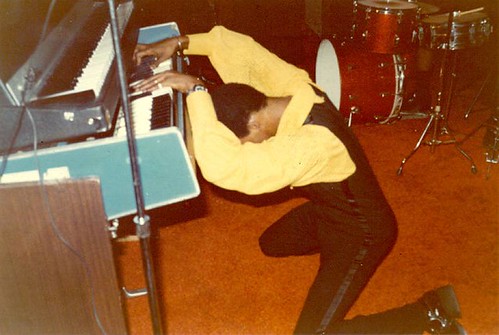
Relentlessly Optimistic pointed me to this cool site full of random pictures. I really liked the one above. I guess it was taken in 1972, and I probably would have been impressed if I'd seen it at the time, when I was four. Even then I loved rock and roll.

It's interesting how the FoundPhoto site came to be. Its founder was looking for music to steal, using Kazzaa or something like that, and he stumbled across someone's picture file. Then he looked around some more and found hundreds of picture files. I guess he could probably get into mine. Which isn't a big deal (with the exception of a few pictures taken on a clothing-optional beach in Mexico).

Reminds me how the other day I went to the monthly meeting of the Cliff Drive Corridor Management Committee (on which I serve, in case I haven't mentioned that before), and found myself looking through a bunch of random pictures of strangers. They'd all been taken by several security cameras folks at the city's parks department had set up along Cliff Drive to deter illegal dumpers and graffitiers. I havde mixed feelings about the cameras. On the one hand, they seem to deter the jerks who deface and pollute the beautiful stuff we have in our neighborhood, not the least of which is Cliff Drive. On the other, it's a troubling example of how weak and disconnected urban communities have become.

A lot of the pictures showed nothing; they'd been triggered by a breeze-blown branch, or a car passing by. There was one of a cat creeping quietly across the pavement. But the one that stuck with me was of a parked car with a man sitting in the passenger seat pointing out the opened window at the camera. His mouth was twisted mid-syllable, and I imagined he was saying to the driver, "Check it out! We're being photographed."

I paused on this photo for a while before flipping to the next. I was surprised to see that the man was still there. He appeared again on the next photo in the stack. And again, for a half dozen more pictures. The immages documented his little break in the park, as he sat in the car for a while, and then got out to stretch his legs and peer over the ledge of the overlook.

It's odd because I know from experience that these cameras talk to you whenever they snap a picture. They say something like, "Stop! You're picture has just been taken. Now enjoy your stay in the park." So this guy kept hanging around in spite of Big Brother's rude interruptions.

Funny how much we'll tolerate. But then, is there really a choice anymore? Was there ever? If so, when was it offered? Because when I downloaded LimeWire, I don't recall seeing a checkbox giving an option to make my photos private, the same way that dude on Cliff Drive wasn't told upon entering that he might be photographed.

Tuesday, August 16, 2005

cracka with attitude

Blogger's note: When I was in Louisville, I was asked to write up an essay about my connection to a rap artist or song and read it in front of a video camera. It's for an online course they'll be offering.

When I was in college, my favorite album was NWA's EFIL4ZAGGIN, and it played a key role in one of the highlights of my entire life.

I went to the University of Colorado, where I majored in film production. It was a competitive major, very competitive, and I really wanted in. My sophomore year I worked hard to put together a solid film for the panel of judges, and I got picked.

But the thrill didn't last. I got in, but I didn't fit in. The department had a strict hierarchy, and I was at the very bottom of it. Bottom line: Nobody liked me, other than my fellow bottom feeders.

I was pissed off and disillusioned, but I found solace in the new NWA album released that year. I've always liked angry music. Punk. Death metal. Hip hop. You name it. But this shit was hardcore. Side one was all about murder. And side two was all about rape and murder.
I'm a muthafuking nigga wit an attitude
I got a case of spitting in a muthafukers face
So me and my ace we got a taste
Of a muthafukers billy club he took his gun and
Put it to my head and said nigga start running
So tell me what's the next episode
Is he crazy does he want to chase me and waste me
I thought run nigga run but I caught myself
Because my secondary thought was death
i get hit hard real but still muthafuker said
I want another black muthafuker dead

I listened to it constantly, usually on my little Walkman, as I made my way around campus or Boulder. I cranked it so loud my ears would practically bleed, and I'd just leer at the world around me, which was the polar opposite of the world NWA described. Boulder is so white the KKK demonstrated there and said, basically, "Why won't you people join us? You’ve created our dream community!"

And I was white too, obviously. I was raised in all-white communities. KKK dream communities, where I had no meaningful contact with black people. Yet I identified with the words of NWA, especially while I was working on my senior thesis film, which was a horrible experience. I spent more than $2,000 on this film. Worse, my job was to act as the director, to be in charge of a crew of fellow film students who didn't like or respect me.

Well, my director of photography apparently cared so little about my project that he failed to load the camera properly, and I wound up with hundreds and hundreds of dollars worth of over exposed film. Just clear plastic. Put it in the projector, all you get is a white screen.

I was devastated. Not knowing what else to do, I just started pouring out my feelings, writing with a fine-point pen directly on the worthless film, writing each word over and over again so it could be red when projected at 24 frames per second.

Then I added a soundtrack. NWA.
Lost in the motherfucking world of madness, sadness,
But Dre is just a nigga that's glad it's
sucker motherfuckers like you making whack jams,
because it only you shows you how dope I am.
Never try to ignore us,
When I'm expressing, stand still like you're full of riggermortis.
Cause I'm a real nigga, but I guess you figure,
You could break me, take me, but watch me pull the trigger.
Dre is just a nigga with heart, a nigga that's smart,
A nigga that's paid to say what others are scared to play.
We started out with too much cargo,
So I'm glad we got rid of Benedict Arto.
Yo, N.W.A., criticized for what we say,
But I'ma do this shit anyway.
Cause I'm the motherfucking doctor, never faking,
Yo Yella, kick the motherfucking break in.

I know I said side one of this album was all about killing, but this is about art. It's about personal expression, pride in that personal expression. Fierce pride. And as a young artist, trying to develop and defend my voice, I was feeling it.

I ended my film with a little throwaway clip a classmate had taken of me storming toward the camera and giving the finger. While this angry image of me flashed on the screen, MC Ren declared "NWA takin' over this motherfucker!"

I entered it in annual student film show, which is a huge event -- a packed crowd in one of the biggest lecture halls on campus. I was nervous. The crowd sat quietly while my film rolled, my angry words mixed with those of Dr. Dre. Then the film ended, the screen went blank, and the crowd erupted in enormous applause.

That was one of the highlights of my life.

After I graduated, I stopped listening to NWA. All the violence in the lyrics got to me. It was too close to reality. Mainstream media began to catch up with NWA, and spread stories about what was going on in our nation's inner cities. Their album EFIL4ZAGGIN came out during the height of the crack epidemic, and violent crime was tearing communities to shreds. By listening to NWA, I felt like I was somehow supporting this, and I wanted no part of it.

Ironically, this was a time of change in hip hop. Artists were rapping less and less about political issues and empowerment, which was the norm when I first got into hip hop, listening to artists like Public Enemy and KRS-1. Now the norm was gangsta rap -- songs about violence, sex, drugs -- and white folks were buying it more than anyone else. It didn't feel right to me. It seemed like a macabre minstrel show.

A few years later, though, I sort of slipped, and bought a Dr. Dre disk. I couldn't resist. I heard a song on the radio and the beat was so good I just had to have it.
Yea nigga
Still fuckin wichya
Still waters run deep
Still snoop dogg and d-r-e, '99 nigga (guess who's back)
Still, still doing that shit, huh dre?

I was living in Kansas City at the time. I'd just moved here to take a job as an investigative reporter. KC was the first city I'd ever lived in with a substantial black population. And I decided to focus my investigative reporting there, to find out what was going on the east side of town, to expose politics and institutional structures that keep my new home town divided and unequal.

Now I gotta pause here to tell you how cool this job is. As an investigative reporter, I felt like a bad ass. I was just an average Joe, but I was penetrating the corridors of power -- city hall, the justice system, the state house -- with the mission of letting everyday folks know what the hell was going on. And when I succeeded, I felt so powerful and tough. It was exhilarating, and Dre's beats fueled my exhilaration. I'd listen to it in my car as I drove around the city, doing my thing, and I would get PUMPED UP.

Then I started listening to the lyrics, and I found I could relate to them. Dre was rapping about being a professional at the top of his game.
It ain't nothing but more hot shit
Another classic cd for y'all to vibe with
Whether you're cooling on a corner with your fly bitch (beyotch)
Laid back in the shack, play this track
I'm representing for the gangstas all across the world
Still (hitting them corners in them low low's girl)
I'll break your neck, damn near put your face in your lap
Niggas try to be the king but the ace is back
So if you ain't up on thangs
Dr. dre be the name still running the game

It wasn't hard for me to draw a metaphor from the music -- from "another classic CD for y’all to vibe with" to "another scorching investigative report," from "representing for the gangstas all across the world" to being a common man fighting so all my fellows can know what they have the right to know. Snoop even makes a direct reference to news: "If you ain’t up on things."

And, like my earlier college experience with NWA, this was a key turning point in my life. Earlier, I was taking a stand for my voice and my vision as an artist. Now, with Dr. Dre, I was coming into my own as a professional. Like Dre, I was "running the game."

But I'll be honest with you, it's not easy to tell these stories, especially to a video camera, not knowing who's going to hear my words and draw conclusions based on what I've said. I knoow I'm treading a thorny patch here. The music and words I've identified with in these instances liberally use a term that's inappropriate for a white guy like me to appropriate. It's like Spike Lee's Bamboozled where all these white folks start walking around in black face.

Worse, or deeper, it's like what Frantz Fanon writes about the colonizing white viewing the colonized black as a savage with the keys to some twisted notion of liberation.

But I can't escape the realness of the connection. And it reminds me of something I read recently in a book by James Cone about how Jesus was black. Now, I'm not afraid to say that I’m a believer. I try to live by the principles of Jesus's life, and I'm still struggling to understand what that means. Cone's words really shook me. He wasn't talking about physical features, the hair as fine as lamb's wool and all that. He was talking about blackness as a state of being, That the Gospels were stories about liberation and that salvation lies at the site of the struggle, among the poor and the oppressed. And in our world, in our era, in America and across the globe, the poor and oppressed have, by and large, black and brown faces. Cone argues that in order to be saved you have to die of your whiteness and be resurrected black.

In other words, in the words of my current favorite rapper Kanye West, the artist I listen to constantly as I move into the next stage of my life, as I emerge as an agent of social justice, you gotta get down.
Get up i get (down)
Get up i get (down)
We are all here for a reason on a particular path
You don't need a curriculum to know that you are part of the math
Cats think I'm delirious, but I'm so damn serious
That's why I expose my soul to the globe, the world
I'm trying to make it better for these little boys and girls
I'm not just another individual, my spirit is a part of this
That's why I get spiritual, but I get my hymns from Him
So it's not me, it's He that's lyrical
I'm not a miracle, I'm a heaven-sent instrument
My rhythmatic regimen navigates melodic notes for your soul and your mental
That's why I'm instrumental
Vibrations is what I'm into
Yeah, I need my loot by rent day
But that is not what gives me the heart of Kunte Kinte
I'm tryina give us "us free" like Cinque
I can't stop, that's why I'm hot
Determination, dedication, motivation
I'm talking to you, my many inspirations
When I say I can't, let you or self down
If I were of the highest cliff, on the highest riff
And you slipped off the side and clinched on to your life in my grip
I would never, ever let you down
And when these words are found
Let it been known that God's penmanship has been signed with a
language called love
That's why my breath is felt by the deaf
And why my words are heard and confined to the ears of the blind
I, too, dream in color and in rhyme
So I guess I'm one of a kind in a full house
Cuz whenever I open my heart, my soul, or my mouth
A touch of God reigns out

Sunday, August 14, 2005

immortal technique

One of the coolest things I came back from Louisville with is Immortal Technique's second album Revolutionary, Vol. 2. He's better than any columnist I know of:
I break it down with critical language and spiritual anguish
The Judas I hang with, the guilt of betraying Christ
You murdered and stole his religion, and painting him white
Translated in psychologically tainted philosophy
Conservative political right wing, ideology
Glued together sloppily, the blasphemy of a nation
Got my back to the wall, cause I'm facin' assassination
Guantanamo Bay, federal incarceration
How could this be, the land of the free, home of the brave?
Indigenous holocaust, and the home of the slaves
Corporate America, dancin' offbeat to the rhythm
You really think this country, never sponsored terrorism?
Human rights violations, we continue the saga
El Savador and the contras in Nicaragua
And on top of that, you still wanna take me to prison
Just cause I won't trade humanity for patriotism.

I wish more hip hop were like this. It makes me feel the way I did when I first heard Public Enemy's It Takes a Nation of Millions to Hold Us Back way back in high school. Back then, I felt I'd caught a sneak peak of a revolution. I guess it was. Hip hop went big. But it also went bling and bang bang. Not that it was all bad (the world would be duller if Dr. Dre had never dropped the Chronic albums). Still, this Immortal Technique reminds me of what hip hop could be, or could have been.

But then again, the new Kanye West album comes out on Tuesday. College Dropout was deep, and it still managed to sell. Counting the hours...

Saturday, August 13, 2005

cut 4

At issue was a tax abatement for Crown Center, an upscale shopping, office and residential center just south of downtown, adjacent to the headquarters for Hallmark, which owns the development. The center was planned in the late 1960s as a means of rejuvenating the area, which had begun to resemble a slum. The project sprawled out over the next two decades, gobbling up acres of old neighborhoods, with each phase's development buoyed by generous tax breaks. Now, in 2002, the last of these was set to expire, but city and business leaders were pushing to have them extended for another 20 years, largely because the center’s retail ventures were unsuccessful and the mall was barely able to stay open even with a reduced tax burden. The abatement would affect the school district because it depends on property tax.

One of the board members, Elma Warrick, stiffened in her seat and frowned. She said she'd been investigating the situation. She’d called a city official and felt "insulted" when the gentleman told her he hadn't spoken with anyone from the school district—indeed, he didn’t even know the proper person to contact. She complained that city leaders could care less about the needs of Kansas City's school children.

Board President Mauro shifted in his seat. He said he wanted to talk about the matter, but he that it would be unethical to do so because his son was a high ranking executive for Hallmark. But the district’s top in-house attorney told him it was OK. "I think you ought to voice your opinion," Warrick said haughtily. "Whether you are able to influence me is another question."

Mauro agreed that the abatement was a bad idea from the school district's perspective, and that they ought to fight it. But, he said, it was already to late. "One of the problems is we hear about these decisions after all of the staff work is done," he said. "And we need to be considered. It’s really at the staff level is where it all happens."

What he meant was that decisions about tax abatements and development projects are made behind the scenes, before the matter comes up for public debate. Public meetings are mere formalities. Mauro would know. He'd been president of the Downtown Council, an group of downtown business owners who pushed for more city investment in its withering commercial core. He helped spearhead a major residential and commercial redevelopment on the western edge of downtown, which was aided by tax breaks and the power of eminent domain given to a few well-connected developers and law firms.

It was all so ironic. Less than a year earlier, Mauro had recruited a slate of candidates to run for the school board because he was frustrated by the way other board members, Warrick among them, would decide matters behind the scenes. Mauro, a longtime civic leader in Kansas City, had trouble swallowing his own medicine. So he held a series of breakfast meetings and built his own majority, a "Mauro Majority," we called it in an article in the Pitch.

Now, as board president, he was saying with a straight face that this is how things work at City Hall, where white folks are in charge, and there's a whole lot more money on the line. Mauro could have spared Warrick the lecture. She knew full well how things worked in this town. Annual audits of the city's tax break system revealed a program in which developers essentially called the shots. These developers and their attorneys formed a small circle of insiders, the reports revealed, nearly all of them heavy campaign contributors. Moreover, the staff and board members who ostensibly represented taxpayers' best interest in these endeavors were typically former employees and associates of the developers and law firms that were benefiting from the program. On the other hand, the developers' attorney's were often former city council members and city staffers. The program had no policy that dictated where such benefits should be directed and which projects ought to be supported, though state law required such a policy to be in place. These investigations found that earning projections for proposed projects were almost always overblown, and that the city was losing hundreds of millions of dollars to fund them. One audit was particularly scathing. It found that the financial books at the city agency that oversees the tax breaks was woefully mismanaged. In many instances, developers were reimbursed with tax money with little or no documentation that they’d spent money. In some instances, these developers double billed or sought repayment for expenditures that were not legal under their contracts.

Not that Warrick was innocent herself. A year earlier, the federal judge overseeing the desegregation case had ordered an investigation into allegations of patronage and micromanagement by board members. Though the judge ultimately ordered that the results of the $100,000 investigation remain sealed, I learned that it had focused primarily on her. Shortly after Warrick and four of her colleagues had unseated the superintendent, Warrick began meeting with the newly installed superintendent and Gwen Grant, director of the Kansas City chapter of the Urban League. Grant and Warrick were close friends; the urban league had established a nonprofit Warrick ran, the Family Resource Center, from which she drew a $50,000 salary. At the time of these meetings, Urban League officials continued to keep the FRC's financial records. Together, Warrick and Grant pushed for the new superintendent to enact a district reform initiative, which would require an outside contractor to provide professional training to principals and teachers. Coincidentally, the Urban League was simultaneously offered a no-bid contract to offer the exact kind of training that was spelled out in the reform initiatives. As soon as the investigators' report was finished, and when board members and other parties in the desegregation case were deciding whether to allow the report to be released to the public, Warrick retained a lawyer to represent her at district expense, costs totaling $20,000. Now, just a year later, at the time of this meeting, the reform initiative had been essentially abandoned, though the Urban League had received full payment on its $160,000 contract. There were other suspicious incidents as well. For a time, Warrick's niece was employed in the district's legal department, which was run by another friend of Warrick’s, Kathy Walter-Mack. And within a few months of the patronage investigation’s conclusion and burial, another close friend of Warrick and Grant, Dianne Cleaver, former mayor Emanuel Cleaver's wife, received a no-bid contract to serve as an assistant to the superintendent. She was later hired to a permanent position after a costly candidate search which Cleaver herself and another close friend of her and Warrick (and district contractor) helped direct.

Through the window from our perch on the tenth floor I could see Crown Center in the distance. It was a cold November morning and long clouds of white steam billowed from vents on the tops of office towers. I could see the neighborhoods of the city’s east side, the shabbiness of some of the houses visible even from the distance, and the tree-lined parkways leading to Country Club Plaza the mansions of the Southwest Corridor, where Mauro lived. These sinewy patches of green perfectly bisected the city and, from where I was sitting, they were framed perfectly between Warrick and Mauro, with Warrick on the left side of the conference table, the east, and Mauro at its head, on the west. It was a perfect image of Kansas City.

kc love


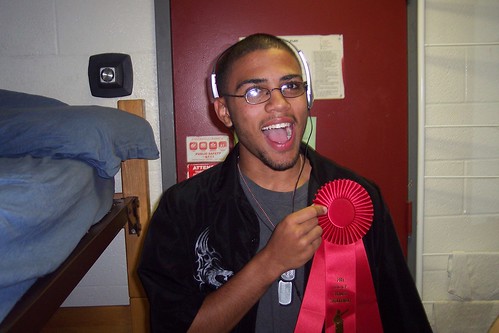
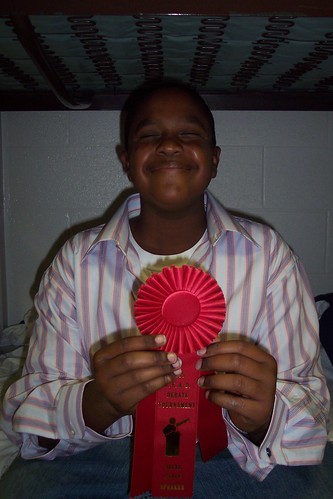
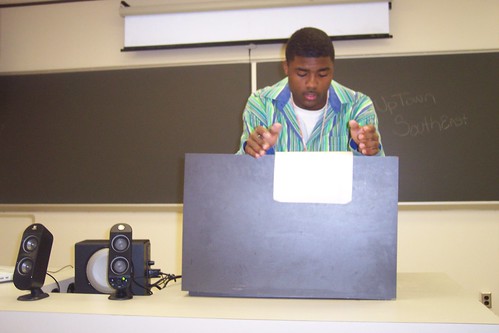
Before I do the whole we-are-the-world/group-hug thing, I have to brag on my hometown heroes. Pictured above is Leodis McCray, top speaker of the camp's first speech contest. His speech is PHENOMENAL. Maybe we'll put up an audioblog of it one of these days.


And James Riley got sixth-place speaker with his intense, evidence-heavy speech. I'm proud of James. He really knuckled down and got it done this week.


Alas. Dominique didn't win anything. (Actually, he and James took fourth in the debate contest on Thursday.)


And Ebony needs to come out the closet.

so long, campers


Well, the camp is over, the kids delivered safely home, and I'm back in my zero-gravity chair and nice house, with my woman, two dogs and four cats. What a great experience! I know the kids learned a lot, but I did too. I feel as though we're all about ready to take the game to a whole new level. This is going to be a great year!!

Here are some more pictures.

Friday, August 12, 2005

ebony rose moves on


Last night I took Ebony to a Target and we loaded up a shopping cart with all the usual college stuff -- sheets, towels, a hamper, a gigantic jug of shopping detergent. He didn't want me to pay for it, but I told him he's family to me, and when I went to college my family took me to Target and loaded up a cart for me. It felt good to return the favor.

Man, I'm gonna miss Ebony. I'm starting to feel a little misty-eyed. I'm so happy for him. He's so excited about this next stage, so ready for it. Louisville's a good place for him. The debate squad here is a family. They've had some spats here and there, like any family, but their bond is strong. And Ebony's going to fit right in. He already does.

Tuesday, August 09, 2005

more pix


More pix for you all to see. (Sorry so few words to accompany.)

Sunday, August 07, 2005

louisville camp day 3


Lot of serious energy today. The main goal was for students to find an "organic intellectual" to begin to build a case around, and to for each student to establish his or her own personal purpose in debate.

First, organic intellectuals. This comes from the writings of Antonio Gramsci, a long-dead Italian revolutionary who wrote all these radical books while he was in jail. One of his big contributions to the world was the idea that intellectuals are not just part of the Ivory Towers of The Academy, but they can also rise up from among the masses, as organic intellectuals, who are from a community with a beef (like blacks or Palestinians, for example), who speak about the issues of their people, who do so in a way that's subversive and revolutionary, and who can motivate people to come together and fight for change.

Here at Louisville, we've been focusing mostly on hip hop artists as organic intellectuals, but not entirely. One girl is using Rage Against the Machine, another dude is leaning on Bob Marley.

As for the purpose, I'll get to that in a minute.

On the organic intellectual pursuit, we went to some computer labs on campus, and surfed the web looking for lyrics, and scrutinizing them through a set of criteria established by some scholar named Nathan D. Abrams, who wrote an article called "Antonio's B-Boys: Rap, Rappers and Grramsci's Intellectuals."

Seen this way, it's amazing how deep some of these lyrics are.

Anyway, once the students had their organic intellectual figured out, and they'd written out a defense of their choice using Abrams's essay, they started figuring out what their purpose is. This is their mission, their personal political goal, something they want to see changed in the world.

For example, Aaron wants to see educational opportunites improve for inner-city kids.

Then they started putting their organic intellectual together with their mission, to begin writing the first chunk of what will become their debate speech.

Here are some pictures of day three.

Saturday, August 06, 2005

louisville camp days 1 and 2


Eigth hours of driving, 500 miles and a cheap Illinois hotel later, we wind up in Louisville, for the first day of debate camp. KC kids have met up with about 20 other kids from DC, NYC, Baltimore, Atlanta and Compton to find their voices as debaters and pick up the tools they'll need to kick ass in the coming year.

Everything's going great so far. We started off with an inspiring lecture from Dr. Ede Warner, director of the Louisville debate program. He really got the kids fired up, at least ones who came with me. Domonique said afterward that Warner said everything he wanted to say about debate but hadn't been able to say himself.

Tomorrow we're going out for brunch at the classiest brunch joint in Louisville (after the kids have an opportunity to go to church), and then we'll dive in. I'll be assisting Tiffany, along with two other adults, in teaching a group of eight or ten debaters. First step: Start writing a speech.

Friday, August 05, 2005

garden update


It hasn't been a bad garden year, but it hasn't been a great one either... mostly because of little mistakes I've made. Learning a lot, though. I suspect next year will be a lot better. Here's a mid-season photo documentary.

louisville bound

I'm off to Louisville today with a vanload of young debaters. We'll be attending their summer debate camp. Keep checking here for regular updates, photos and audioblog entries. Should be fun...

Thursday, August 04, 2005

a not-so-final final


Today I printed out the rewrite, to be shipped tomorrow. It's 40 pages lighter, and, I hope, a bit tighter. I'm pretty sure I'll have one more pass through before it's accepted and we can move into production.

I'm not sure how I feel. I'm neither elated nor anxious. A little happy, for obvious reasons, and sad, for not so obvious ones. This is a wild process. I guess the toughest thing has been the drastic mood swings. I've had some extreme highs (when the book sold, when I sent off the manuscript, when I got it back with a six-page glowing letter). Against these, the mundane drudgery of actually writing a book has felt, at times, like severe depression. Indeed, for a while after the book sold, before I really got started writing, I literally shut down. I was so bummed out I could barely move. I think (hope) things are starting to even out, and I am beginning to take it all in stride.

I've been meaning to blog about the experience of getting the manuscript back. It was quite overwhelming, but time has passed since then, and the feelings are a bit distant.

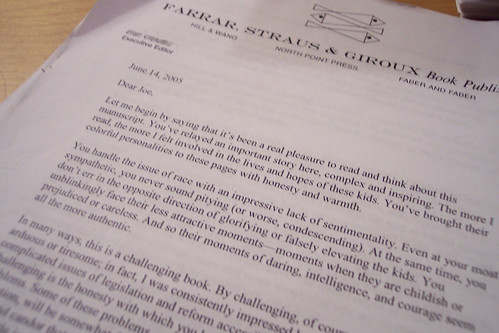
I wasn't home when the package arrived for it, so I had to go to the FedEx office to sign for it. I started tearing open the package before I even got back to my car. I started reading the letter. Three paragraphs in, I read, "In many ways, this is a challenging book. By challenging, of course, I don't mean arduous or tiresome; in fact, I was consistently impressed by your ability to make complicated issues of legislation and reform accessible to your reader. What's challenging is the honesty with which you bring to light a number of thorny racial problems. Some of these problems, such as poverty or systemic failures in public education, will be somewhat familiar to your reader (although you elaborate on them with a voice and candor that are uniquely yours). But what really distinguish CROSS-X are the more subtle issues of race and racism that you tackle -- many of them difficult precisely because they point to the complacency that accompanies privilege."

I read this and I just started sobbing. It was a culmination (not the last, I hope) of a journey that had begun about seven years earlier, when I first started toying with the idea of writing a book (actually, "toying around" doesn't quite describe it: I set a life goal of writing a book, the one thing I intended to do before I die). I was living in Colorado then and I had no real idea what I might write about, just that I wanted to create something of "length and substance" (that's actually how I described it). The goal had no financial components, no fancy publisher wish list. Just: I want to write a book, and I want it to be the best book I can write.

When I finally found a subject, three years later, and I got permission from the subjects to write about them, I had no publisher, and no guarantee that I would ever have one. All I had was a flexible job and about $7,000 left over from the sale of my house in Colorado, which I spent on the project without hesitation.

So I cried when I read that paragraph because it said, in essence, You did it! But also because it was addressed to me, and only I have lived with me my whole life, and, frankly, it's hard to believe that I could do such a thing. I'm the one lugging around the comprehensive files on all the stupid stupid shit I've done in my life (and, honestly, continue to do). Even while I was immersed in the project, even after it sold, I didn't really totally completely believe I could do it (Allie, who listened to my long, insecure sob sessions, can testify to this). And I know this is all coming off kind of arrogant and cocky, but really what I'm trying to explain here is a moment of extreme humility and gratitude, because that's what I felt in that moment, and that's why I cried (and I mean cried; like, I all-out bawled all the way down Front Street).

I felt grateful for all the folks at Central who let me into their world, to tell this amazing story they were already living (and, believe me, the telling was the easy part). And I felt deep gratitude for my experience at the Pitch, because so much of the editor's glowing letter cited aspects of my writing and reporting which were things I specifically learned on the job there. And for a host of other folks, above all Allie, who held my hand on many a freaked out night (and who edited the entire 630-page manuscript before I submitted it).

I cried because I felt very lucky, and that I didn't really deserve it. And once the initial elation wore off, I began to doubt, at times, that the editor honestly meant what he said, which is absolutely insane, I know. But such are the highs and lows, I suppose. Perhaps that's what keeps us going.

flickr


I went ahead and upgraded to a Pro account on flickr, so now I have a bunch of group sets like this one. It's fun. I like all this bloggy, live-out-loud-on-the-Internets stuff. Definitely hobby-worthy.

Wednesday, August 03, 2005

new beginning

It looks as though I am soon to be a full-fledged debate coach. Today I met with the folks at De La Salle Education Center here in KC, and we shook hands on plans to start things up there in late September.

I'm excited and a little nervous. It's the getting started part that has me nervous, getting kids interested and encouraging them to stay with it.

But I guess it's just one step at a time. I have a hunch this'll work out.

Tuesday, August 02, 2005

sewage

I voted today, mostly to honor those who've died and been beaten for the right to vote. At issue was a half billion in bonds to fix the city's water and sewer systems. It was a tough decision. I actually stood there, staring at the ballot, not knowing what to do.

The choice as I saw it:

1. Vote yes, and get much needed infrastructure improvements... and higher water bills, which have been pretty damn high lately.

2. Vote no, and punish the city for wasting money on all kinds of crap and letting our deferred maintenance bill mushroom to $1.5 billion.

I went with choice #1, and winced.

Monday, August 01, 2005

eulogy

It's odd, but I actually feel a bit of grief over the death of the Nate character on Six Feet Under, which really means I'm grieving over the end of the show, which was very, very good. I'm not ashamed to say that I think the show was a work of art, certainly a defining portrait of our time, and I'm grateful to have had the opportunity to watch it.

For one, it just might be the definitive movie/TV show about life in Los Angeles, at least middle-class life, and for that reason alone it's a significant work. Though LA plays a huge role in the defining of America, both as a producer of so much media and as a massive consumer market, New York tends to be America's fantasy city of choice, a character in its own right. Too often, LA is just a set. But if you've ever visited the place, and I've really only been there once, you get a sense of not only how important it is, but also how unique, indeed, downright strange -- as if its story conveys a theme no other story can, at least not as poignantly. LA is like something out of Sci Fi, or the book of Revelations, which has been edited down to near normalcy. New York might be the tip of the American knife, but LA is its long, decorative, razor-sharp blade.

The ocean played a huge, if sporadic role in the series, and that's partly why the LA setting was key. We were led to believe in an earlier episode, for instance, that the ocean had swallowed up Nate's first wife, Lisa, at a moment when she'd finally found some peace. Later Nate and Brenda were married on the shore, while she carried a dead fetus in her womb. And in Nate's death sequence was where he wound up, running into the waves, yelling over his shoulder, "Come on! This is what we came for!!"

As a fledgling story teller myself, I can't help but think, How perfect! The closeness between life (and by life I mean life at its most alive: elation, ecstasy) and death is a time-honored device of art, one that'll never be worn out because it's so true. And to me that's what LA is: this place on the edge where the fire burns a bit brighter and hotter than anywhere else. It's the spot where those with the most acute cases of wanderlust stopped, because they had to stop, and infected the gene pool with their dangerously curious spirits. The ocean. Life and death rolling, one over the other, again and again, endlessly.

Of course, the Fisher's funeral home, which Nate couldn't succeed in escaping, was a bigger, more obvious thematic backdrop -- and recurring character, what with each episode beginning with a different, unexpected death. These little stories, and the morbid setting, tempered the intensity of life in all the main characters' storylines, grounded them in reality. And isn't this what America is: plain, old mortality wrapped in an illusion of self importance and invincibility?

In this setting, with such real characters, and in the hands of sophisticated writers, actors and directors, Six Feet Under became, in my mind, a true American masterpiece, and I'm really going to miss it.

Wednesday, July 27, 2005

one more sojuorn


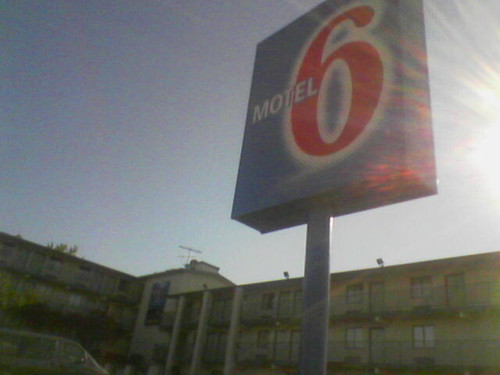
I'm rounding into the final stretch of my rewrite. Surprisingly, the editor didn't have a whole lot of changes he wanted me to make. But there were a couple of major turning points in the narrative that he wanted me to bear down and nail. For the past few weeks, I've been putting off this challenge. I just couldn't seem to get my brain going, and I stuck to more nechanical line editing. So to trick myself into productivity, I took yet another sojourn, this time to the Motel 6 pictured above.

This place is on 87th just off I-435, not ten minutes from my house. But it was far enough away, and austere enough to do the trick. All I needed was one day, a night, and the better part of a morning. The rain was especially helpful, coming right when I was writing the thematic climax of the book, easily the most difficult-to-write four paragraphs in the whole thing -- it poured so hard, I couldn't even go for a walk; I had to just sit there with my thoughts until I figured it all out.


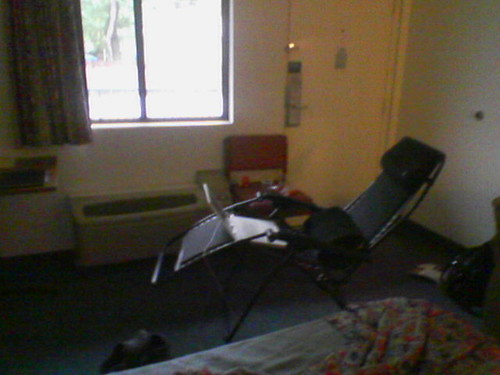
My cubicle.


My work station.


The view from the break room.

Writing is a strange occupation. A lot of times it feels like not working. That's because a lot of times -- hell, most of the time -- it is not working.

And part of me is ashamed of this. I'm not a gold brick, I've put in a few days of hard, physical labor. And I've been hustling to advance my career ever since I got out of college. But now I'm living this two-to-four-hour-work-day writer's life, and I feel torn, like I'm a lucky bastard and a total cheater all rolled into one.

But then, the time not working really is a lot of work. I saw Joyce Carol Oates speak once, and she explained the feeling of being a writer as like having a vice clamped on you head every waking moment. You never really stop thinking about your project until it's done and the editor deems it good.

And it's simply impossible to write eight hours a day. At least it is for me, and just about every writer I've heard talk about writing. If I were to compare it to some of the jobs I've had, like, say, carpet laying, it would be like having all your muscles just suddenly shut down after several hours of exertion. Or if you were dishwasher, and, midway through the shift, every effort you made actually got the dishes dirtier.

So I garden, and help coach debate. Just so's I'm not a totally lazy fool.

Sunday, July 24, 2005

early this morning

I wish I had looked at the clock, because I can't recall the exact time. I'm guessing it was about 3 in the morning. I was having a nightmare of sorts. All I remember was the image of my neighbor (a dream neighbor, who bore no resemblence to my real neighbors) about to bludgen me to death with a two-by-four.

I jolted awake to escape this fate and, in less than a second, I heard six gun shots in the not-so-distant distance -- I'd say half a block south.

I got up and called 911 and got a machine: Do not hang up! Please hold...

While on hold, I heard tires screach from generally the same direction and distance as the shots.

Twenty, maybe thrity seconds later the operator came on and I told her about the shots. She said she'd gotten other calls from the vacinity.

I peaked out the windows a few times, trying to get a glimpse of some excitement, but I saw none, so I went to bed.

This is the second time I've heard shots in the middle of the night in my neighborhood. The first was a week after we moved in.

In neither instance did I feel scared.

Now I'm sitting out on my front porch and the birds are singing and it's the same safe, quiet neighborhood it's always been.

It all makes me think about my profession. How many times have we read an article about the inner-city where they used the phrase "shots rang out in the night," or some variation thereof? I know for a fact that I have in at least one article. I've definitely lingered for a while on details of shootings to set the scene for whatever urban tale I'm telling.

And there's nothing wrong with that. Periodic shootings are somewhat peculiar to poorer, urban neighborhoods, and reporters, who hail primarily from neighborhoods where shootings are very, very rare, tend to zero in on them.

The problem (or should I say "challenge?") is how do you point out this peculiar aspect without making the shootings out to be more than they are: noisy flair-ups from folks living dangerous lives, incidents that tend to hurt the risk-takers, not the majority of the folks in the neighborhood, for whom it's basically a safe place most of the time? Too often, the details aboout the shootings make it seem like neighborhoods like mine are all about shooting. Like we're just ducking bullets left and right.

I wish there were an easy way to put things into perspective. So-called 'hoods are safe places. It's the city, so you shouldn't just go walking around after dark. But the real dangers aren't the guys with the guns, not for honest, clean-living folks anyway. Like, I have less of a chance of getting hit by an errant bullet near my home than I do getting hit by a drunk driver on I-35 in JoCo.

Saturday, July 23, 2005

art

Creativity is more than just being different. Anybody can play weird--that's easy. What's hard is to be as simple as Bach. Making the simple complicated is commonplace--making the complicated simple, awesomely simple--that's creativity. -- Charles Mingus

Thursday, July 21, 2005

christmas in july

Forget about carbon. The most essential element of life is the paradox. That's true for everything, including gardening.

July is the time to prepare the winter garden. Which means hard, physical labor -- shoveling, hauling, garden weeseling.

Problem is, it's July.

All the radio stations say it was 94 today, with a heat index of 102. But my car thermostat sez it was 100, with a heat index of God knows what. I'm going with the latter, because it's freaking hot.

So garden prep must take place in the wee morning hours. I got to it at 6 this morning, and by 8:30 I was sweating so hard my feet were slipping around in my Crocs.

All this for a December harvest of spinach.

Oh, the irony.

Sunday, July 17, 2005

breakfast

I'm not sure if can call this an official end to my fast, or just a midnight snack, but I've decided to add a couple of news sources to my meager media survival gruel.

First, there's a couple of new blogs in my regular rotation:

dangerblog
and
relentlessly optimistic (nice title, isn't it?)

But those don't really count, because what I'm really trying to get away from is the onslaught of info that comes from folks who make money onslaughting us with it.

So it's with some embarrassment and regret that I must admit here that I've been lured into relapse by the good folks at NPR and PRI and KCUR. And the simple reason is this: It's good stuff to listen to when I'm chopping vegetables.

Moreover, I'm beginning to develop a bit of a routine on Sunday nights, listening to KC Currents and then the documentary that follows as I prepare salads and such for the coming week.

So I'm not even sure it's still accurate to say I'm on a news fast anymore. Moreover, I'm not sure this is going to end at Labor Day weekend. What I think is happening is I'm becoming more choosy about what I let into my brain. There's so damn much media out there, so much info, so much noise, that I think it might well be a matter of survival to severely limit its flow.

When I was following a bunch of news sites and blogs everyday, two things happened. At best, all the info started to sound the same and it lacked meaning. At worst, it depressed the hell out of me, or made me angry.

It's interesting now to look at my list of media sources, how the overwhelming majority are blogs by neighborly folks. This is a good thing, I think. It's sort of like going back in time, when news-sharing was more of a community event. I think of the folks who write the blogs I read as friends, even those I've never met, so I trust them, and I appreciate the way they spin the news for me. I know it's not spin for the sake of some other motive, such as profit, or -- as is often the case at news organizations -- for the sake of better access down the road.

But even more than that, I like the way blogs mix the personal with the political. In blogs, so-called mundane human events get just as much if not more ink than so-called newsmaking events. I find comfort in this.

And then there's radio, which has made its way back into the mix.

For one, I have to be honest, I've recently made friends with some of the folks at KCUR, so there's a bloggy quality to my following their work. But there's also the convenience of it. I can do other stuff while I get informed.

And that, my dear friends, is why I think Bush's cronies are going after NPR. It's got real mass appeal, but it's not as easily spun as the Today Show -- lies don't resonate for as long on Morning Edition as they do on Good Morning America. So, naturally, they want to shut it down.

How's that for a rambling post? Kind of reminds me of a scene from an old W.C. Fields movie:
Reporter: Professor, what's your opinion of Dr. Chang's invention?

Professor: Worthless!

Reporter: The invention?!

Professor: My opinion.

Wednesday, July 13, 2005

progress


The tomatoes are starting to rock out.

(And for those of you in the know: Things are going well with Bob. Got a good report today.

Tuesday, July 12, 2005

subversive tv

I've been hanging out on memory lane. My babysitters growing up were syndicated TV sitcoms, and lately I've been watching them again.

I've often thought that Norman Lear had a lot to do with racism going into hiding. Specifically, Archie Bunker made being an outspoken bigot undesirable. Like, he was a fat, ugly idiot. You might love him, in a comedy sort of way, but you sure don't want to be him.

From the Museum of Broadcast Communications:
All In The Family first aired on 12 January 1971. Wood commented in a 1979 interview that CBS had added several extra phone operators to handle an expected flood of reactions. They never came.

All in the Family's impact went beyond the world of television. The show became the focus of a heated national debate on whether the use of comedy was an appropriate means by which to combat prejudice and social inequality.

Over its early life there were a continuous flow of letters objected to language and themes and challenging Lear for his "liberal" views. Looking back in 1979 Lear remarked that he responded to such criticism by stating, "I'm not trying to say anything. I am entertaining the viewers. Is it funny? That was the question." Later, when attacks on the show asked how he dared to express his views he altered his response. "Why wouldn't I have ideas and thoughts and why wouldn't my work reflect those ideas?" And of course they did.

I can't find All in the Family on Netflix (though the library has it). So I've been watching a spin-off of a spin-off of the show: Good Times. I became interested in the show again when Janet Jackson hosted Saturday Night Live a few months back. They did a hilarious Good Times spoof, where one wretched thing after another happens to the family, to the howls of the studio audience.

So far I've gotten through the first disk of the first season, and I find it to be quite touching and profound. My favorite episode is "Black Jesus," in which Michael, the young radical in the family, hangs a painting JJ did of a neighborhood wino posing as the Savior. As soon as the picture goes up, the family starts getting lucky with "the long green" coming in left and right, much to mama Flo's chagrine. And the episode where Michael gets suspended for calling George Washington a racist. There are great subversive moments, like when Flo gets turned down for welfare and jokes that the rich look down on welfare but welcome "subsidies," and when dad James loses a job opportunity because "government rules can't be broken -- unless your the government." Everyone talks so openly and naturally about race.

I guess it didn't last, though. According to the broadcast museum's site:
Good Times is also significant for many layers of controversy and criticism that haunted its production. Both stars, Rolle and Amos, walked away and returned as they became embroiled in various disputes surrounding the program's direction. A major point of disagreement was the J.J. character, who metamorphosed into a coon-stereotype reminiscent of early American film. His undignified antics raised the ire of the Black community. With his toothy grin, ridiculous strut and bug-eyed buffoonery, J.J. became a featured character with his trademark exclamation, "DY-NO-MITE!" J.J. lied, stole, and was barely literate. More and more episodes were centered around his exploits. Forgotten were Michael's scholastic success, James' search for a job and anything resembling family values.

No doubt JJ was big when I was a kid. I think I even had a DY-NO-MITE T-shirt.

Still, I can't deny that these early shows had a positive impact on me. I don't know if Good Times broke down stereotypes, but it did humanize -- and not in a pitying way. And it had a strong moral core, certainly stronger than Gilligan's Island or Seinfeld.

But what really gets me wistful is the theme song, really any theme song from the great Norman-Lear era of TV. I still find comfort in them, their familiarity, their assurance that for the next 30 minutes I'll be safely transfixed by a good story.

cut 3

Marcus dragged his feet down the halls of Shawnee Mission South. The corridors went on and on, turning abruptly every fifty yards or so to pass through handsome add-ons built over the years to accommodate the growing population. The school opened in 1969, amid new subdivisions twelve miles southwest of downtown Kansas City, near where construction crews were then laying out the first stretch of the metro area's outer beltway, I-435. That was the first year the Kansas City school district became majority black, and from day one Shawnee Mission South was an anti-Central, a white yang to the black school’s yin, as it had remained through fall 2002, when Marcus roamed its halls like a sleep-deprived zombie. Actually, Central didn't get good enough grades to be the polar opposite of Shawnee Mission South, where the drop out rate was a mere two percent and more than half the students tested at "advanced" or "exemplary" levels in reading, math, science and social studies. Still, the contrasting schools were a perfect symbol of Kansas City’s fractured community.

Whenever folks from Kansas City call national radio talk shows, the hosts almost always refer to them as being from Kansas, which annoys Missouri-side Kansas Citians to no end. Everything that makes Kansas City Kansas City, they believe, is in the Show-Me State. The Kauffman and Arrowhead stadiums, where the Royals and Chiefs play, are on the city’s far east side, where the countryside begins rippling southeastward toward the Ozarks. The towers of Kansas City's skyline house Missouri-based corporations. Gates Barbecue and Arthur Bryant’s, which Calvin Trillin once declared 'the single best restaurant in the world,' both serve the city’s trademark beef sandwiches in knolls south of the Missouri River, not on the prairie west of where the river turns north. When Jimmy Witherspoon sang "Goin' to Kansas City," he was headed for a row of night clubs a couple miles east of the state line. But if the radio hosts are thinking in terms of demographics, they’re right: Kansas City is in Kansas. The bulk of the metro area's wealth and power is concentrated around Shawnee Mission South and the other turbo-charged high schools in Johnson County.

A few miles to the west of Shawnee Mission South, the Johnson County Museum History tells the story of how this came to be in a permanent exhibit called 'Seeking the Good Life.' There, a short video greets visitors, which begins with a quick nod to some early settlers, the Shawnee Indians, who were banished from Ohio and made to live in the area’s dry prairie. Then the missionaries come in the 1820s to tame the savages who, by the Turn-of-the-Century, would be pushed away again to Oklahoma. The county was a farm community until the Roaring Twenties, when wealthy Kansas Citians moved southwestward to, as the video says, "escape the filth of the city." The earliest of these escapees moved into homes built by J. C. Nichols, the nation’s pioneer of suburban, self-contained community development. In 1905 he began work on the Country Club Plaza, the United States' first shopping mall, and its surrounding neighborhoods of homes fashioned in the classic hard-wood-and-stucco style of old Europe. The district, located on the Missouri side, remains Kansas City's top tourist attraction, with its stately storefronts adorned with hand-made tiles imported from Spain. Dozens of statues and fountains line the sidewalks that lead shoppers to Saks Fifth Avenue, Armani Exchange and the Plaza III Steakhouse. For the shaded residential blocks around the Plaza, Nichols sought "an element of people who desired a better way of life, a nicer place to live and would be willing to work in order to keep it better." To realize this vision, Nichols mastered the art of the "restrictive deed," which was created in Boston in the 1840s to keep blacks and immigrants out of the Louisburg Square neighborhood on the city’s elite Beacon Hill. When he sold his new homes, Nichols made buyers sign a contract promising to not sell to blacks or Jews. His mastery of this practice came in the clauses he added to the contracts, which perpetually renewed the restrictions every ten or fifteen years unless a majority of the community's home owners voted to let them expire, which, of course, never happened.

By the 1920s, his empire was beginning to spread across Stateline Road, into a wooded area he called Mission Hills, which he set out to shape into "the most distinguished of American garden suburbs." The Country Club District, which is still revered as one of the greatest developments in American history and today serves as a model for "new urbanism," was a mere appetizer for Nichols’s ostentatious feast just west of the border. Among shaded knolls and streams, Nichols built scores of mansions and an exclusive golf and tennis club. The area is remains home for Kansas City’s high society, people like Royals legend George Brett, diamond tycoons Barnett and Shirley Helzberg (who moved in a while after the Supreme Court shot down restrictive deeds in 1948), the Halls and Hockadays of Hallmark Cards and Julia Irene Kauffman, daughter of Ewing Marion Kauffman, namesake for the place where the Royals play and for one of wealthiest charitable foundations in America (no philanthropic slouch herself, Julia put up tens of millions for a new performing arts center in downtown Kansas City). The median income there is just shy of $200,000. The median cost of a house is over half a million. In 2000 Census officials counted just three blacks among its 3,600 residents.

Johnson County really began taking shape, though, after World War II, when middle class families took advantage of long-term, low-interest FHA loans to claim their piece of "the good life." During 1950s, the county’s population doubled to 60,000. And by the end of the 1960s, when Shawnee Mission South opened its doors, it had doubled again. With new skyscrapers just south of I-435 from Shawnee Mission West, the area had become an "edge city," having lured some of the metro area’s corporate giants, such as Black and Veatch and Sprint Telecommunications, to set up shop in the Sunflower State.

Meantime, the Kansas City School District withered. In 1969, when Shawnee Mission South opened, the urban district boasted 75,000 students. By the time Marcus reached his senior year, his district had dwindled to 27,500 and was still shrinking. With close to 30,000 students, Shawnee Mission had taken its place as the largest district in the metro area. It also ranked among the best, with test scores at its five high schools well above the state average and loads of AP classes to choose from. Unlike Kansas City, where voters hadn’t approved a school bond since 1969, residents in the Shawnee Mission School District were so eager to fund their schools they frequently persuaded their mostly Republican state representatives to draft laws that would allow them to raise their own taxes beyond state limits. And Marcus could see the results of these political actions as he aimlessly navigated the sprawling school, past the pastel-colored tiles of the late 1960s that gave way to the glass, cinder block and steel of the 1980s and, finally, to the brick and blonde-wood trim of the 1990s. Not that he noticed. To him it was just another clean, colorful school for white kids. A place where segregation had shifted from overt evil to the simple nature of things. Marcus looked around and saw a place frozen in time, not so much because of its obvious counterpoint to integration, but because of the kind of debate they did here. Here, debaters argued the way their grandparents would have in the years before Brown vs. the Board of Education, a time when, if Marcus had been a teenager then, he sure as well wouldn’t be debating. Not because he because Jim Crow wouldn’t have let him, but because he wouldn’t have wanted to. He’d just as soon watch asphalt decay as debate the way these suburban kiss-asses did.

Sunday, July 10, 2005

payday

Now I can buy that loaf of bread I've had my eye on.

Based on my calculations, I ran out of money on May 1. And my payment finally arrived on Friday, July 8. In that 10-week period, my income was, to the best of my recollection:

Hedge clipping Job: $150
Garage Sale $50
Birthday Money: $75
Old Records Sold: $6
Old Books Sold: $42
Schwinn Cruiser 6-Speed Sold: $75
Johnny Horton Boxed Set Sold: $54.95

Total: $452.95

No. That's not all I lived on. I leaned pretty heavily on my Sugar Mama. But still. I was broke-ass broke. On the afternoon when the money finally showed up in my account, I was looking under couch cushions for spare change to buy pasta. Seriously. I was.

Now here's the weird part. I had everything I needed. I didn't really even need to scrounge for pasta money -- there was plenty of food around, I just wanted pasta. In truth, I probably would have gotten along just fine with a third of that figure listed above. Indeed, every time one of those piddly amounts came in, I raced out to spend it. And that's what's weird. I felt like an addict. Like I just had to spend.

Like when that birthday money came in, I headed over to Habitat Restore and bought a bunch of wood I still haven't used (plan to, though). And when I sold the books, I wasted about an eighth of it on Arby's, when I had plenty to eat at home. I bought something dumb at a thrift store too, I can't remember what. (To be fair, a lot of that $452.95 went into the garden which isn't a total waste.)

So then the big eagle finally lands and Good Lord! I wanna go on a shopping spree. And I have, sort of, though I'm being really careful. Allie and I are having regular financial planning meetings to keep on our frugal course while we transition into the next career phase.

Just makes you think about capitalism, I guess. I told Ebony all this and he nodded knowingly. He told me that Ivan Illich says I was programmed to be a spending addict in grade school.

"That's why we need to de-school society," Ebony said.

Sounds good to me.

Thursday, July 07, 2005

cut 2

Lisa was classified by school administrators as a “gifted” and “at risk” kid. At their urging, she joined Upward Bound, a program aimed at preparing low-income, inner-city kids for college. Like Lisa, the other kids in the program had gotten high test scores, but were earning poor grades in school. They met once a week, and every summer they went to the University of Kansas for six weeks, staying at dorms and taking small-college-style classes, which would be counted for credit at college, to which admission was guaranteed upon completion of the program. They took field trips and watched movies. The program’s director was from Venezuela. “She would tell us about black people being everywhere in the world,” Lisa recalled. “She said, ‘Stop thinking of yourself as the only black people in the world. As minorities. You might be minorities in this country, but most of the world is brown.’”

Lisa finished the program successfully, but she never made it to the university. “The program reached me, and it was great at that time,” Lisa told me. “But when I got home that lackadaisical attitude kinda stuck with me.” When it came time to enroll at KU, she took the paperwork for financial aid to her father, but he didn’t want his business exposed to some new bureaucracy, so she decided to try to go through the process of establishing her independence and try again in a year. Then she got pregnant with Antoine, and that was the end of that.

cut 1

He longed to travel, like his mother did when she was young. When Lisa was ten years old, she traveled with grandmother and her aunt on a summer-long train trip, from Kansas City to Detroit and Canada to San Diego and Mexico, then back home. They rode first class, because her aunt “wasn’t gonna ride no coach,” sleeping in bunk beds and eating breakfast every morning in the restaurant car. Lisa would spend hours just staring out the window, watching the world gradually change as they moved along, from farmland to prairie to mountains to desert, marveling at how the sunset looked different in each new place. She saw, for the first and only time in her life, a hang glider, gently floating across a valley they were passing through. In California, she went to Disneyland, and crossed over into Tijuana, where she bought earrings and a set of maracas. For a week she called herself Rosa, and danced around the house shaking the things incessantly, driving the grown-ups nuts. Her uncle took her fishing in the ocean. He was light skinned, a bit snooty. He liked to say, a bit too often for Lisa’s taste, “We are the particular negroes.” His family had peach and lemon trees growing in their backyard. She ate bananas every day. Now whenever she peels one, she thinks of California. For a long time one of her prized possessions was a picture of her grandmother from that trip. In it, she wore a pink sleeveless blouse, loud 1970s polyester pants and a great big straw hat, standing in front of a pier that stretched out into a perfectly small cove.

She misplaced the photo when she and Jay and the kids moved to their current house, and she still ached at the loss. All through her adolescent the picture had hinted at a life she hoped to one day lead, free, worldly, and, at very least, far from the doldrums of a Midwestern ‘hood. “I knew there was something better out there,” she told me. “I was young, but I knew all this around here is the same, even though I hadn’t experienced it yet. Shit, I know the hell out of it now. And I don’t care about what I don’t know.”

Wednesday, July 06, 2005

crony

On Sunday, I was confined to my bed with the pain of a bruised rib. Allie came up and dropped a copy of the Star on the bed beside me, thus breaking, for a moment, my news fast. Top story: Waris pleads guilty to lying to FBI.

I skimmed the piece, and the sidebar, after which I was quite pleased, not so much because Jackson County appears to be headed for a much needed house cleaning, but because the Star finally used the word "patronage" in an article about a white guy. (For now I'll ignore the fact that this comes only after an indictment and admitted guilt of a felony.)

A few tidbits about Waris that have been missing from the coverage:

When he was Jackson County Executive in the early 1990s, he made a big show of not collecting the tax increase Federal Judge Clark ordered as part of the Kansas City desegregation case.

In case you don't remember, the school district had been unable to pass a bond levy since 1969, the last year the school district's student population was majority white. To end segregation, Clark ordered a costly magnet-school plan, which the district couldn't afford. After a bond initiative failed yet another time, Clark ordered a tax increase himself. The matter made it all the way to the Supreme Court, which ruled that Clark had no Constitutional right to raise taxes. But he could order the school district to do so, they decided.

Of course the whole ordeal raised quite a ruckus. Folks got all pissy, and the national press decended, and Waris saw his moment to step into the spotlight and play the spoiler. Which, obviously, he couldn't really do. The Supreme Court had made its decision; the tax had to be collected.

But here's the punchline: A little over ten years later, Waris winds up with a fat lobbying contract with the district.

He's one of several folks who've been publically critical of the district's financial business who also wound up sucking a few checks out of the public-school tit.

Worse, I don't have a sense Waris did much of a good job as a lobbyist for the district. This is based on a pretty narrow focus, admittedly.

In spring 2001, I wrote an article for the Pitch about how the state high school activities association wouldn't allow the Central High debate squad compete at a very prestigious tournament. The story generated a bit of buzz. KC school board members met to discuss ways to fight the decision, and several state legislators wrote a letter to the association's executive director.

Well, while Waris was supposedly looking out for the district's best interest in Jefferson City, a bill came up which would have dealt directly with the problem. It came from a representative from the St. Louis area. But apparently Waris had no clue of the board members' and the legislators' desires, because the bill came up and tanked in committee before any of Waris's clients knew anything about it. (I was the one who wound up telling them about it, after the fact.)

Our tax dollars at work, I suppose. Certainly another example of why Democrats aren't necessarily the saviors.

Sunday, July 03, 2005

pain

I'm a hurtin' unit. The doctor -- and everything I've read -- tells me this'll take 4 to 6 weeks to heal. It's just a bruise, but it's the worst pain I've felt in years.

Saturday, July 02, 2005

exxxtreme gardening

Two years of serious gardening, two trips to the emergency room.

Last year it was me muscling a massive hunk of concrete out of the ground and somehow slipping and puncturing my ankle with a rusty wire.

This year:
Emergency Room Nurse: So what happened?

eXXXtreme Gardener: I tripped over a hammock.

ERN: Ah. Those hard summer days.

EG (thinking): Damn right, be-yotch!

Actually, I was carrying fertilizer. No. Not one of those 40-pound bags. Two quart-sized bottles. But still. My hands were full and I didn't quite lift my leg high enough to clear the hammock. Thought maybe I broke my ribs. (Just bruised.)

No, I didn't even think of going around it. Sheesh! What kind of pussy do you think I am?

But seriously. Has anyone ever died from gardening?

Friday, July 01, 2005

why i lean lean left

It's odd, but I actually feel a bit of grief over the death of the Nate character on Six Feet Under, which really means I'm grieving over the end of the show, which was very, very good. I'm not ashamed to say that I think the show was a work of art, certainly a defining portrait of our time, and I'm grateful to have had the opportunity to watch it.

For one, it just might be the definitive movie/TV show about life in Los Angeles, at least middle-class life, and for that reason alone it's a significant work. Though LA plays a huge role in the defining of America, both as a producer of so much media and as a massive consumer market, New York tends to be America's fantasy city of choice, a character in its own right. Too often, LA is just a set. But if you've ever visited the place, and I've really only been there once, you get a sense of not only how important it is, but also how unique, indeed, downright strange -- as if its story conveys a theme no other story can, at least not as poignantly. LA is like something out of Sci Fi, or the book of Revelations, which has been edited down to near normalcy. New York might be the tip of the American knife, but LA is its long, decorative, razor-sharp blade.

The ocean played a huge, if sporadic role in the series, and that's partly why the LA setting was key. We were led to believe in an earlier episode, for instance, that the ocean had swallowed up Nate's first wife, Lisa, at a moment when she'd finally found some peace. Later Nate and Brenda were married on the shore, while she carried a dead fetus in her womb. And in Nate's death sequence was where he wound up, running into the waves, yelling over his shoulder, "Come on! This is what we came for!!"

As a fledgling story teller myself, I can't help but think, How perfect! The closeness between life (and by life I mean life at its most alive: elation, ecstasy) and death is a time-honored device of art, one that'll never be worn out because it's so true. And to me that's what LA is: this place on the edge where the fire burns a bit brighter and hotter than anywhere else. It's the spot where those with the most acute cases of wanderlust stopped, because they had to stop, and infected the gene pool with their dangerously curious spirits. The ocean. Life and death rolling, one over the other, again and again, endlessly.

Of course, the Fisher's funeral home, which Nate couldn't succeed in escaping, was a bigger, more obvious thematic backdrop -- and recurring character, what with each episode beginning with a different, unexpected death. These little stories, and the morbid setting, tempered the intensity of life in all the main characters' storylines, grounded them in reality. And isn't this what America is: plain, old mortality wrapped in an illusion of self importance and invincibility?

In this setting, with such real characters, and in the hands of sophisticated writers, actors and directors, Six Feet Under became, in my mind, a true American masterpiece, and I'm really going to miss it.