A friend of ours came back from a business trip and told us that Omaha rocks. It's got a lively downtown, a developed waterfront and a refreshing sense of community.
All this despite the fact that the city has no major league sports teams.
I'm going to vote no on this referendum to raise taxes to spend half a billion on stadium improvements, and I'm going to cross my fingers and hope that the cheifs and the Royals pack up and leave. KC will be a much better place.
Here's some more righteous grassroots propaganda.
For once in our lives we've got to tell these corrupt, clubby Democrats to stop raising our taxes every freakin' April for their "Big Visions" that don't fit in with what Kansas City obviously wants to be.
Sure, folks want to go to Chiefs games. And they're willing to pay out the nose to do it. Seems like a viable business to me. How 'bout these business owners bo what business folks do: Make an investment to earn some more.
Yeah, we've got this downtown arena coming. Not much we can do about that. Stiill, the fact is that Kansas Citians don't want to go downtown. We want the sidewalks around our houses to be smooth, the roads pothole free. We want our backyards to not flood and our sewers to not leak stench into the summer air.
Sure, let's give incentives to economic development. But lets put them in distressed areas that the market is actually interested in embracing. Not sure-bet places like Zona Rosa up north of the river, but areas that are a little riskier, like the St. John corridor, Troost from 31st to Cleaver II, yet still potentially viable. I'm talkin' micro loans for mom and pops that want to offer good products and services near the places where we live. Not major condo developments. Just a little fertilizer to enhance what'll grow organically.
Our so-called leaders are so freakin' stupid and arrogant.
Half a billion would make a pretty good dent in our $1.5 billion worth of unfinished infrastructure chores.
But our Democratic leaders want to give us bread and circuses. And give boatloads of unearned cash to people who are already filthy rich.
VOTE NO!
Wednesday, March 22, 2006

Tuesday, March 21, 2006

Saturday, March 18, 2006

Mad About Bubba
We awoke last night to shouts and screams. I went to the window and saw a crowd of people gathered in front of the house across the street. I asked Allie what time it was. 2 AM.
I lingered at the window for a while and watched. The crowd started to roil at the edges like a pot of water on a stove.
"Allie, come check this out," I said. "They're fighting."
Allie put on her glasses and came to the window.
I had to pee so I took a break from the action. When I came back, Allie had the window open.
"Apparently, Gina's mad about Bubba," she told me.
"How do you know?" I asked.
"Because they shouted, 'Gina, you're drunk, and you're mad about Bubba.'"
She added, "And she kept shouting, 'I wouldn't fuck a white bitch!'"
Allie said she's happy we have them as neighbors.
I lingered at the window for a while and watched. The crowd started to roil at the edges like a pot of water on a stove.
"Allie, come check this out," I said. "They're fighting."
Allie put on her glasses and came to the window.
I had to pee so I took a break from the action. When I came back, Allie had the window open.
"Apparently, Gina's mad about Bubba," she told me.
"How do you know?" I asked.
"Because they shouted, 'Gina, you're drunk, and you're mad about Bubba.'"
She added, "And she kept shouting, 'I wouldn't fuck a white bitch!'"
Allie said she's happy we have them as neighbors.
Friday, March 17, 2006
Hyper-ghetto/Prison
A few weeks ago I came across a fascinating essay by Berkeley sociology professor Loïc Wacquant. It was a real moment of clarity. The main point of the essay is summed up in these three paragraphs:
But where the essay really changed my understanding of the world was in the passages about the production of race:
I'd heard the argument that race isn't real before, of course, but I'd never believed it. Now I understand.
Wacquant is expanding this essay into a book, which will be released later this year (cover art by Jean Michel Basquiat -- cool!).
The task of defining, confining, and controlling African Americans in the United States has been successively shouldered by four "peculiar institutions": slavery, the Jim Crow system, the urban ghetto, and the organizational compound formed by the vestiges of the ghetto and the expanding carceral system. The first three served, each in its own way, both to extract labor from African Americans and to demarcate and ultimately seclude them so that they would not "contaminate" the surrounding white society that viewed them as irrevocably inferior and vile.
These two goals of labor extraction and social seclusion are in tension: extracting a group's labor requires regular intercourse with its members, which may blur the line separating "us" from "them." Conversely, social isolation can make efficient labor extraction more difficult. When the tension between exploitation and exclusion mounts to the point where it threatens to undermine either of them, the institution is re-stabilized through physical violence: the customary use of the lash and ferocious suppression of slave insurrections on the plantation, terroristic vigilantism and mob lynchings in the post-bellum South, and periodic bombings of Negro homes and pogroms against ghetto residents (such as the six-day riot that shook up Chicago in 1919) ensured that blacks kept to their appointed place at each epoch.
But the built-in instabilities of unfree labor and the anomaly of caste partition in a formally democratic and highly individualistic society guaranteed that each of these peculiar institutions would in time be undermined by the weight of its internal tensions as well as by black resistance and external opposition, and be replaced by its successor regime. At each new stage, the apparatus of ethno-racial domination became less total and less capable of encompassing all segments and dimensions of the pariah group's social life. As African Americans differentiated along class lines and acceded to full formal citizenship, the institutional complex charged with keeping them "separate and unequal" grew more differentiated and diffuse, allowing a burgeoning middle and upper class of professionals and salary earners to partially compensate for the negative symbolic capital of blackness through their high-status cultural capital and proximity to centers of political power. But lower-class blacks remained burdened by the triple stigma of "race," poverty, and putative immorality.
But where the essay really changed my understanding of the world was in the passages about the production of race:
Slavery, Jim Crow, and the ghetto are each "race making" institutions: they do not simply process an independently-existing ethno-racial division; rather, each produces (or co-produces) this division (anew) out of inherited demarcations and disparities of group power and inscribes it at every epoch in a distinctive constellation of material and symbolic forms. All three have consistently racialized the arbitrary boundary that sets African Americans apart from all others in the United States by actively denying that boundary's cultural origin in history, and ascribing it instead to the fictitious necessity of biology.
The highly particular conception of "race" that America has invented, virtually unique in the world for its rigidity and social consequences, is a direct outcome of the momentous collision between slavery and democracy. The Jim Crow regime reworked the racialized boundary between the free and the enslaved into a rigid caste separation between "whites" and "Negros" (comprising all persons of known African ancestry, no matter how minimal), that infected every crevice of the postbellum social system in the South. The ghetto, in turn, imprinted this dichotomy onto the spatial and institutional schemas of the industrial metropolis. So much so that, in the wake of the "urban riots" of the sixties, "urban" and "black" became near-synonymous in policy making as well as everyday parlance. And the "crisis" of the city came to stand for the enduring contradiction between the individualistic and competitive tenor of American life, on the one hand, and the continued seclusion of African Americans from it, on the other.48 Now, a fourth "peculiar institution"—joining the hyperghetto with the carceral system—is remolding the social meaning and significance of "race" in accordance with the dictates of neoliberalism. To be sure, the penal apparatus has long served as accessory to ethno-racial domination. But the role of the carceral institution today is different. For the first time in U.S. history, it is the primary apparatus for the social production of "race."
I'd heard the argument that race isn't real before, of course, but I'd never believed it. Now I understand.
Wacquant is expanding this essay into a book, which will be released later this year (cover art by Jean Michel Basquiat -- cool!).
Thursday, March 16, 2006
Book Review

Incredible story. Callie House was a dirt poor woman from Nashville who lead a remarkably large grassroots movement to push the government to pay pensions to ex-slaves. It was obviously a long shot, but the movement was big enough to scare The Man. Government officials cracked down on her, blatantly violating her constitutional rights over and over again. In the end she was found guilty of mail fraud by an all-white jury and locked away in Jefferson City, Missouri, for just long enough to pretty much kill the movement. She went down about the same time Marcus Garvey rose in power and influence.
The book drags a bit in some parts. But you can skim the ponderous parts and still get your money's worth. This is an important chapter in our story. Mary Frances Berry definitely deserves a big hand for digging it up!
Our Tax Dollars

Ugh.
I knew we spent a lot of money on the military, but I didn't know Congress spent more than half of its discretionary budget on it. This chart gives a proportional representation of where our money goes.
There are so many ways to look at this, all of which make me feel really awful inside.
For one, it displays very starkly an overwhelmingly male ethos. It's like, Fuck everyone else! We want our dick toys!!
Or, 51 cents out of every dollar goes to the art of killing people.
And to filthy rich war merchants.
On the other hand, I know thata lot of that money on the right side of the charts -- the help-our-fellow-Americans money -- is totally tainted with bureaucratic dysfunctiionality by the time it reaches street level. As in, idiots like Steve Glorioso and Kathy Walter Mack (KC SchoolDistrict attorney) and thousands upon thousands of unmotivated, disaffected and/or disempowered drones wind up controlling it.
Yuck.
Thank God America's got so many totally freakin' cool redeeming facets. Because it totally sucks otherwise.
Donkey Doo
It's bash on the Democrats day here at KC Soil. This video is hilarious and, unfortunately, totally on point.
Stadium Flap
A couple days ago Dave Helling called me and asked for my opinion about the rising controversy over political blogs and campaign finance disclosure. He said local political snake Steve Glorioso is all in a tizzy about a couple of homegrown website (here, here!) that have dared to speak the truth about the local liberal morons' latest scheme to raise taxes in support of a worthless boondoggle.
I told Dave, "Here's your quote: I find it supremely ironic that Steve Glorioso is bitching about fairness."
Obviously that didn't make it into the article. I think Dave was digging for background and perspective.
With regards to the larger question, I was legitimately stumped. I told Dave that the question aims right at the gray area between two principles I feel passionate about: unfettered free speech and government/political transparency.
But after a few days of thought, and after reading the article, I feel strongly that websites and blogs ought to be placed in the same category as newspapers and other media outlets. The main reason is that it's only fair. As it stands now, the law only protects those who are rich and powerful enough to control the airwaves and buy ink by the gallon. In all honesty, there's never really been anything to stop those folks from using their expensive mediums to push partisan ideas.
My other reason is more gut-level. Honestly, if Steve Glorioso and snakes like him are against it, then I'm for it.
I'm pretty much a left-leaning guy. But it's public-bilking, inside-baseball-playing, idiotic, arrogant whores-to-the-corporate-elite like him that make Democrats damn near unsupportable.
Besides, who would want to do anything to limit such wonderful free expression as this? (Warning, Grandma: It has dirty pictures at the end.)
(Sheesh. Only four posts into the revamped blog and I'm already getting myself in trouble again.)
Vote no on this stupid rolling roof scam!
Full campaign disclosure: I'm broke phi broke, cracka!
I told Dave, "Here's your quote: I find it supremely ironic that Steve Glorioso is bitching about fairness."
Obviously that didn't make it into the article. I think Dave was digging for background and perspective.
With regards to the larger question, I was legitimately stumped. I told Dave that the question aims right at the gray area between two principles I feel passionate about: unfettered free speech and government/political transparency.
But after a few days of thought, and after reading the article, I feel strongly that websites and blogs ought to be placed in the same category as newspapers and other media outlets. The main reason is that it's only fair. As it stands now, the law only protects those who are rich and powerful enough to control the airwaves and buy ink by the gallon. In all honesty, there's never really been anything to stop those folks from using their expensive mediums to push partisan ideas.
My other reason is more gut-level. Honestly, if Steve Glorioso and snakes like him are against it, then I'm for it.
I'm pretty much a left-leaning guy. But it's public-bilking, inside-baseball-playing, idiotic, arrogant whores-to-the-corporate-elite like him that make Democrats damn near unsupportable.
Besides, who would want to do anything to limit such wonderful free expression as this? (Warning, Grandma: It has dirty pictures at the end.)
(Sheesh. Only four posts into the revamped blog and I'm already getting myself in trouble again.)
Vote no on this stupid rolling roof scam!
Full campaign disclosure: I'm broke phi broke, cracka!
Wednesday, March 15, 2006
Debate Diary
Some of you who read my blog before it went into hybernation may recall that I was starting up a debate team at a local alternative school. Well, I'm still at it. We meet on Tuesdays and Thursdays. I have five students who regularly attend.
Yesterday was probably our best session of the year. All five kids were there, and when I showed up they were full of energy and ready to debate. They wanted to debate about whether or not drugs should be legalized.
"That sounds good to me," I said. "Except none of you will want to take the negative side."
Fortunately, one kid declared that he was adamently anti-drug, so the teacher and I teamed up with him to go against the other four.
Usually when I'm with kids from De La Salle or Central or wherever and the subject of drugs comes up we talk about crack as the default worst of the worst. But lately I've been trying to mix things up a bit by mentioning meth. I did this yesterday as we were preparing for the practice round. It was interesting because as the round progressed more and more of the students began using meth as an example of the worst drug you could do. At one point one of the kids even suggested that it is so bad that it has no redeeming value.
I wanted to ask the students if they know anyone who does meth, so as to determine if there are any blacks who use it. But the opportunity didn't really arise.
Besides, I'm a little nervous that my experiment with mentioning meth in conversations about drugs might somehow begin some sort of word-of-mouth buzz that'll make meth popular among blacks. Which is a pretty absurd notion, I know.
Yesterday was probably our best session of the year. All five kids were there, and when I showed up they were full of energy and ready to debate. They wanted to debate about whether or not drugs should be legalized.
"That sounds good to me," I said. "Except none of you will want to take the negative side."
Fortunately, one kid declared that he was adamently anti-drug, so the teacher and I teamed up with him to go against the other four.
Usually when I'm with kids from De La Salle or Central or wherever and the subject of drugs comes up we talk about crack as the default worst of the worst. But lately I've been trying to mix things up a bit by mentioning meth. I did this yesterday as we were preparing for the practice round. It was interesting because as the round progressed more and more of the students began using meth as an example of the worst drug you could do. At one point one of the kids even suggested that it is so bad that it has no redeeming value.
I wanted to ask the students if they know anyone who does meth, so as to determine if there are any blacks who use it. But the opportunity didn't really arise.
Besides, I'm a little nervous that my experiment with mentioning meth in conversations about drugs might somehow begin some sort of word-of-mouth buzz that'll make meth popular among blacks. Which is a pretty absurd notion, I know.
Tuesday, March 14, 2006
Design Change
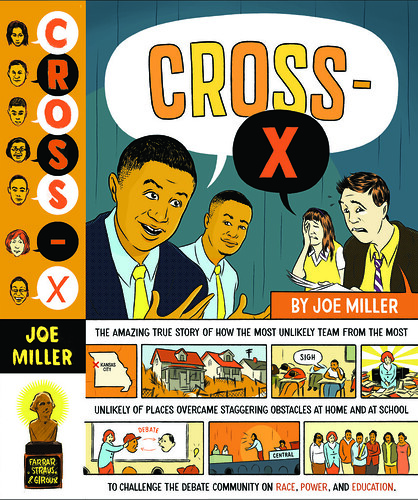
They did a little tweeking of the design. Some color changes, and Marcus and Brandon are drawn just a bit differently. Plus, you can see the spine here. I think the back cover will have a drawing of a classroom with a chalkboard filled with debate jargon and debate-themed drawings, including pictures of Michel Foucault and Aristotle.
Monday, March 13, 2006
$11

Allie found $11 on the ground in our neighborhood. I told her to frame it.
For the past several weeks, Allie has been worried about money. She works freelance. She makes very good money doing so, but the paydays are somewhat unpredictable. So far it has worked like this: She gets worried about running out of money and starving to death. To avoid this she does a lot of work to find more work. The work comes in, often from the most unexpected places, and she gets busy working. Because she's working, she doesn't do a lot of work finding work. So when the work's all done, she gets worried again about where more work is going to come from. And that starts the cycle over again, with her working to find more work.
During the worrisome times she confides in me about her worry. I tell her, "Don't worry. When you put it out there, stuff always comes through. You always find money in the most unexpected places."
And right after I said this she found $11 on the ground. This proved me right. I told her to frame the money. Because she won't really need it. Not with the several thousand dollars of work she's suddenly gotten from the most unexpected places.
These are good things to remember. If you have a computer and are privileged enough to be able read this or any other blog entry, chances are things will work out no matter how tight things seem with money. You will not starve until the revolution comes and the East conquers the West in capitalism.
(Allie will not frame the money but instead she has photographed it and she will use it as wallpaper on her laptop.)
Sunday, March 12, 2006
Help!
Could someone out there please tell me how to get rid of the gap at the top of the page, above my title graphic? It doesn't show up when I hit "preview" in Blogger. But after I upload it shows up in both Safari and Firefox.
Please help me.
Please help me.
Galleys
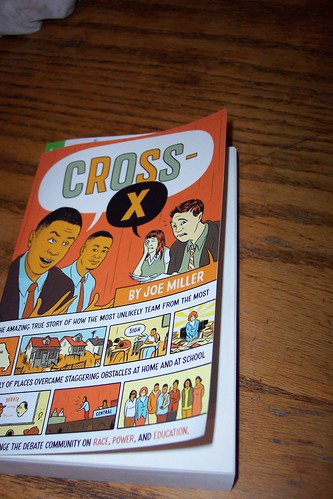
This week I received six copies of the galleys for my book. I give five to the principle subjects of the book, and kept one for myself.
The cover here is pretty much what it'll look like when it's released this fall, except it'll be a hardback. I'm very excited. I think the art looks cool.
It weighs in at 477 pages. I'm worried that's a bit too long. But too late now.
Saturday, March 11, 2006
Grocery Store
In the supermarket checkout line today I went to pull out my debit card, and as I did the KKK card that was hidden in my wallet slid out an inch or so, just far enough for black checkout lady to see the bold, red "KKK" printed across the top. I wasn't sure what to do.
I'd been carrying the card in my wallet for the last month or so, ever since I was at the Johnson County Library and I opened up a book called Profiles in Black Power and the card tumbled out in my lap. This was a disconcerting experience. I kept the card. I showed it to the kids at Central and told them the story and we were all suitably appalled. I'm not sure why I kept the card. I guess as a reminder of having found it in a book about Black Power, as a testament to how chicken shit and sleezy KKK types are.
A few weeks ago the card fell out of my wallet and I told Allie that I should get rid of it lest it fall out at a moment when it would not be welcome, like when I'm around black folks, which I often am.
So it came out today in the checkout line. I don't know if the woman saw it. She works there a lot and I shop there a lot. I don't want her to think that I'm with the KKK.
Right before the card fell out, the checkout lady had to call a manager over to her register to deal with someone's check. The woman had a gaunt face that looked like a skull. Her teeth appeared as though they are rotting. I immediately assumed that she is on meth.
I've been making this assumption a lot lately, ever since I saw a special about meth on Frontline. The show reported on the physical effects of meth. One of the cops interviewed for the show said he can spot a meth addict from a mile away. After seeing the show I now think I can too.
I live in a relatively poor area of town. It's racially diverse. Often when I see whites walking down the main drag in my part of town I take a good long look to see if they have sunken cheekbones and eyes. When they do I say to myself, "I bet they're on meth." There are a lot of white people with this look.
The woman had the look. It was interesting because she's obviously gainfully employed. As she dealt with the check I conjured a story about her. I imagined that she was high on meth at that very moment. It seemed plausible because she seemed to have a lot of energy. I thought that maybe this woman thought the drug actually helps her, that it gives her the energy she needs to survive in the 21st century marketplace. But then I also thought about how tenuous this would be if it were true. My hunch is that a meth addict would eventually run into big problems down the road and their success would disappear along with their cheeks and teeth.
Then I wondered, why don't blacks do meth? Do they?
What am I going to do about this woman who thinks I'm a Klansman? I hope she never covers the express lane while I'm there.
I'd been carrying the card in my wallet for the last month or so, ever since I was at the Johnson County Library and I opened up a book called Profiles in Black Power and the card tumbled out in my lap. This was a disconcerting experience. I kept the card. I showed it to the kids at Central and told them the story and we were all suitably appalled. I'm not sure why I kept the card. I guess as a reminder of having found it in a book about Black Power, as a testament to how chicken shit and sleezy KKK types are.
A few weeks ago the card fell out of my wallet and I told Allie that I should get rid of it lest it fall out at a moment when it would not be welcome, like when I'm around black folks, which I often am.
So it came out today in the checkout line. I don't know if the woman saw it. She works there a lot and I shop there a lot. I don't want her to think that I'm with the KKK.
Right before the card fell out, the checkout lady had to call a manager over to her register to deal with someone's check. The woman had a gaunt face that looked like a skull. Her teeth appeared as though they are rotting. I immediately assumed that she is on meth.
I've been making this assumption a lot lately, ever since I saw a special about meth on Frontline. The show reported on the physical effects of meth. One of the cops interviewed for the show said he can spot a meth addict from a mile away. After seeing the show I now think I can too.
I live in a relatively poor area of town. It's racially diverse. Often when I see whites walking down the main drag in my part of town I take a good long look to see if they have sunken cheekbones and eyes. When they do I say to myself, "I bet they're on meth." There are a lot of white people with this look.
The woman had the look. It was interesting because she's obviously gainfully employed. As she dealt with the check I conjured a story about her. I imagined that she was high on meth at that very moment. It seemed plausible because she seemed to have a lot of energy. I thought that maybe this woman thought the drug actually helps her, that it gives her the energy she needs to survive in the 21st century marketplace. But then I also thought about how tenuous this would be if it were true. My hunch is that a meth addict would eventually run into big problems down the road and their success would disappear along with their cheeks and teeth.
Then I wondered, why don't blacks do meth? Do they?
What am I going to do about this woman who thinks I'm a Klansman? I hope she never covers the express lane while I'm there.
Tuesday, December 13, 2005
ice
I'm going to put this blog on ice for a while. If you want to know what's up with me, drop me an e-mail at joemiller [at] kc [dot] rr [dot] com.
See you 'round.
See you 'round.
Saturday, December 03, 2005
my needs
A meme, via Professor Kim,
Google "[your first name] needs" and write down the first lines from the first page of hits:
Joe needs his Tampa tame.
Joe needs two cracking matches.
joe needs help.
Joe needs an editor.
Joe Needs You.
Joe needs our help.
Joe Needs your Help.
Joe needs help!
Joe needs to try a number of different things.
Google "[your first name] needs" and write down the first lines from the first page of hits:
Joe needs his Tampa tame.
Joe needs two cracking matches.
joe needs help.
Joe needs an editor.
Joe Needs You.
Joe needs our help.
Joe Needs your Help.
Joe needs help!
Joe needs to try a number of different things.
matinee

Allie and I went to a double feature matinee with our friend Mark. It was at the new Screenland theater. Great place. They've got some plush recliner chairs.
We saw The Untold Story of Emmitt Louis Till and The Prize Winner of Defiance, Ohio, both of which were fantastic.
It was a good pairing. Both were set in the 1950s (the latter stretching into the 60s) and they both gave a some perspective on how much American society has changed over the last 50 years. We still have a lot of growing to do in this country. But sometimes it's good to take stock of the progress we've made.
The Emmitt Till documentary told the more extreme story of the two films. It's kind of startling to look back only one or two generations and see a culture with values that are so utterly foreign to those of today. Can you imagine a group of white men committing such an evil, hateful crime? And then being declared not guilty to the applause of an entire community?
Watching this documentary I got to thinking of the OJ trial. Imagine if that had happened in 1955. A black guy is charged with the murder of a white woman, and it looks like a slam dunk, with blood and DNA everywhere. Then when he's declared innocent blacks are out dancing in the streets. And there are no riots and lynch mobs in response. The connection might be tenuous. Indeed, the celebration wasn't for OJ's innocence so much as for a win against a so-called justice system that's still terribly unfair, for an instance in which a black man beat whites at their own game. But certainly these events are milestones in an era of incredible societal change.
The oppression depicted in The Prize Winner of Defiance, Ohio wasn't anywhere near as intense, but it showed a time when the order of things were quite a bit different. Great film, with many insights into the ways gender roles have transformed over the last half century, and ways they've stayed the same. I found it unsettling how I could relate on some level to Woody Harrelson's character, the drunken loser dad, whose anguish thrived on almost mythical social constructions of who he ought to be. Just a little thought, really. A small opportunity for introspection. The overwhelming feeling I had was one of gratitude for living in a time and relationship where equality is more the norm.
I guess this film hasn't quite caught on yet. I think it will, though. It's just terrific. Brought tears to me eyes.
regrets
When it comes to hard-hitting stories I've written about black leaders, there are two that haunt me. One I completely regret having written. I might talk about that one in a later post. The other I don't necessarily regret. But as time goes on I feel more and more uneasy about it.
It was an election story about Wesley Fields's bid for city council.
This is a story I was encouraged to do by a number of political insiders I used to keep close contact with. I was given a good number of promising leads early on. I also had a small number of black sources who were pretty much provided to me by folks affiliated with Fields's opposing candidate, incumbant Becky Nace, who is white.
In retrospect, a lot of the "dirt" I digged up on Fields was insignificant. He was clearly a carpetbagger, having moved to Nace's district after local leaders talked Fields out of challenging Troy Nash.
But I need to stop right here and acknowledge that if Fields had been taking on Nash, another black candidate, I have no doubt that we would have not gone with the story. Even if you think carpetbagging is bad, the racial dynamics of this should tell you a lot.
Then I found that Fields had registered his car in Grandview, at his parents' house. As such, he didn't pay taxes to the Kansas City school district in which he lived.
Ok.
I don't know. In the big scheme of things, this doesn't seem a very big deal. Indeed, I did the same thing when I was in college, so as to avoid the higher taxes of the town where I was living.
But in a large story package, it seemed to add to the heft of the case against Fields.
That said, the bulk of the investigative work I did on the story was aimed at Fields's position at Bryan Cave, a law firm with deep political connections. Fields was one of the primary lawyers on Bryan Cave's contract with the quasi-public Economic Development Corporation, which administers the city's corrupt tax-incentive program. And this was my main justification for doing the story. I felt very strongly at the time that Fields was a pawn of The Man.
Also I should add that I worked very hard to investigate and publicize Fields's strengths and accomplishments. And I even went so far as to point out that he's a textbook example of how Kansas City ought to develop new generations of leaders. He was valedictorian of his high school, he went to an Ivy League school and then to the top-ranked University of Virginia law school. All along the way he distinguished himself as a natural leader. Unfortunately, young men and women like Fields tend to not return to Kansas City, opting instead for cities like Chicago and Atlanta, where the power structures in the black community are much stronger.
One thing that I still ache over with regards to the story was that one of Fields's roommates from college didn't get back to me until after the story had gone to print. This former classmate gave some terrific examples of what kind of a leader Fields is. The stories he shared with me offered particularly strong evidence of Fields's ability to bridge divides between whites and blacks, and that's something Kansas City obviously needs.
I began regretting the story almost as soon as it ran. While I got a lot of props behind the scenes from white leaders, and a few blacks, some of my more reliable contacts in the black community were pretty lukewarm about it. When I explained my concerns about Fields's tax-incentive-program connections they seemed to understand, but there was lingering discomfort of the all-out-effort nature of the investigation, digging up every little piece of dirt I could possibly find.
Worse, I heard from a lot of sources that the main black sources I relied on to call Fields's credibility as a black leader into question were themselves not the most credible within the black community.
And this was confirmed quite emphatically when the election reslts came out. Though Fields lost handily, he beat Nace decisively in the black districts.
When that happened I had two unsettling thoughts. One, I and the Pitch had little clout in the political landscape. And, two, I was wrong.
And now, with the passage of more time, I'm thinking that Fields might well have been a better choice, though it's still tough to get around the whole tax-incentive-program angle. But even there, I think I have to come clean about the institutionally racist nature of my coverage of this story. As I said, we probably wouldn't have done the story if Fields were challenging Nash. And if it were really all about the tax-incentive stuff, why work so hard to call Fields out on the petty stuff, which people probably wouldn't think twice about if he were white?
It was an election story about Wesley Fields's bid for city council.
This is a story I was encouraged to do by a number of political insiders I used to keep close contact with. I was given a good number of promising leads early on. I also had a small number of black sources who were pretty much provided to me by folks affiliated with Fields's opposing candidate, incumbant Becky Nace, who is white.
In retrospect, a lot of the "dirt" I digged up on Fields was insignificant. He was clearly a carpetbagger, having moved to Nace's district after local leaders talked Fields out of challenging Troy Nash.
But I need to stop right here and acknowledge that if Fields had been taking on Nash, another black candidate, I have no doubt that we would have not gone with the story. Even if you think carpetbagging is bad, the racial dynamics of this should tell you a lot.
Then I found that Fields had registered his car in Grandview, at his parents' house. As such, he didn't pay taxes to the Kansas City school district in which he lived.
Ok.
I don't know. In the big scheme of things, this doesn't seem a very big deal. Indeed, I did the same thing when I was in college, so as to avoid the higher taxes of the town where I was living.
But in a large story package, it seemed to add to the heft of the case against Fields.
That said, the bulk of the investigative work I did on the story was aimed at Fields's position at Bryan Cave, a law firm with deep political connections. Fields was one of the primary lawyers on Bryan Cave's contract with the quasi-public Economic Development Corporation, which administers the city's corrupt tax-incentive program. And this was my main justification for doing the story. I felt very strongly at the time that Fields was a pawn of The Man.
Also I should add that I worked very hard to investigate and publicize Fields's strengths and accomplishments. And I even went so far as to point out that he's a textbook example of how Kansas City ought to develop new generations of leaders. He was valedictorian of his high school, he went to an Ivy League school and then to the top-ranked University of Virginia law school. All along the way he distinguished himself as a natural leader. Unfortunately, young men and women like Fields tend to not return to Kansas City, opting instead for cities like Chicago and Atlanta, where the power structures in the black community are much stronger.
One thing that I still ache over with regards to the story was that one of Fields's roommates from college didn't get back to me until after the story had gone to print. This former classmate gave some terrific examples of what kind of a leader Fields is. The stories he shared with me offered particularly strong evidence of Fields's ability to bridge divides between whites and blacks, and that's something Kansas City obviously needs.
I began regretting the story almost as soon as it ran. While I got a lot of props behind the scenes from white leaders, and a few blacks, some of my more reliable contacts in the black community were pretty lukewarm about it. When I explained my concerns about Fields's tax-incentive-program connections they seemed to understand, but there was lingering discomfort of the all-out-effort nature of the investigation, digging up every little piece of dirt I could possibly find.
Worse, I heard from a lot of sources that the main black sources I relied on to call Fields's credibility as a black leader into question were themselves not the most credible within the black community.
And this was confirmed quite emphatically when the election reslts came out. Though Fields lost handily, he beat Nace decisively in the black districts.
When that happened I had two unsettling thoughts. One, I and the Pitch had little clout in the political landscape. And, two, I was wrong.
And now, with the passage of more time, I'm thinking that Fields might well have been a better choice, though it's still tough to get around the whole tax-incentive-program angle. But even there, I think I have to come clean about the institutionally racist nature of my coverage of this story. As I said, we probably wouldn't have done the story if Fields were challenging Nash. And if it were really all about the tax-incentive stuff, why work so hard to call Fields out on the petty stuff, which people probably wouldn't think twice about if he were white?
media blackout
Lately, I've written a number of posts that were very critical of the local media's coverage of race issues. And it got me thinking about my own work, from when I used to be employed. One thing that's always troubled me is that a lot of my hardest hitting stories were about black leaders. Sure, I wrote stories that came down hard on white leaders, too. But it was much easier to get dirt on blacks. There just seemed to be a lot more people, white and black, who were willing to dish it out.
Plus it was hard to frame stories about whites in the same you'd frame ones about blacks. For instance, if I were looking into a development project on the East Side that had gone over budget and was loaded with politically connected contracts, that would be fairly easy to pull together and present as a patronage/corruption story. But if I were to tackle a story about a Northland development project loaded with tax breaks that was being put together by politically connected folks, I'd get a different response. Not necessarily from readers but from the folks I'd be interviewing. Like, if I were to suggest in an interview with a white bureaucrat at city hall that the Northland development looks like a patronage situation, they'd likely look at me as if I were a little odd, as if I were just another alt-weekly radical.
It's all very troubling, really. I can look back on all of my stories and see the subtle and not so subtlle ways I was encouraged to expose the datardly deeds of blacks. In some cases entire, readymade stories were dropped in my lap, documents and all. And I was never lacking a tip or a lead into some story about a black leader who was doing something wroong.
And it's not that I regret doing those stories. I think it's important to be an equal-opportunity watch dog. But really, it's not equal.
Plus it was hard to frame stories about whites in the same you'd frame ones about blacks. For instance, if I were looking into a development project on the East Side that had gone over budget and was loaded with politically connected contracts, that would be fairly easy to pull together and present as a patronage/corruption story. But if I were to tackle a story about a Northland development project loaded with tax breaks that was being put together by politically connected folks, I'd get a different response. Not necessarily from readers but from the folks I'd be interviewing. Like, if I were to suggest in an interview with a white bureaucrat at city hall that the Northland development looks like a patronage situation, they'd likely look at me as if I were a little odd, as if I were just another alt-weekly radical.
It's all very troubling, really. I can look back on all of my stories and see the subtle and not so subtlle ways I was encouraged to expose the datardly deeds of blacks. In some cases entire, readymade stories were dropped in my lap, documents and all. And I was never lacking a tip or a lead into some story about a black leader who was doing something wroong.
And it's not that I regret doing those stories. I think it's important to be an equal-opportunity watch dog. But really, it's not equal.
Thursday, December 01, 2005
blog against racism
I was born to two teenagers out of wedlock.
My dad got caught up in drugs and left my mom and I when I was about two years old. He came back, and straightened his life out, but my mom had moved on. She remarried three times. I went through three divorces.
My dad died in an accident when I was eight.
I didn't like school. I didn't do much homework, goofed off a lot, got into trouble often.
I started smoking pot in sixth grade. In high school I got real into partying, expanding my drug diet beyond weed. I frequently skipped classes.
Yet I graduated. I never doubted I would go to college. I was supremely confident. And after college, I never really had a problem landing good jobs. I'm now working on a book that sold for six figures.
The book is about black kids. If I were to lay out the details of their childhoods as starkly as I've laid out my own, the stories would seem similar. Same thing for their relatives and for many of their friends.
But in most cases the endings would be different.
My dad got caught up in drugs and left my mom and I when I was about two years old. He came back, and straightened his life out, but my mom had moved on. She remarried three times. I went through three divorces.
My dad died in an accident when I was eight.
I didn't like school. I didn't do much homework, goofed off a lot, got into trouble often.
I started smoking pot in sixth grade. In high school I got real into partying, expanding my drug diet beyond weed. I frequently skipped classes.
Yet I graduated. I never doubted I would go to college. I was supremely confident. And after college, I never really had a problem landing good jobs. I'm now working on a book that sold for six figures.
The book is about black kids. If I were to lay out the details of their childhoods as starkly as I've laid out my own, the stories would seem similar. Same thing for their relatives and for many of their friends.
But in most cases the endings would be different.
Wednesday, November 30, 2005
tomorrow
Apparently December 1 is "Blog Against Racism Day". I'm not sure who started it, but I'm up for it. Anybody else? We'll see tomorrow.
Thursday, November 24, 2005
thanksgiving
I went to Ebony's house for Thanksgiving. Allie is at her folks' house, in western New York.
When I arrived, there was a friend of the family sprawled out on the floor by the TV, taking a nap. Later he woke up, and when he spotted me his face twisted up, as if to say, "Who the fuck is that white dude?" But everyone else knew me, and were at ease, so he quickly figured out that I am harmless.
It wasn't a vegan affair. I had turkey, duck, ham and brisket. And giblet gravy. In the non-meat category there were mashed potatoes, dressing and several varieties of pie. Ebony's mom and auntie are outstanding cooks. The turkey was very moist. The duck was especially good. Ebony's little cousin Duran said he liked the duck best. I told him it was Daffy Duck. Then I told him I was kidding when he made a face like he believed me.
I brought the camera, and Ebony spent the day snapping pictures.
The Lions game was on while we ate. But it was boring, so we watched DVDs. At first we watched part of a bootlegged movie. I don't know what the movie was called; we only watched a couple of minutes of it. It was one of those hardcore bootlegged movies, the kind that are video taped in the theater. The picture was filmed at a slight angle, and you could see the dark edge of the movie screen on the top and the bottom of the TV screen. You could hear people in the audience cough.
Ebony switched it to Scarface. I've never seen this movie.
Ebony's mom said, "So many black men have died because of this movie. But they didn't get the message. And the message is: The guy dies in the end."
I wasn't upset that she gave it away for me. She repeated this point several times during the film, especially as the violence escalated toward the finale.
Scarface is one of Ebony's favorite movies. He's seen it several times. As we watched, I kept turning to Ebony and saying, "This isn't very interesting. This is just like everyday life for me." When Scarface watched his friend get chopped up with a chainsaw in a bathroom, I said, "I had to go through a similar situation before I could break into journalism."
My tolerance for violence in movies has diminished as I've aged, but I hung in there with this one. It was very violent. But I liked the part where Scarface told the rich people in the restaurant that they need bad guys like him. I wish they'd pushed this concept a little more.
Then we watched Dave Chappelle's concert movie on Ebony's laptop, and I about fell out of my chair several times, I was laughing so hard. Like when he said, in reference to R Kelly's recent dramas, "I'm just saying that if 15-year-olds are old enough to get life in prison, they oughta be old enough piss on."
I miss Allie, and I miss my family, but this was one of the best Thanskgivings I've had in a while.
Wednesday, November 23, 2005
brick by brick
Jessi left an interesting comment on my post about the media's response to the murder wave here in KC. A lot of really tough questions.
I felt sort of like a schmuck when I read it. I think I come off sounding high and mighty when I try to tackle such a difficult and complicated issue in a little blog post.
And I know I'm a pretty easy target for Tony's criticism that I blame everyone but the blacks who are actually commiting the crimes. I'm probably guilty of painting blacks as victims, and that carries its own set of dangers.
Truth is, there probably is no viable solution. Not in an immediate global sense. This is probably as obvious here in Kansas City as it is anywhere in the country, considering our epic failures at integration.
It's important to remember, though, who these words are coming from, and who they're directed toward.
I'm a white, middle-class American, and my comments are aimed at me and my kind. More specifically, with regards to the post Jessi was commenting on, I feel compelled -- perhaps foolishly -- to challenge myself as a journalist, and other journalists like me, to rethink our assumptions about stories with an obvious racial component. And to consider how these assumptions perpetuate the injustice of the status quo.
There are quite a few books I've read which have really shaped my thinking on this subject. One of the best is Dismantling Racism, by Joseph Barndt. In it he writes:
In the book, Barndt (a white man) argues that the first step whites need to take is to realize that there are privileges we're afforded because of the color of our skin, and the class we were born into, and all the history that has carved out our position in the world. And these privileges are made possible in part by others' lack of privilege. We also need to understand, as he says in the passage above, that racial separation hurts us, too.
So the obvious next step is to try to eliminate the separation.
That's where it can get really tough.
I'm reading a great book right now by Samuel G. Freedman called Upon This Rock, about a black church in Brooklyn. In it, the main character, Pastor Johnny Ray Youngblood, tells a group of white seminary students:
Good advice, if a bit discouraging. But then he says:
And this is where, on the other hand, it can get really easy, and fun, and cool, and rewarding. Like, it feels great to break out of the white ghetto. It didn't take long trying before much of my perspective on things did a complete 180, and my life feels much, much richer.
But how do we begin to tear down the walls? How do you start a movement that people are running away from before it's even begun?
I felt sort of like a schmuck when I read it. I think I come off sounding high and mighty when I try to tackle such a difficult and complicated issue in a little blog post.
And I know I'm a pretty easy target for Tony's criticism that I blame everyone but the blacks who are actually commiting the crimes. I'm probably guilty of painting blacks as victims, and that carries its own set of dangers.
Truth is, there probably is no viable solution. Not in an immediate global sense. This is probably as obvious here in Kansas City as it is anywhere in the country, considering our epic failures at integration.
It's important to remember, though, who these words are coming from, and who they're directed toward.
I'm a white, middle-class American, and my comments are aimed at me and my kind. More specifically, with regards to the post Jessi was commenting on, I feel compelled -- perhaps foolishly -- to challenge myself as a journalist, and other journalists like me, to rethink our assumptions about stories with an obvious racial component. And to consider how these assumptions perpetuate the injustice of the status quo.
There are quite a few books I've read which have really shaped my thinking on this subject. One of the best is Dismantling Racism, by Joseph Barndt. In it he writes:
To study racism is to study walls. We have looked at barriers and fences, restraints and limitations, ghettos and prisons. The prison of racism confines us all, people of color and white people alike. It shackles the victimizer as well as the victim…
But we have also seen that the walls of racism can be dismantled. We are not condemned to an inexorable fate, but are offered the vision and possibility of freedom. Brick by brick, stone by stone, the prison of individual, institutional, and cultural racism can be destroyed. You and I are urgently called to join the efforts of those who know it is time to tear down, once and for all, the walls of racism.
In the book, Barndt (a white man) argues that the first step whites need to take is to realize that there are privileges we're afforded because of the color of our skin, and the class we were born into, and all the history that has carved out our position in the world. And these privileges are made possible in part by others' lack of privilege. We also need to understand, as he says in the passage above, that racial separation hurts us, too.
So the obvious next step is to try to eliminate the separation.
That's where it can get really tough.
I'm reading a great book right now by Samuel G. Freedman called Upon This Rock, about a black church in Brooklyn. In it, the main character, Pastor Johnny Ray Youngblood, tells a group of white seminary students:
"The white person who ministers in the slum better not do it because you feel sorry for poor people or because you think it's the Christian thing to do or you need to feel some leftover liberal guilt. That will get your ass killed...
"We don't need any more Great White Fathers or Great White Mothers."
Good advice, if a bit discouraging. But then he says:
"Don't do for us. Do with us. Don't believe what others tell you about us. Ask us."
And this is where, on the other hand, it can get really easy, and fun, and cool, and rewarding. Like, it feels great to break out of the white ghetto. It didn't take long trying before much of my perspective on things did a complete 180, and my life feels much, much richer.
debate update
Having failed to engage an entire class full of high school kids in the great game of debate, I and the folks at [The School] decided to start trying to teach it to kids after school. I'd be working with only the most motivated kids, and there'd be less of them, and we figured I might be more succesful that way.
Well, no doubt there's been fewer kids. I had two show up for the first practice, one for the second, and three for the third, which was yesterday. This wouldn't be an issue if it were just me running the show. I can work with what I get. But the folks at [The School] really want there to be four kids involved on a consistent basis, so as to make it worth their while. Obviously I haven't quite reached that level.
Still, it's been a pretty cool experience. Two girls showed up to the first practice, and we spent the whole time just talking. I told them why I want to start a debate program ("I'm kind of a radical," I said), then I asked why they joined debate, what they want to get out of it. Then I asked what their goals are in life, and I told them ways in which debate could help them achieve those goals. Finally, I asked, "If you were in charge, if you were the president or the mayor, and you could change one thing, what would it be?"
This sparked a wide ranging conversation, covering everything from murders in the inner-city to reparations for the decendents of enslaved Africans. All the while I kept asking questions, trying to sharpen their focus, until I isolated one goal the two new debaters share: To gain respect for themselves and for their community.
With this mission statement of sorts in place, we turned to the topic high school kids across the country are debating this year:
I wrote this resolution on the board and we went through it section by section until the girls understood it. Then we started talking about how this relates to respect for them and for their community. Soon, we were discussing racial profiling, how cops seem to disrespect blacks. From there, we started piecing together a plan, a debate case we might argue this season, that would help us achieve our mission of gaining respect.
It was pretty simple. We'd have Congress pass a Racial Profiling Act, and we'd add on a requirement for cops to have regular meetings with people in the community, to learn more about them and naturally build more respect. If this were to happen, we reasoned, racial profiling would go down because cops would have a better idea of who's who, who deserves respect, and who deserves more scrutiny.
All the while I'm thinking about how this fits into a bunch of evidence I have at home, selections from policy papers and news reports and philosophical books which give warrants to the very arguments we were generating in this little classroom on Kansas City's East Side.
I said, "What would you think if I were to tell you that the ideas you came up with are the same ideas that scholars and people in power have come up with? How does that make you feel?"
They didn't qite know how to answer.
I continued, "See, you're just as smart as the people who run the world. Debate is a way for you to build on those smarts. To get some of the skills people use to get power."
They seemed to like the idea.
More later...
Well, no doubt there's been fewer kids. I had two show up for the first practice, one for the second, and three for the third, which was yesterday. This wouldn't be an issue if it were just me running the show. I can work with what I get. But the folks at [The School] really want there to be four kids involved on a consistent basis, so as to make it worth their while. Obviously I haven't quite reached that level.
Still, it's been a pretty cool experience. Two girls showed up to the first practice, and we spent the whole time just talking. I told them why I want to start a debate program ("I'm kind of a radical," I said), then I asked why they joined debate, what they want to get out of it. Then I asked what their goals are in life, and I told them ways in which debate could help them achieve those goals. Finally, I asked, "If you were in charge, if you were the president or the mayor, and you could change one thing, what would it be?"
This sparked a wide ranging conversation, covering everything from murders in the inner-city to reparations for the decendents of enslaved Africans. All the while I kept asking questions, trying to sharpen their focus, until I isolated one goal the two new debaters share: To gain respect for themselves and for their community.
With this mission statement of sorts in place, we turned to the topic high school kids across the country are debating this year:
Resolved: The United States federal government should substantially decrease its authority either to detain without charge or to search without probable cause.
I wrote this resolution on the board and we went through it section by section until the girls understood it. Then we started talking about how this relates to respect for them and for their community. Soon, we were discussing racial profiling, how cops seem to disrespect blacks. From there, we started piecing together a plan, a debate case we might argue this season, that would help us achieve our mission of gaining respect.
It was pretty simple. We'd have Congress pass a Racial Profiling Act, and we'd add on a requirement for cops to have regular meetings with people in the community, to learn more about them and naturally build more respect. If this were to happen, we reasoned, racial profiling would go down because cops would have a better idea of who's who, who deserves respect, and who deserves more scrutiny.
All the while I'm thinking about how this fits into a bunch of evidence I have at home, selections from policy papers and news reports and philosophical books which give warrants to the very arguments we were generating in this little classroom on Kansas City's East Side.
I said, "What would you think if I were to tell you that the ideas you came up with are the same ideas that scholars and people in power have come up with? How does that make you feel?"
They didn't qite know how to answer.
I continued, "See, you're just as smart as the people who run the world. Debate is a way for you to build on those smarts. To get some of the skills people use to get power."
They seemed to like the idea.
More later...
Tuesday, November 22, 2005
murder pool
It's interesting to watch the response to the high number of murders in Kansas City this year. I might be wrong, but it seems as though every comment or publicity stunt I've read has operated with the assumption that it's the governnment's responsibility to solve this problem.
Perhaps.
The most poignant comment I've heard about the issue came from an old friend I bumped into back in August who blamed the whole matter on the Republican-controlled White House, pointing out that the last time violent crime spiked so high was at the tail end of the Reagan and Bush Sr. years. Seems plausible, especially after hearing from Ebony yesterday that the murder rate has spiked in Louisville as well. Kind of gives me the sense that things are bad all over.
But I'm convinced that the problem goes much deeper than government, and I'm generally uneasy with the conversation so far. I think it's missing the mark. Just about every morning I read my favorite blog taking our local leaders to task over the issue. He's relentlessly slammed Mayor Kay Barnes, suggesting that she cares more about condo developments than about dying black people. I doubt this is true, though the mayor's silence betrays her obvious detachment from poor and downtrodden in her city, which is certainly worthy of stinging editorial comment.
But then, what would she really accomplish by calling some press conferences and making a show of doing something about it?
She'd get slammed.
Tony has consistently lampooned Alvin Brooks, Mike Sanders and Terry Riley for their responses to the situation. And now my former employer has taken an extremely odd, not-so-subtle dig at Brooks with their latest cry for attention, by asking contestants of a twisted betting pool to guess how many more murders will occur, and how many people died before Brooks "proposed the formation of the new Commission on Violent Crime." Aside from being another example of how the paper mirrors the inconsistent personality of its corporate owner, Michael Lacey (which, as the anemic page counts would seem to suggest, might not be a perfect match for Kansas City), the implied barb of this contest, and of Tony's regular sniping, only serve to reveal how disconnected both of these media sources are from the black side of town, where most of the crimes have taken place.
I don't want to prop Brooks up as some kind of saint. But the fact is that he's one of the only leaders in this city who has consistently addressed the issue of violent crime in the black community. He's done so on many, many levels. He founded the Ad Hoc Committee on Crime back in 1977, and he's served on numerous criminal and social justice committees over the years. But perhaps more important than that is the work he does behind the scenes. He routinely visits prisons with the hopes of reaching some young convict and setting him or her straight. He counsels families of young people who are falling into lives of crime. And he consoles folks whose loved ones have been murdered. He doesn't make a big show of this. Indeed, I wanted to profile him a few years ago when I worked for the Pitch and he declined because he didn't really want the attention. But this is all widely known in the black community. (Similar things can be said of Riley, who started his public life as a community volunteer in the Blue Hills neighborhood during the height of the crack epidemic. I've spent just a little time with Riley, but it was enough to see that he's deeply involved in the lives of his constituents, that he's well known, widely respected, and that folks truly depend on him.)
I have to admit that I'm skeptical of how effective this new committee Brooks has founded will be. But that's not because of some lack of sincerity on his part. It's because the problem is beyond the grasp of government. This is a societal thing, stemming from what Joseph Barndt calls "the prison of individual, institutional and cultural racism." And the media's calls on the government to find solutions only contribute to this because it distances the majority community -- the consumers of media -- from the problem. It's the classic middle-class liberal approach: We want to help the poor and the downtrodden, but we don't want to get our hands dirty.
It's doubly sad that I'm singling out Tony's Kansas City and the Pitch for this criticism, because, aside from The Call, Carter Broadcast and KC Currents, they're without a doubt the media sources in this city that are the most proactive in airing diverse points of view. I would count them among the good guys. So if they're contributing to the problem, then the problem is very, very bad. Indeed, the focus of my fury should be on the Star for its dangerous and irresponsible series rating suburban communities, because that -- the cult of separation -- is what I think is truly at the heart of the issue. (In fairness, I should note that the author of the Star's "Rate the Suburbs" series wrote an excellent series ten years ago called "Divided We Sprawl" about how disconnected this metro area is.)
History has shown that segregation is a blight governments simply cannot solve. The solution lies with us. Bottom line, we all need to get off our asses and start tearing down the walls of separation.
Perhaps.
The most poignant comment I've heard about the issue came from an old friend I bumped into back in August who blamed the whole matter on the Republican-controlled White House, pointing out that the last time violent crime spiked so high was at the tail end of the Reagan and Bush Sr. years. Seems plausible, especially after hearing from Ebony yesterday that the murder rate has spiked in Louisville as well. Kind of gives me the sense that things are bad all over.
But I'm convinced that the problem goes much deeper than government, and I'm generally uneasy with the conversation so far. I think it's missing the mark. Just about every morning I read my favorite blog taking our local leaders to task over the issue. He's relentlessly slammed Mayor Kay Barnes, suggesting that she cares more about condo developments than about dying black people. I doubt this is true, though the mayor's silence betrays her obvious detachment from poor and downtrodden in her city, which is certainly worthy of stinging editorial comment.
But then, what would she really accomplish by calling some press conferences and making a show of doing something about it?
She'd get slammed.
Tony has consistently lampooned Alvin Brooks, Mike Sanders and Terry Riley for their responses to the situation. And now my former employer has taken an extremely odd, not-so-subtle dig at Brooks with their latest cry for attention, by asking contestants of a twisted betting pool to guess how many more murders will occur, and how many people died before Brooks "proposed the formation of the new Commission on Violent Crime." Aside from being another example of how the paper mirrors the inconsistent personality of its corporate owner, Michael Lacey (which, as the anemic page counts would seem to suggest, might not be a perfect match for Kansas City), the implied barb of this contest, and of Tony's regular sniping, only serve to reveal how disconnected both of these media sources are from the black side of town, where most of the crimes have taken place.
I don't want to prop Brooks up as some kind of saint. But the fact is that he's one of the only leaders in this city who has consistently addressed the issue of violent crime in the black community. He's done so on many, many levels. He founded the Ad Hoc Committee on Crime back in 1977, and he's served on numerous criminal and social justice committees over the years. But perhaps more important than that is the work he does behind the scenes. He routinely visits prisons with the hopes of reaching some young convict and setting him or her straight. He counsels families of young people who are falling into lives of crime. And he consoles folks whose loved ones have been murdered. He doesn't make a big show of this. Indeed, I wanted to profile him a few years ago when I worked for the Pitch and he declined because he didn't really want the attention. But this is all widely known in the black community. (Similar things can be said of Riley, who started his public life as a community volunteer in the Blue Hills neighborhood during the height of the crack epidemic. I've spent just a little time with Riley, but it was enough to see that he's deeply involved in the lives of his constituents, that he's well known, widely respected, and that folks truly depend on him.)
I have to admit that I'm skeptical of how effective this new committee Brooks has founded will be. But that's not because of some lack of sincerity on his part. It's because the problem is beyond the grasp of government. This is a societal thing, stemming from what Joseph Barndt calls "the prison of individual, institutional and cultural racism." And the media's calls on the government to find solutions only contribute to this because it distances the majority community -- the consumers of media -- from the problem. It's the classic middle-class liberal approach: We want to help the poor and the downtrodden, but we don't want to get our hands dirty.
It's doubly sad that I'm singling out Tony's Kansas City and the Pitch for this criticism, because, aside from The Call, Carter Broadcast and KC Currents, they're without a doubt the media sources in this city that are the most proactive in airing diverse points of view. I would count them among the good guys. So if they're contributing to the problem, then the problem is very, very bad. Indeed, the focus of my fury should be on the Star for its dangerous and irresponsible series rating suburban communities, because that -- the cult of separation -- is what I think is truly at the heart of the issue. (In fairness, I should note that the author of the Star's "Rate the Suburbs" series wrote an excellent series ten years ago called "Divided We Sprawl" about how disconnected this metro area is.)
History has shown that segregation is a blight governments simply cannot solve. The solution lies with us. Bottom line, we all need to get off our asses and start tearing down the walls of separation.
Sunday, November 20, 2005
earth to america

Allie and I watching Earth to America. Larry and Laurie David are brilliant. The should be given jobs with the DNC.
This is like a two-hour long sustained attack ad against the GOP, except it's funny as hell and totally entertaining. I about fell off the couch during Will Ferrell's impression of George W. Bush talking about global warming from his ranch in Texas. And when Triumph the Dog interviewed four stubborn Republican congressmen.
Seriously. If the Dems have Hollywood on their side, they shoul use it like this, over and over again.
But maybe I'm biased.
Saturday, November 19, 2005
emasculation complete
When Allie first suggested the notion of watching a five-hour BBC production of Pride and Prejudice I grew quite distressed. It sounded most insufferable, yet I suspected I was going to have to suffer through it.
And yes, it did wind up in the Netflix queue, but, no, it wasn't as awful as I suspected. Actuallly, I really got into it.
Honestly, my favorite character was Mr. Collins, who is this hideous, stupid suck-up. I also loved the scene where Lizzie had it out in the garden with ultra-snob Lady Catherine de Bourgh. And both Mr. Darcy and Lizzie Bennet were suitably swoonworthy for Allie and I, respectively. The whole thing was captivating, thoroughly entertaining.
At the end, Allie felt victorious. "A five-hour chick flic," she crowed, "and you liked it!"
And yes, it did wind up in the Netflix queue, but, no, it wasn't as awful as I suspected. Actuallly, I really got into it.
Honestly, my favorite character was Mr. Collins, who is this hideous, stupid suck-up. I also loved the scene where Lizzie had it out in the garden with ultra-snob Lady Catherine de Bourgh. And both Mr. Darcy and Lizzie Bennet were suitably swoonworthy for Allie and I, respectively. The whole thing was captivating, thoroughly entertaining.
At the end, Allie felt victorious. "A five-hour chick flic," she crowed, "and you liked it!"
Friday, November 18, 2005
kerry james marshall
I surfed around today and wound up on the site for PBS's Art:21. They have a bunch of video clips about some really cool contemporary artists. I was happy to find some stuff on Kerry James Marshall. I'd almost forgotten about him.

Marshall's been one of my favorite artists ever since I saw one of his paintings at the Denver Art Musuem back in the late 1990s. It was such an awesome painting. Huge. Like, ten by twelve. It was of a housing project, painted in crisp lines and brilliant colors. It suggested the American Dream of a clean and sturdy place to live. The people posed in these environs were black -- very black, like, pitch black -- and they were well dressed and they had perfect postures. It was like something out of a 1950s' Life magazine ad.
But at the same time the canvas was strewn with dozens of sloppy strokes of runny paint, loose spirals that looked a lot like graffiti and garbage but were oddly beautiful at the same time. Indeed, at first glance some of these intrusions appeared to be flowers until one looked closer. They were like ghosts from a rotten future.
When I go to museums I usually find at least one painting or sculpture that I simply can't stop looking at and this was one of those. I kept coming back to it. It was as deep and vast as a novel.
Anyway, it was nice to be reminded of his work -- even if the images on the web are maddeningly small:

Marshall's been one of my favorite artists ever since I saw one of his paintings at the Denver Art Musuem back in the late 1990s. It was such an awesome painting. Huge. Like, ten by twelve. It was of a housing project, painted in crisp lines and brilliant colors. It suggested the American Dream of a clean and sturdy place to live. The people posed in these environs were black -- very black, like, pitch black -- and they were well dressed and they had perfect postures. It was like something out of a 1950s' Life magazine ad.
But at the same time the canvas was strewn with dozens of sloppy strokes of runny paint, loose spirals that looked a lot like graffiti and garbage but were oddly beautiful at the same time. Indeed, at first glance some of these intrusions appeared to be flowers until one looked closer. They were like ghosts from a rotten future.
When I go to museums I usually find at least one painting or sculpture that I simply can't stop looking at and this was one of those. I kept coming back to it. It was as deep and vast as a novel.
Anyway, it was nice to be reminded of his work -- even if the images on the web are maddeningly small:
work update
At several points while I was working on my book I was overcome with doubt and anxiety. In fact, it happened again recently, as I was going over the copy-editor's comments on my manuscript. As I reread my own work I felt convinced that it was subpar and that it'll be a flop.
Fortunately it was just a bad day. I'm actually having a very good time rereading this work for the umpteenth time, and I think that's a good sign.
Lately I've been distressed about my next project. My idea is a book about a particular area of contemporary Christianity. The subject is rich, particularly from a historic perspective, and while there've been a number of books written about it, none that I've found really succeed at telling a good story. So I've been spending a lot of time lately at several churches in the area. And I've been vascilating wildly between confidence and uncertainty.
My main challenge has been figuring out where the story is. With the first book, I had a clear narrative structure: A debate season. And I lucked out when the team I was following finished tenth in the nation.
But with these churches there's not as clear a structure for a complete story. I'm sort of jumping into the life midstream and seeing where it'll take me. It's a lot like a ride-along with the cops, and I remember hearing a person say once at a journalism conference that these experiences rarely result in good stories because they don't offer clear beginnings, middles and ends.
For now, though, my spirits are up, and I'm feeling confident I'll find my hook. I have to keep reminding myself that this is a process. I'm just trying to make incremental progress, and I feel as though I'm succeeding.
At this point, I'm mostly just conducting in-depth interviews, and trying to find characters to focus on, and negotiating access. The interview process has been particularly fruitful. I'm using an interview technique I picked up at another journalism conference I attended years ago, from a lecture by Leon Dash. Dash won the Pulitzer for his work at the Washington Post investigating the root causes of poverty and teen pregnancy. To get to these deep underlying stories, he would conduct several series of very in-depth biographical interviews -- one of the subjects' family histories, another of school history, another on church and still another on the subjjects' social lives (their friendships and romantic relationships). All of these interviews begin with the subjects' earliest memories and progress very slowly from there. Each history is typically explored in several interviews, each lasting an hour to 90 minutes. These are all tape recorded and transcribed prior to the subsequent interviews.
He started doing this because when he sat down and tried to ask folks directly about things like teen pregnancy and poverty he would get canned answers that weren't particularly enlightening. But by facilitating an autobiographical discourse, he found that subjects would eventually get around to describing the deep underlying forces that drive their lives.
It's really hard work (especially the transcription part, which is maddening), but the results are remarkable. I conducted one on Wednesday night, and by the end of it I had gathered some fascinating information about the subject's spiritual life, which is one of the primary aims of my journalistic inquiry.
I'm starting to think I might be ready to start piecing together a proposal. I think I'll begin Thanksgiving weekend, right after I ship my manuscript back to the publisher for them to begin laying out in an actual book.
So exciting!
Fortunately it was just a bad day. I'm actually having a very good time rereading this work for the umpteenth time, and I think that's a good sign.
Lately I've been distressed about my next project. My idea is a book about a particular area of contemporary Christianity. The subject is rich, particularly from a historic perspective, and while there've been a number of books written about it, none that I've found really succeed at telling a good story. So I've been spending a lot of time lately at several churches in the area. And I've been vascilating wildly between confidence and uncertainty.
My main challenge has been figuring out where the story is. With the first book, I had a clear narrative structure: A debate season. And I lucked out when the team I was following finished tenth in the nation.
But with these churches there's not as clear a structure for a complete story. I'm sort of jumping into the life midstream and seeing where it'll take me. It's a lot like a ride-along with the cops, and I remember hearing a person say once at a journalism conference that these experiences rarely result in good stories because they don't offer clear beginnings, middles and ends.
For now, though, my spirits are up, and I'm feeling confident I'll find my hook. I have to keep reminding myself that this is a process. I'm just trying to make incremental progress, and I feel as though I'm succeeding.
At this point, I'm mostly just conducting in-depth interviews, and trying to find characters to focus on, and negotiating access. The interview process has been particularly fruitful. I'm using an interview technique I picked up at another journalism conference I attended years ago, from a lecture by Leon Dash. Dash won the Pulitzer for his work at the Washington Post investigating the root causes of poverty and teen pregnancy. To get to these deep underlying stories, he would conduct several series of very in-depth biographical interviews -- one of the subjects' family histories, another of school history, another on church and still another on the subjjects' social lives (their friendships and romantic relationships). All of these interviews begin with the subjects' earliest memories and progress very slowly from there. Each history is typically explored in several interviews, each lasting an hour to 90 minutes. These are all tape recorded and transcribed prior to the subsequent interviews.
He started doing this because when he sat down and tried to ask folks directly about things like teen pregnancy and poverty he would get canned answers that weren't particularly enlightening. But by facilitating an autobiographical discourse, he found that subjects would eventually get around to describing the deep underlying forces that drive their lives.
It's really hard work (especially the transcription part, which is maddening), but the results are remarkable. I conducted one on Wednesday night, and by the end of it I had gathered some fascinating information about the subject's spiritual life, which is one of the primary aims of my journalistic inquiry.
I'm starting to think I might be ready to start piecing together a proposal. I think I'll begin Thanksgiving weekend, right after I ship my manuscript back to the publisher for them to begin laying out in an actual book.
So exciting!
Tuesday, November 15, 2005
channel 41's big investigation
Last night I did something I rarely do: I watched the news. I lucked out, I guess. Channel 41, our local NBC affiliate, was airing a big woopty-doo investigation of the Kansas City School District.
I heard about this investigation back in September. That's when district officials sent teachers an e-mail informing them that the station had filed a Sunshine Law request for the e-mail address of every teacher in the district. In the memo they reminded the teachers of district policy that no one is allowed to talk to the media without first getting permission from Central Office.
In last night's report, the NBC reporter made a big deal about this, saying that their report offered information district officials "don't want you to know." He added indignantly that district officials blocked the station's domain name from their e-mail system.
Channel 41 got a few sympathy points from me here. It's a crime how hard it is to get information out of the school district. When I was working for the Pitch, it got to the point where I had to CC the lawyer for New Times (which owns the Pitch) on every info request I made of the school district.
But then it's hard to blame the district for playing interference when the info winds up in lazy and dumb reports like this.
OK. Maybe I'm being unfair. The district has a real challenge with regards to school safety, and they don't always meet it. Case in point: Early this year a kid got his throat slit at Central High. From what I gathered on the gossip chain, the alleged assailant had snuck an Exacto blade into the school. Worse, the blade bearer is rumored to have been transfered to Cedntral from another school after being kicked out for violent behavior, but the administrators and teachers at Central were not informed of this, nor of the student's history of mental health problems.
On the other hand, KC school officials are so vigilent about safety that schools like Central feel more like prisons than places of learning. Plus, as Superintendent Taylor said in the news report, the school system has to provide an education to the city's kids. Presumably this includes the so-called problem kids.
So the issue is much more complicated and difficult than Channel 41's report would lead us to believe. The reporter continually harped on the district for allowing students back into schools after they'd done something violent, such as threatening or pushing a student.
But what then? Where do the presumably bad kids go? Do they just disappear? Are they sent to jail? Do they walk the streets? What?
I have some real problems with such simplistic thinking.
Worse, the reporter didn't even try to get at what might be causing the violent behavior they were raising alarms about. For instance, they mentioned instances of arson at Southeast High. But they said nothing about how notoriously wretched that place is as a place of learning. Nothing about the high rates of turnover in that school among teachers and administrators. And certainly nothing about the racist block-busting and white flight that shaped that school's history.
And it really bugs me that the story package was billed as a "School Safety Survey." If you read the actual survey results, you see this is a deceptive title. Out of 24 questions, the survey offers just four on safety. Really, it's sort of a fishing-expedition survey, with a wide range of general questions.
Indeed, if you read through the answers you'll find hints at a much more dangerous violence in the KC school district, a cognitive violence that, in my humbly radical opinion, is nothing short of dehumanizing.
The 20th statement in the survey was "I feel the Kansas/Missouri Assessment is an accurate measure of a student's ability." Eighty two percent of the respondents disagreed, and only ten percent agreed.
This was by far the most decisive response to any of the statements in the survey.
This tells me that the professionals who work most closely with our community's children day in and day out are in almost unanimous agreement that the fundamental basis of our educational system is intrinsically flawed.
That's where the investigation needs to go.
Fix that and I would argue that safety will become a non-issue.
But that wouldn't win sweeps month, would it? The fear associagted with the prospect of violent black kids is a much easier sell.
I heard about this investigation back in September. That's when district officials sent teachers an e-mail informing them that the station had filed a Sunshine Law request for the e-mail address of every teacher in the district. In the memo they reminded the teachers of district policy that no one is allowed to talk to the media without first getting permission from Central Office.
In last night's report, the NBC reporter made a big deal about this, saying that their report offered information district officials "don't want you to know." He added indignantly that district officials blocked the station's domain name from their e-mail system.
Channel 41 got a few sympathy points from me here. It's a crime how hard it is to get information out of the school district. When I was working for the Pitch, it got to the point where I had to CC the lawyer for New Times (which owns the Pitch) on every info request I made of the school district.
But then it's hard to blame the district for playing interference when the info winds up in lazy and dumb reports like this.
OK. Maybe I'm being unfair. The district has a real challenge with regards to school safety, and they don't always meet it. Case in point: Early this year a kid got his throat slit at Central High. From what I gathered on the gossip chain, the alleged assailant had snuck an Exacto blade into the school. Worse, the blade bearer is rumored to have been transfered to Cedntral from another school after being kicked out for violent behavior, but the administrators and teachers at Central were not informed of this, nor of the student's history of mental health problems.
On the other hand, KC school officials are so vigilent about safety that schools like Central feel more like prisons than places of learning. Plus, as Superintendent Taylor said in the news report, the school system has to provide an education to the city's kids. Presumably this includes the so-called problem kids.
So the issue is much more complicated and difficult than Channel 41's report would lead us to believe. The reporter continually harped on the district for allowing students back into schools after they'd done something violent, such as threatening or pushing a student.
But what then? Where do the presumably bad kids go? Do they just disappear? Are they sent to jail? Do they walk the streets? What?
I have some real problems with such simplistic thinking.
Worse, the reporter didn't even try to get at what might be causing the violent behavior they were raising alarms about. For instance, they mentioned instances of arson at Southeast High. But they said nothing about how notoriously wretched that place is as a place of learning. Nothing about the high rates of turnover in that school among teachers and administrators. And certainly nothing about the racist block-busting and white flight that shaped that school's history.
And it really bugs me that the story package was billed as a "School Safety Survey." If you read the actual survey results, you see this is a deceptive title. Out of 24 questions, the survey offers just four on safety. Really, it's sort of a fishing-expedition survey, with a wide range of general questions.
Indeed, if you read through the answers you'll find hints at a much more dangerous violence in the KC school district, a cognitive violence that, in my humbly radical opinion, is nothing short of dehumanizing.
The 20th statement in the survey was "I feel the Kansas/Missouri Assessment is an accurate measure of a student's ability." Eighty two percent of the respondents disagreed, and only ten percent agreed.
This was by far the most decisive response to any of the statements in the survey.
This tells me that the professionals who work most closely with our community's children day in and day out are in almost unanimous agreement that the fundamental basis of our educational system is intrinsically flawed.
That's where the investigation needs to go.
Fix that and I would argue that safety will become a non-issue.
But that wouldn't win sweeps month, would it? The fear associagted with the prospect of violent black kids is a much easier sell.
Saturday, November 12, 2005
jane austen interrupted

Today was a big day for Allie and her Jane Austen buddy, one they'd been looking forward to for weeks. The new Pride and Prejudice opened this weekend in KC. They went to the matinee at the Cinemark on the Plaza. The place was packed with Jane Austen fans, some of whom had driven more than two hours to see the film.
Then, after a half hour of previews, 15 minutes into the movie, the screen went blank, and there was nothing but sound. It was a pivotal moment. "When she first meets Mr. Darcy," Allie tells me. "Elizabeth first meets him. At the ball!"
It took the theater people forever to even do anything about it. This throng of Jane Austen fanatics were left to just sit there seething with neo-Victorian rage. "You could people in the theater shifting around," Allie says, "and maybe like cursing under their breath."
Finally, the lights went on, and they could hear the sounds of people trying to fix things up in the projection booth. But all they could get was pictures and no sound. "So this key, key scene was going by, and you couldn't tell what was going on," Allie says.
After some banging around upstairs, the theater hacks got the sound fixed, but now the pre-movie slides of Coke and popcorn were being projected on top of the film, which was "supremely annoying."
As if that weren't bad enough, the screen then started going blank intermittantly until it ultimately succumbed to complete darkness.
At last, a man came in and said, "I'm not with Cinemark, but I'll tell you what's happening because they're not going to come in to tell you."
Allie and her pal got up to leave. They were pretty steamed. Allie's friend said, "If this had been any other movie, I would've been ok with it."
In the lobby, they encountered an angry mob of Jane Austen fans, shouting stuff like, "This is a big theater! You should have someone working the projector!!"
The manager, I'm told, was being quite pissy about the whole thing.
One woman appeared to be about nine and a half months pregnant. She was especially furious, because she knew this would be the last movie she'd be able to go to for a long time. The woman she was with said to her, "You could go into labor right here!"
"If I do, I hope that manager has to clean it up! Anything to make his day worse!!"
Allie got her money back, and free passes.
george w. bush's head
Regular readers might know that our youngest dog, Gobo, is a biter, which is usually a drag. But then we got him ">George W. Bush's head, and now we're very happy. It squeeks!
Wednesday, November 09, 2005
future
This blog entry is on point. And gutsy -- it's written by a reporter at the Philadelphia Daily News, which is owned by Knight-Ridder (which also owns our beloved Star), and it actually takes a few smacks at the corporate ownership.
What's great about it is that the fictional part that opens the passage is probably the best prediction I've yet seen about the future of news. And I like it! It looks really cool.
I know I bash on the local paper here quite a bit here, but the truth is, I'm scared to death at the prospect of the Star or any other big daily paper going under. Grumbles aside, these papers still have the the only real institutional heft to carry the Fourth Estate forward in our country. Bloggers can't do it. Alt-weeklies can't do it. And TV news is racist drivel.
So this idea of the "norg" being a converged salon of information where folks can enter from whichever direction they feel comfortable, interact with the info, repackage it, share it with one another -- I think it's exciting.
This Attytood post reads in parts like a manifesto:
Damn right!
What's great about it is that the fictional part that opens the passage is probably the best prediction I've yet seen about the future of news. And I like it! It looks really cool.
I know I bash on the local paper here quite a bit here, but the truth is, I'm scared to death at the prospect of the Star or any other big daily paper going under. Grumbles aside, these papers still have the the only real institutional heft to carry the Fourth Estate forward in our country. Bloggers can't do it. Alt-weeklies can't do it. And TV news is racist drivel.
So this idea of the "norg" being a converged salon of information where folks can enter from whichever direction they feel comfortable, interact with the info, repackage it, share it with one another -- I think it's exciting.
This Attytood post reads in parts like a manifesto:
We prefer to talk down to the public rather than talk to them. Even at our very best – and there are many, many talented newspaper journalists in America – we are more likely to aim at wooing contest judges than at wooing new readers. And we have a knee-jerk tendency to defend our narrow world of messy ink printed on dead trees, when instead the time is here to redefine who we are and what we do.
We are, and can continue to be, the front-line warriors of information -- serving up the most valuable commodity in a media-driven era. But that means we must be the message, not the medium, and so we must adjust to give consumers news in the high-tech ways that they are asking for, not the old-tech way that we are confortable with.
Damn right!
Tuesday, November 08, 2005
the last abortion clinic

I was an unplanned pregnancy, pre Roe v. Wade, and I'm happy to be alive. So, on a very superficial level, some of the rhetoric associated with the so-called pro-life movement appeals to me. But I can't get around the hipocracy.
Tonight Allie and I watched Frontline's "The Last Abortion Clinic," about how a seldom discussed Supreme Court decision of 1989 has made it increasingly difficult -- in some cases, almost impossible -- for a growing population of women to choose to have an abortion. The documentary focused on Mississippi, where there's basically just one abortion clinic still in operation. And even that clinic could close its doors early next year.
The show offered lots of interviews with so-called pro-lifers, and it showed them praying outside of the clinic in Jackson. Most of them were men, and I can't recall seeing a black face among them. And I kept thinking, You don't really care about these babies you think you're saving.
After just two minutes of Googling, I found a handful of Mississippi counties where 40 percent of the children live in poverty (that's federally defined poverty, which is artificially low, not actual poverty), and the infant mortality rate is as high as 20 per thousand. Statewide, 24 percent of Mississippi's children live in poverty, the highest rate in the country. Twelve percent live in "extreme poverty."
Mississippi ranks 50th among states (including DC) in per-pupil expenditures on education.
And this:
Mississippi families who pay for care spend an average of 9 percent of earnings on child care. Families with incomes below 200 percent of poverty spend an average of 14 percent of parental earnings, more than the 7 percent of earnings spent by families with incomes at or above 200 percent of poverty.
In Mississippi, at least 41 percent of families with incomes below 200 percent of poverty get some sort of child care help; at least 15 percent have government/organization help and at least 20 percent have all their child care provided free by relatives. The percentage of these families with government/organization help is lower in Mississippi than in the United States as a whole. (Urban Institute)
And, of course, there are lots of kids in Mississippi who are waiting for someone to give them a stable home, as there are in every state.
I'm not necessarily trying to bash Mississippi.
But come on! What are you doing for the kids that are already alive?
In the Frontline show, the Mississippi so-called pro-lifers crowed about these "Pregnancy Crisis Centers" they've established across the state to help poor women deal with their lack of choice. I yelled, "Right on!" at the screen when an anonymous abortion clinic owner addressed these outposts of dubious benevolence.
Right now it seems that the crisis pregnancy centers want to help women have babies, but really offer no real alternatives for women to raise these babies and have no resources truly available to them for the long term.
And again, a woman with children already, some baby clothes and formula and even a stroller isn't going to help for that long. That's just not what's required to raise a child. The whole thing that is really problematic for me is the disconnect between the pre-born and the post-born. I just don't understand that. It seems that so many of these groups, so many of the hardliners, when they say, "I'm pro-life," they mean "I support the pregnancy in utero," in the uterus. But I see so little sustenance and support for women and children, particularly poor women and children. Those are the ones that are castigated and blamed.
kcc
I found this description of Central High on a Xanga site:
Cross-X by Joe Miller
teachers threaten your families safety to get you on the debate team, and the scariest person in the building is a 5 foot red-headed white woman with a knack for making you feel like less of a man. also there're like 26 people with the nickname toot. and 90 percent of the female population have 'esha' or 'aunda' or 'shaun' at the end of there name. every other female has slept with [BLANK BLANK]. they confiscate cell phones but let people with knives run rampant. only thirteen percent of the enrolled students show up on any given day, and half of the ones that do are late the other half are leaving early. prison is a guarantee for 7 of the 14 people who graduated last year. a dog comes in through the front door and chases a four foot 5 inch girl around the building, twice. the nerds can't spell their own names and can beat the sh- out of any given member of the surrounding suburban schools. everybody wants to be a lawyer and graduate from CMSU. nobody actually graduates from CMSU... i can't think of anything else... lata nigga!
Cross-X by Joe Miller
Monday, November 07, 2005
hard to believe
The first thought that crossed my mind when I read about prison conditions in Africa was, You should be happy. You're life isn't that hard.
Ugh. How self absorbed.
News like this really challenges my faith. Lately I've been praying with fair regularity. Pretty much every morning. I ask God to guide me, to put me to good use. And, down in the bottom of each prayer, mostly unspoken, is a request to feel happy, light of spirit.
Then I read about people stacked up on top of one another in disease ridden shacks in Africa, and I think it's all absurd.
God's plan for me??!!
I just can't make sense of it.
What kind of God would intercede in the life of a privileged American schmoe like me, and yet let so many people live in absolute misery?
To me, that's the hardest question.
Ugh. How self absorbed.
News like this really challenges my faith. Lately I've been praying with fair regularity. Pretty much every morning. I ask God to guide me, to put me to good use. And, down in the bottom of each prayer, mostly unspoken, is a request to feel happy, light of spirit.
Then I read about people stacked up on top of one another in disease ridden shacks in Africa, and I think it's all absurd.
God's plan for me??!!
I just can't make sense of it.
What kind of God would intercede in the life of a privileged American schmoe like me, and yet let so many people live in absolute misery?
To me, that's the hardest question.
Sunday, November 06, 2005
future
This blog entry is on point. And gutsy -- it's written by a reporter at the Philadelphia Daily News, which is owned by Knight-Ridder (which also owns our beloved Star), and it actually takes a few smacks at the corporate ownership.
What's great about it is that the fictional part that opens the passage is probably the best prediction I've yet seen about the future of news. And I like it! It looks really cool.
I know I bash on the local paper here quite a bit here, but the truth is, I'm scared to death at the prospect of the Star or any other big daily paper going under. Grumbles aside, these papers still have the the only real institutional heft to carry the Fourth Estate forward in our country. Bloggers can't do it. Alt-weeklies can't do it. And TV news is racist drivel.
So this idea of the "norg" being a converged salon of information where folks can enter from whichever direction they feel comfortable, interact with the info, repackage it, share it with one another -- I think it's exciting.
This Attytood post reads in parts like a manifesto:
Damn right!
What's great about it is that the fictional part that opens the passage is probably the best prediction I've yet seen about the future of news. And I like it! It looks really cool.
I know I bash on the local paper here quite a bit here, but the truth is, I'm scared to death at the prospect of the Star or any other big daily paper going under. Grumbles aside, these papers still have the the only real institutional heft to carry the Fourth Estate forward in our country. Bloggers can't do it. Alt-weeklies can't do it. And TV news is racist drivel.
So this idea of the "norg" being a converged salon of information where folks can enter from whichever direction they feel comfortable, interact with the info, repackage it, share it with one another -- I think it's exciting.
This Attytood post reads in parts like a manifesto:
We prefer to talk down to the public rather than talk to them. Even at our very best – and there are many, many talented newspaper journalists in America – we are more likely to aim at wooing contest judges than at wooing new readers. And we have a knee-jerk tendency to defend our narrow world of messy ink printed on dead trees, when instead the time is here to redefine who we are and what we do.
We are, and can continue to be, the front-line warriors of information -- serving up the most valuable commodity in a media-driven era. But that means we must be the message, not the medium, and so we must adjust to give consumers news in the high-tech ways that they are asking for, not the old-tech way that we are confortable with.
Damn right!
Saturday, November 05, 2005
poem
Yesterday, I got an e-mail from a student at a local high school who apparently reads my blog regularly (I read his, too; when he posts). He wanted help on a homework assignment, which was to interview someone and write a poem based on the answers. I quickly sent my answers back to him, and this morning I was greated with one of the nicest and most touching messages I've ever had delivered to me. I feel a little weird posting it. But I've been pretty down lately, dealing with a lot of very intense, bizarre conflicts. So... I don't know. Just, so, here it is:
The Writer
Through his wireframe glasses, the Writer views
A world in which all the people must choose
Between good and evil, virtue and sin
And all this he incorporated within
Five hundred words in the local news rag
Informing us all, raising a red flag
When injustice rears its horrible head
We march the streets, he uses words instead
Opening doors and breaking down walls
Making us rethink who we pass in the halls
But now he has moved into penning books
Telling a tale of teens judged by their looks
Who overcame the obstacles to win
In a contest ruled by well-dressed men
Even though at times he has pennies to his name
And he might not bask in the glow of fame
Passion for knowledge is what guides his life
Learning as he writes of a world full of strife
As well as joy, and fear, and loathing of all
And through it he continues to stand tall
Never wavering with his true morals
Even if it will strip him of his laurels
On the internet he scribes of his days
And looks at the world with an unflinching gaze
He speaks for others who have no choice
And are screaming, but without any voice
being right
Years ago, when I lived in Boulder, I had a spiritual advisor of sorts. He wasn't some far-out, long-haired dude like you might think. He was a machinist. An old gearhead.
I used to call him when I was in a jam, or I wasn't quite feeling right. Often, this was during periods of conflict.
He'd patiently listen to all the details of whatever drama I was living, and then he'd say, "Would you rather be right, or dead? Because there's no life in being right."
It's so true. When I feel as though I'm "right" and someone else is "wrong," it's as if I cease to fully live. All I do is think over and over and over in my head all the ways I'm right and they're wrong. The thoughts are so persistent and strong that I become numb to pretty much everything else. Dead, in a way.
Cross-X by Joe Miller
I used to call him when I was in a jam, or I wasn't quite feeling right. Often, this was during periods of conflict.
He'd patiently listen to all the details of whatever drama I was living, and then he'd say, "Would you rather be right, or dead? Because there's no life in being right."
It's so true. When I feel as though I'm "right" and someone else is "wrong," it's as if I cease to fully live. All I do is think over and over and over in my head all the ways I'm right and they're wrong. The thoughts are so persistent and strong that I become numb to pretty much everything else. Dead, in a way.
Cross-X by Joe Miller
Thursday, November 03, 2005
good debate
I spent some of the afternoon at Central High debriefing about the tournament this past weekend. The next stop for the squad is the Shawnee Mission East tournament in Johnson County, which Geoffery and Ebony won last year. It's going to be interesting this year because they won't have the same judging pool. It'll be more folks from the community, and they might not be as open to the "exclusionary norms" arguments Central runs. I think it'll be an interesting challenge, though.
The following weekend, Geoffery and Leodis will compete in Chicago at The Glenbrooks, one of the biggest debate tournaments in the country. There'll be something like 200 teams in their division. Last year, Ebony and Geoffery went 3-4, though Geoffery picked up fifth-place speaker, which was pretty huge.
This tournament's a challenge not only because of its size, but because it's more likely there'll be judges who are resistent to so-called nontraditional arguments. But I think Geoffery and Leodis might have a better chance this year, becauuse they've gottenn a lot better at controlling debate rounds and making it really clear why judges should vote for their case. Which -- Duh! -- is what it's all about.
Debate practice provided a nice break from this weird resentment/conflict hole I dove into over the last couple of days on this blog. It's such an incredible game, really, and sometimes I feel as though I learn more than the kids. It sharpens soo many skills. And I just loved sitting in that classroom at Central for an hour or so trying to figure out how express arguments more clearly, to get down to the essence of
The following weekend, Geoffery and Leodis will compete in Chicago at The Glenbrooks, one of the biggest debate tournaments in the country. There'll be something like 200 teams in their division. Last year, Ebony and Geoffery went 3-4, though Geoffery picked up fifth-place speaker, which was pretty huge.
This tournament's a challenge not only because of its size, but because it's more likely there'll be judges who are resistent to so-called nontraditional arguments. But I think Geoffery and Leodis might have a better chance this year, becauuse they've gottenn a lot better at controlling debate rounds and making it really clear why judges should vote for their case. Which -- Duh! -- is what it's all about.
Debate practice provided a nice break from this weird resentment/conflict hole I dove into over the last couple of days on this blog. It's such an incredible game, really, and sometimes I feel as though I learn more than the kids. It sharpens soo many skills. And I just loved sitting in that classroom at Central for an hour or so trying to figure out how express arguments more clearly, to get down to the essence of
Wednesday, November 02, 2005
mr. journalist
I've been following the adventures of Mr. Cellophone, a brilliant student at Oak Park High in suburban KC, for some time now. I'm particularly pleased with the recent twists of his life story. It seems he's gone and gotten himself enrolled in newspaper class. Today he reported that his first story got published in the school paper, but it wasn't very satisfying:
Hmm. Sounds like my early career.
I got my thing published in the school paper. It's kind of cool to see your name on the front of a paper with several thousand copies. But, ya know, meh. Doesn't change the fact that it's boring as hell. I want to start an Oak Park alternative news magazine. We'd print really subversive and inflammatory and unnecessarily long features about how the administrators are fucking us over with their MAP testing and their socialist philosophies and their high cafeteria prices. Maybe some investigative journalism about how our assistant principal used to be a transvestite stripper or something. We'd write reviews of really obscure Italian films and the newest avant-freak-folktronica albums. It would be called OP Weekly.
Hmm. Sounds like my early career.
Tuesday, November 01, 2005
good gates
'm midway through a fascinating and deeply challenging New Yorker article about Bill and Melinda Gates and their efforts to eliminate diseases that affect the poor. By challenging I don't mean tough read, but because it has quotes from world health officals:
Meantime, the Gates foundation has spent "six billion dollars to address health issues in the third world -- more than nearly every other... nation" that contributes to the World Health Organization.
I recall not so long ago believing that Bill Gates was evil. Sort of a 21st Century railroad baron. But, man, if this is where he's going to put his money, I'm all over the Microsoft products.
Gotta dig this:
Right on!
Cross-X by Joe Miller
"There is one sad fact about the malaria community," kent Campbell, a former chief of the malaria branch at the Centers for Disease Control, told me. "We have always been so wedded to failure that we don't even have the leadership necessary to risk the additional failure to get where we need to be. This would cost two or three dollars a person." He was referring to treatment and prevention services for Africans. "It has gone on for too long. I would love to believe that in the United States this effort is being driven by a decent desire to help, but I don't think most American's give a rat's ass about the death of millions of African kids each year. I don't think they ever have."
Meantime, the Gates foundation has spent "six billion dollars to address health issues in the third world -- more than nearly every other... nation" that contributes to the World Health Organization.
I recall not so long ago believing that Bill Gates was evil. Sort of a 21st Century railroad baron. But, man, if this is where he's going to put his money, I'm all over the Microsoft products.
Gotta dig this:
Gates owns more than a billion shares of Microsoft, which at times have been worth as much as a hundred billion dollars. Today, after his contributions to the foundation, his net worth stands at roughly half that amount. "We knew that we wanted to give virtually all of it away instead of having it go to our kids," he said.
Right on!
Cross-X by Joe Miller
iowa caucus 2005
Some of you more loyal readers might recall a post I made last year about Central High's fantastic performance at the Iowa Caucus, a big debate tournament in Cedar Rapids. Well, we returned this year and did even better.
All of Central's varsity debaters had winning records. Dominique Baker and Sean Easterwood went four-two, though they didn't clear to the trophy rounds.
Geoffery Stone took first-place speaker for the second year in a row:

(BTW, when his name was called at the awards ceremony he received a standing ovation, which is something I can't recall ever seeing at a tournament, though I haven't been around the game for long.)
Sophomores Aaron Thomas and Matheno Frasier-Bey advanced to octofinals, where they lost to eventual champion LeMars High of Iowa:
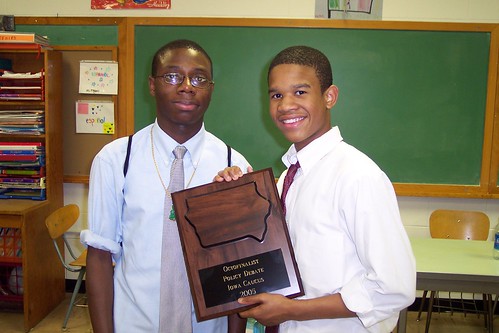
(This is quite an accomplishment, considering the two are sophomores; the jump from novice to varsity is very, very difficult.)
Geoffery and Leodis advanced to semifinals, where they got beat by a very good team from Wichita East:
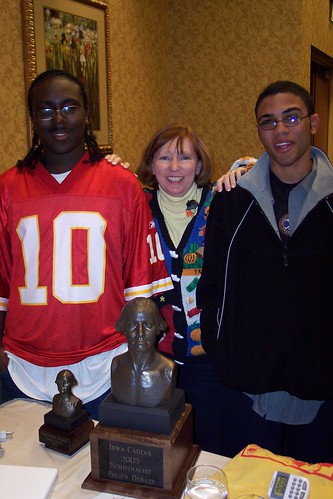
(in the process, they picked up their first TOC bid of the year, which is a pretty big deal if you're sompeting on the national debate circuit.)
It was a great weekend, with many highlights. Above all it was great to see our squad (coaches, like me, included) having good, friendly interactions with folks from other schools. There were a lot of Kansas schools there, and it was cool to get to know some of them, and to see them do so well in the competition.
I came home exhausted, but with my spirits lifted considerably.
All of Central's varsity debaters had winning records. Dominique Baker and Sean Easterwood went four-two, though they didn't clear to the trophy rounds.
Geoffery Stone took first-place speaker for the second year in a row:
(BTW, when his name was called at the awards ceremony he received a standing ovation, which is something I can't recall ever seeing at a tournament, though I haven't been around the game for long.)
Sophomores Aaron Thomas and Matheno Frasier-Bey advanced to octofinals, where they lost to eventual champion LeMars High of Iowa:
(This is quite an accomplishment, considering the two are sophomores; the jump from novice to varsity is very, very difficult.)
Geoffery and Leodis advanced to semifinals, where they got beat by a very good team from Wichita East:
(in the process, they picked up their first TOC bid of the year, which is a pretty big deal if you're sompeting on the national debate circuit.)
It was a great weekend, with many highlights. Above all it was great to see our squad (coaches, like me, included) having good, friendly interactions with folks from other schools. There were a lot of Kansas schools there, and it was cool to get to know some of them, and to see them do so well in the competition.
I came home exhausted, but with my spirits lifted considerably.
Thursday, October 27, 2005
bunk
Senator Jim's latest move is obviously a campaign ploy. One of Claire's primary campaign platforms is government spending -- as in the so-called small-government GOP has created the biggest, most expensive government in Americankind, and she -- a Show-me Donkey with lots and lots of favors to repay -- is going to be the one to bring it all under control. No doubt this strategy comes right out of the focus groups Claire's Big Dem backers from Back East have paid for, because it sure as hell doesn't jibe with the spirit of Democrats (especially Missouri Dems), who never saw a piece of pork they didn't like, or a crony they didn't want to pay.
So now Talent calls a press conference and announces a bill to give the president line-item veto power, to cut down on all this ridiculous spending he's party to. He's mixed some Eye of Newt into the brew. Well folks, it's just posturing, because it'll never pass both houses of Congress, much less a nationwide vote. He might as well have gotten up to the podium and made fart sounds. This bill will have about the same effect.
Plus it's stupid. This bill basically says that hundreds and hundreds of members of Congress can't be trusted to prevent one another from using our tax dollars as a bribery slush fund. So we should instead trust one man (and, I suppose, his cronies) to control spending. Yeah, right. Like we can expect the President not to play favorites and the bribery game. Graft will just be more focused if the President gets the line-item veto.
But, no matter. Politics isn't about doing right by the people so much as getting re-elected. Senator Jim's gotta keep his job. He needed an answer to Claire's needling. Now he can roll into Rolla, clear his throat and say, "I agree that government spending is out of control, that's why I introduced a bill calling for a line-item veto..."
So now Talent calls a press conference and announces a bill to give the president line-item veto power, to cut down on all this ridiculous spending he's party to. He's mixed some Eye of Newt into the brew. Well folks, it's just posturing, because it'll never pass both houses of Congress, much less a nationwide vote. He might as well have gotten up to the podium and made fart sounds. This bill will have about the same effect.
Plus it's stupid. This bill basically says that hundreds and hundreds of members of Congress can't be trusted to prevent one another from using our tax dollars as a bribery slush fund. So we should instead trust one man (and, I suppose, his cronies) to control spending. Yeah, right. Like we can expect the President not to play favorites and the bribery game. Graft will just be more focused if the President gets the line-item veto.
But, no matter. Politics isn't about doing right by the people so much as getting re-elected. Senator Jim's gotta keep his job. He needed an answer to Claire's needling. Now he can roll into Rolla, clear his throat and say, "I agree that government spending is out of control, that's why I introduced a bill calling for a line-item veto..."
Wednesday, October 26, 2005
race test
I've been at Central since noon, working on debate stuff. After a while, we got bored with debate. The kids decided to try to take the race test. None of the kids could get it to work. They kept filing the images and words in the wrong caterories, and the results were inconclusive. So I took it.
When I first took it, it came back saying I have no preference between black and white. This time it said I have a "strong preference" for African-Americans over Caucasian Americans.
"Huh," I said. "That means I'm racist."
"Against your own race!" Geoffery shouted, laughing. "Welcome to the Dark Side!!"
Seriously, this is a fascinating development. I first learned of this test through Malcolm Gladwell's best-seller, Blink. In it, Gladwell said he often scored as slightly prejudiced against blacks, which alarmed him because he's "half black." Indeed, he reported, blacks often score as prejudice as well.
He did say, however, that he could change this if he took the test after being surrounded by positive images of blacks. This part of the book was one of the best arguments I've ever seen for diversity. He writes that one can reduce prejudice by spending time with blacks.
MMy most recent results on this test would seem to support this, since I took it while spending an afternoon with brilliant black teens.
Kinda cool.
When I first took it, it came back saying I have no preference between black and white. This time it said I have a "strong preference" for African-Americans over Caucasian Americans.
"Huh," I said. "That means I'm racist."
"Against your own race!" Geoffery shouted, laughing. "Welcome to the Dark Side!!"
Seriously, this is a fascinating development. I first learned of this test through Malcolm Gladwell's best-seller, Blink. In it, Gladwell said he often scored as slightly prejudiced against blacks, which alarmed him because he's "half black." Indeed, he reported, blacks often score as prejudice as well.
He did say, however, that he could change this if he took the test after being surrounded by positive images of blacks. This part of the book was one of the best arguments I've ever seen for diversity. He writes that one can reduce prejudice by spending time with blacks.
MMy most recent results on this test would seem to support this, since I took it while spending an afternoon with brilliant black teens.
Kinda cool.
Tuesday, October 25, 2005
gut ache
Most folks I know have a hard time with conflict. Today I received a strongly worded, pissed off e-mail from an acquaintance. It was based on a simple misunderstanding, and I called the person up, and cleared it up. But I still feel a gnawing ache in my gut. It won't go away. In fact, it seems to be getting worse. It's in the space just below my rib cage, just above my abdomen, just a little bit below the skin of my belly. It feels like a hole. I've felt this feeling many, many times, always in the same place, almost always after a sour interaction with someone else. It seems to just stick around until it's ready to go, like a cold. I can nurse it, but it has t run its course.
I've read recently that there's a physiological correlation for everything human's experience. I've long felt emotions in this space in my abdomen. Has anyone studied this place in the body? I've long suspected that it's the center of my soul.
Today I went for a long run. I was thinking about stories, the actual structure and phenomenon of them, the way they're impressions of time driven by conflict, struggle, suffering and lead, one usually hopes, to resolution and joy. And I wondered if suffering is one of the many extra dimensions physicist say exist in our universe. I thought as I ran along on this lovely fall day, I wonder if these other dimensions, at least one or two of them, are emotions, struggle, the stuff of story, that which defines, in many ways, our relation to time.
And maybe this makes me sound as though I'm back on drugs, but it's just an interesting notion to play with.
Like, we're in a three-dimensional world. And Einstein says time is a fourth dimension, and that's fairly easy to comprehend. But what about all these other dimensions they say exist -- as many as 12 or 13, according to the string theorists. What on earth might those be like? How could we possibly begin to comprehend those?
One way physicists try to describe other dimensions is to imagine how a being in a two-dimensional world would experience a three-dimensional object. A ball, for instance. They say they would experience a ball as a circle that expands and contracts. Can you picture that? A ball experienced as many succeeding two-dimmensional cross sections of itself? An expanding and contracting circle?
Maybe that's how we experience these other dimensions, if they do actually exist. I thought, as I ran, maybe suffering or ecstacy or whatever is those other dimensions. We cant see them in their totality, just experience them as these clouds of sensation that pass through in ways that seem at times to be mysterious, but which ultimately drive and define our relationship to time.
Anyway, it was just a crazy long thought I had while running. And recounting it here kind of eases the wounded feeling I have because of my little e-mail conflict, which, in the big scheme of things, won't amount to anything, but still has me utterly captivated for the moment, in the worst way.
I've read recently that there's a physiological correlation for everything human's experience. I've long felt emotions in this space in my abdomen. Has anyone studied this place in the body? I've long suspected that it's the center of my soul.
Today I went for a long run. I was thinking about stories, the actual structure and phenomenon of them, the way they're impressions of time driven by conflict, struggle, suffering and lead, one usually hopes, to resolution and joy. And I wondered if suffering is one of the many extra dimensions physicist say exist in our universe. I thought as I ran along on this lovely fall day, I wonder if these other dimensions, at least one or two of them, are emotions, struggle, the stuff of story, that which defines, in many ways, our relation to time.
And maybe this makes me sound as though I'm back on drugs, but it's just an interesting notion to play with.
Like, we're in a three-dimensional world. And Einstein says time is a fourth dimension, and that's fairly easy to comprehend. But what about all these other dimensions they say exist -- as many as 12 or 13, according to the string theorists. What on earth might those be like? How could we possibly begin to comprehend those?
One way physicists try to describe other dimensions is to imagine how a being in a two-dimensional world would experience a three-dimensional object. A ball, for instance. They say they would experience a ball as a circle that expands and contracts. Can you picture that? A ball experienced as many succeeding two-dimmensional cross sections of itself? An expanding and contracting circle?
Maybe that's how we experience these other dimensions, if they do actually exist. I thought, as I ran, maybe suffering or ecstacy or whatever is those other dimensions. We cant see them in their totality, just experience them as these clouds of sensation that pass through in ways that seem at times to be mysterious, but which ultimately drive and define our relationship to time.
Anyway, it was just a crazy long thought I had while running. And recounting it here kind of eases the wounded feeling I have because of my little e-mail conflict, which, in the big scheme of things, won't amount to anything, but still has me utterly captivated for the moment, in the worst way.
Monday, October 24, 2005
awakening
I've been depressed lately. Some days are worse than others, and today started as one of those days. My weekly debate session at The School felt daunting.
I felt completely empty as I began the class. I was just saying words. My brain was straining. And I sensed that the students could pick up on my emptiness, and this made me feel panicky. My mind froze. I could barely talk.
The teacher and I divided the class into two groups and had them read one paragraph from an Amnesty International report about racial profiling. Just one paragraph. That's it. But the group I was working with didn't want to do it. I tried to get them to try, but it was no use, so I just sat there numbly. I looked up at the clock. A mere ten minutes had passed. This was going to be a long hour.
Then the teacher came over to bail me out. She re-explained the task and one of the girls, K., jumped right in, reading the text clearly and with conviction. She hadn't been in the class before. She pulled the cap off of a highlighter and highlighted the good parts. Explained to her that this would be evidence for her to make a case to the government, and she instantly understood, started constructing a speech. She caught on so fast I grabbed the evidence from my previous classes, and she read that and highlighted it, and understood how it would all fit together to make a case.
Then it was time to give speeches, and she marched right up to the front of the room and cold nailed it. Natural born debater.
I asked her if she'd be into staying after school to practice, and she said yes without hesitation.
There are three other kids in the class who were into it as well, all of them girls. I asked them if they'd be willing to after school, and they said they would -- though one, T, a 17-year-old, has a four-year-old son and will need to work out childcare.
Now my spirits were lifted. I can work with this, I thought.
I felt completely empty as I began the class. I was just saying words. My brain was straining. And I sensed that the students could pick up on my emptiness, and this made me feel panicky. My mind froze. I could barely talk.
The teacher and I divided the class into two groups and had them read one paragraph from an Amnesty International report about racial profiling. Just one paragraph. That's it. But the group I was working with didn't want to do it. I tried to get them to try, but it was no use, so I just sat there numbly. I looked up at the clock. A mere ten minutes had passed. This was going to be a long hour.
Then the teacher came over to bail me out. She re-explained the task and one of the girls, K., jumped right in, reading the text clearly and with conviction. She hadn't been in the class before. She pulled the cap off of a highlighter and highlighted the good parts. Explained to her that this would be evidence for her to make a case to the government, and she instantly understood, started constructing a speech. She caught on so fast I grabbed the evidence from my previous classes, and she read that and highlighted it, and understood how it would all fit together to make a case.
Then it was time to give speeches, and she marched right up to the front of the room and cold nailed it. Natural born debater.
I asked her if she'd be into staying after school to practice, and she said yes without hesitation.
There are three other kids in the class who were into it as well, all of them girls. I asked them if they'd be willing to after school, and they said they would -- though one, T, a 17-year-old, has a four-year-old son and will need to work out childcare.
Now my spirits were lifted. I can work with this, I thought.
Sunday, October 23, 2005
meixcan buffer
ere's one for TKC, who tirelessly exposes the Star's institutionally racist ways.
Yesterday I was at Central and I casually picked up a copy of the Star. I flipped to a story about hurricane Wilma, and I couldn't believe what I read. I read it out loud, to guage the students' reactions (emphasizing a few key points):
Much of Florida went on high alert Wednesday, and the keys ordered visitors to evacuate as Wilma exploded into the most intense Atlantic hurricane on record.
Still, a small ray of hope emerged: If Wilma rams into Mexico’s Yucatan region,its expected right turn toward Florida could be significantly altered and the storm system could be considerably weakened, the National Hurricane Center said.
The students all laughed, and widened their eyes.
"Damn," Geoffery said. "That's just blatant."
Yesterday I was at Central and I casually picked up a copy of the Star. I flipped to a story about hurricane Wilma, and I couldn't believe what I read. I read it out loud, to guage the students' reactions (emphasizing a few key points):
Much of Florida went on high alert Wednesday, and the keys ordered visitors to evacuate as Wilma exploded into the most intense Atlantic hurricane on record.
Still, a small ray of hope emerged: If Wilma rams into Mexico’s Yucatan region,its expected right turn toward Florida could be significantly altered and the storm system could be considerably weakened, the National Hurricane Center said.
The students all laughed, and widened their eyes.
"Damn," Geoffery said. "That's just blatant."
Tuesday, October 18, 2005
a good star blog

No sooner do I diss the Star's early forrays into the blogosphere when I happen across a really good one, Bill's "Faith Matters" Weblog.
Now this is how you do it. He provides good info and lots of links to interesting stuff around the web. But above all it's honest and authentic. I get a real sense of who Bill is when I read this blog, and that makes me trust him. He's willing to be vulnerable, to stand out there in cyberspace as a human being, not some professional contrivance of humanity. And this, I think, is key to journalists' success in this new forum of blogs. My sense is that the reason why blogs are so popular is because they humanize information. They let you get your news from friends. And, conversely, that's part of the reason why newspapers are losing popularity. They aspire to that God's-eye view that's impossible to obtain, that savvy info consumers are coming to resent more and more.
And furthermore (I say from my soap box, wagging a pointy finger), this'll make for better journalists. If blogs can make journalists more trustworthy to consumers, I think they'll also make us more trustworthy to sources, and that'll make for better stories.
Good job, Bill! This one's definitely going to be a daily read.
Monday, October 17, 2005
happiness
On my morning walk today, I listened to a podcast of NPR's Science Friday. The guests were Daniel Nettle and Gregory Berns, two experts in happiness and satisfaction. I found it very interesting, because I was in a bit of a funk recently, and I still have lingering feelings of dissatisfaction.

There were a couple key things I got from the program.
One is that our brains appear to be geared toward a constant quest for new experiences. As Dr. Berns, humans seem to be engineered to learn more and more about the world.
The other was balance. As Dr. Nettle observed, this striving for the new, especially with regards to material posessions can begin to resemble addiction, and this can have an opposite effect. He talked about the differing approaches to happiness in Eastern and Western cultures, with the West in constant search of conquest and the East angling always toward detachment.
II found the whole conversation to be helpful and comforting.
For one, it made me feel good about my career choice. As a jjournalist, it's my job to go out and try experience and understand things outside my day-to-day range of experiences. On the other hand, the conversation offered an exciting challenge, though not entirely new, to try to detach myself some from my desires and find contentment in what I already have.
There were a couple key things I got from the program.
One is that our brains appear to be geared toward a constant quest for new experiences. As Dr. Berns, humans seem to be engineered to learn more and more about the world.
The other was balance. As Dr. Nettle observed, this striving for the new, especially with regards to material posessions can begin to resemble addiction, and this can have an opposite effect. He talked about the differing approaches to happiness in Eastern and Western cultures, with the West in constant search of conquest and the East angling always toward detachment.
II found the whole conversation to be helpful and comforting.
For one, it made me feel good about my career choice. As a jjournalist, it's my job to go out and try experience and understand things outside my day-to-day range of experiences. On the other hand, the conversation offered an exciting challenge, though not entirely new, to try to detach myself some from my desires and find contentment in what I already have.
Sunday, October 16, 2005
revisiting esmie
Last week, a got a big spike in visitors looking for stuff about Esmie Tseng, the 16-year-old girl accused of stabbing her mother to death. There was another hearing in her case on Wednesday, and I guess that sparked the interest. I didn't attend the hearing. From what I understand, it was short and uneventful. I've been told that Esmie smiled a lot at her attorney, which indicates a turnaround in their relationship since the last hearing.
I had intended to go to a hearing in another juvenile murder case which was scheduled for the exact time as Esmie's, but I was too busy trying to earn money. It was a pre-trial hearing for Michael Jones, a 17-year-old who faces second-degree murder charges in the September killing of Steven Peters, a bassist for the Kansas City Symphony. Like Esmie, Michael is being triied as an adult. I became interested in Michael's case because he's a longtime friend of a student I work with at Central High, Geoffery Stone. Geoffery's the leader of the debate squad there, and an all around good kid.
Last month, on the afternoon after I attended Esmie's earlier hearing, I showed up at Central and found Geoffery in a state of distress because he had visited Michael in jail that morning. He felt as though this kid he'd been friends with since kindergarten was being ramrodded into a very long prison sentance, and really had no one to advocate for him. And he was dismayed by his friend's behavior. A few days earlier, Geoffery had seen Michael on TV, walking into the court room with a big smile, flashing gang signs.
"Why did you do that, Michael?" he asked his friend that morning. "They're going to fry you."
"Because," Michael saiid, "I have nothing more to live for."
Geoffery told me that Michael has had a tough life. His mother raised him and his siblings until she was murdered when he was under ten years old. He would go wiith Geoffery to church sometimes and everyone there really liked him. He's mild-mannered and friendly. Geoffery told me Michael's not the least bit violent.
All I know about Michael's case comes from the Star and Geoffery's account of his conversation with Michael. None of these reports place Michael in the room where Peters was murdered. He was in a car parked outside when Peters was shot. But Michael admits that he and his co-defendent had gone to Peter's place to rob him, and this falls squarely under Missouri's secoond-degree murder statutes. If you are committing a felony, or even if you plan to commit a felony, and someone dies in the course of events, then you face second-degree murder charges.
I feel much more sad about Michael's situation than about Esmie's. Yes, Michael appears to have made a very bad decision when he got in that car and headed off to commit a robbery. But I don't think he planned for it to end in death. Perhaps our community will be safer if Michael is tried and convicted as an adult for second-degree murder, if he's locked up for most of his adult life. But I've been around enough kids like Michael to suspect that, for the most part, he's not a menace to society. If Geoffery says he's basically a good kid, I believe him. I just think he needs soome help.
It's puzzling situation. While I want to see young men like Michael take responsibility for their actions, to make better decisions, I'd also like to see our community do a better job of making better decision-makers out of kids like Michael. Much of this burden falls on the folks who played an immediate role in Michael's upbringing. But I also believe that we who never knew Michael, who rarely walk in his circles, also share some blame. To me, it boils down to privilege. My privilege in this society is braced, at least in part, by the relative lack of privilege for kids like Michael. And believe I have an obligation to use my privilege to help, even in the smallest way, level the playing field.
After Geoffery told me about Michael's situation, I told him about Esmie's case. I was curious to know his opinion as to whether or not she should be tried as an adult. After thinking about it for a while, he said he thought she should be. Unlike Michael, there appears to be little doubt that she murdered her mother. And the crime was horribly vicious. The fact that she was so bright and full of potential only makes the case for adult punishment stronger, Geoffery said.
Then I told him about all the people who have been rallying behind Esmie, trying to move her case into the juvenile division. I think this really disturbed Geoffery. Where's the community to support Michael? Esmie had a vast, strong support system for her entire life. Michael's family is poor and broken. His schools suck. His neighborhood dirty and run down compared to Esmie's. It offers few opportunities. And I believe his neighborhood is that way n large part because Esmie's neighborhood is so good. Kansas City's east side exists for the sake of Johnson County.
It all makes Geoffery feel like society places more value on kids like Esmie than on kids like Micheal.
"These people should ask themselves," Geoffery said, "if they would do the same thing if this were a black male."
I had intended to go to a hearing in another juvenile murder case which was scheduled for the exact time as Esmie's, but I was too busy trying to earn money. It was a pre-trial hearing for Michael Jones, a 17-year-old who faces second-degree murder charges in the September killing of Steven Peters, a bassist for the Kansas City Symphony. Like Esmie, Michael is being triied as an adult. I became interested in Michael's case because he's a longtime friend of a student I work with at Central High, Geoffery Stone. Geoffery's the leader of the debate squad there, and an all around good kid.
Last month, on the afternoon after I attended Esmie's earlier hearing, I showed up at Central and found Geoffery in a state of distress because he had visited Michael in jail that morning. He felt as though this kid he'd been friends with since kindergarten was being ramrodded into a very long prison sentance, and really had no one to advocate for him. And he was dismayed by his friend's behavior. A few days earlier, Geoffery had seen Michael on TV, walking into the court room with a big smile, flashing gang signs.
"Why did you do that, Michael?" he asked his friend that morning. "They're going to fry you."
"Because," Michael saiid, "I have nothing more to live for."
Geoffery told me that Michael has had a tough life. His mother raised him and his siblings until she was murdered when he was under ten years old. He would go wiith Geoffery to church sometimes and everyone there really liked him. He's mild-mannered and friendly. Geoffery told me Michael's not the least bit violent.
All I know about Michael's case comes from the Star and Geoffery's account of his conversation with Michael. None of these reports place Michael in the room where Peters was murdered. He was in a car parked outside when Peters was shot. But Michael admits that he and his co-defendent had gone to Peter's place to rob him, and this falls squarely under Missouri's secoond-degree murder statutes. If you are committing a felony, or even if you plan to commit a felony, and someone dies in the course of events, then you face second-degree murder charges.
I feel much more sad about Michael's situation than about Esmie's. Yes, Michael appears to have made a very bad decision when he got in that car and headed off to commit a robbery. But I don't think he planned for it to end in death. Perhaps our community will be safer if Michael is tried and convicted as an adult for second-degree murder, if he's locked up for most of his adult life. But I've been around enough kids like Michael to suspect that, for the most part, he's not a menace to society. If Geoffery says he's basically a good kid, I believe him. I just think he needs soome help.
It's puzzling situation. While I want to see young men like Michael take responsibility for their actions, to make better decisions, I'd also like to see our community do a better job of making better decision-makers out of kids like Michael. Much of this burden falls on the folks who played an immediate role in Michael's upbringing. But I also believe that we who never knew Michael, who rarely walk in his circles, also share some blame. To me, it boils down to privilege. My privilege in this society is braced, at least in part, by the relative lack of privilege for kids like Michael. And believe I have an obligation to use my privilege to help, even in the smallest way, level the playing field.
After Geoffery told me about Michael's situation, I told him about Esmie's case. I was curious to know his opinion as to whether or not she should be tried as an adult. After thinking about it for a while, he said he thought she should be. Unlike Michael, there appears to be little doubt that she murdered her mother. And the crime was horribly vicious. The fact that she was so bright and full of potential only makes the case for adult punishment stronger, Geoffery said.
Then I told him about all the people who have been rallying behind Esmie, trying to move her case into the juvenile division. I think this really disturbed Geoffery. Where's the community to support Michael? Esmie had a vast, strong support system for her entire life. Michael's family is poor and broken. His schools suck. His neighborhood dirty and run down compared to Esmie's. It offers few opportunities. And I believe his neighborhood is that way n large part because Esmie's neighborhood is so good. Kansas City's east side exists for the sake of Johnson County.
It all makes Geoffery feel like society places more value on kids like Esmie than on kids like Micheal.
"These people should ask themselves," Geoffery said, "if they would do the same thing if this were a black male."
Subscribe to:
Posts (Atom)